

ArmInfo.Fitch Ratings has revised the Outlook on Armenia's Long-Term Issuer Default Ratings (IDR) to Negative from Stable and affirmed the IDRs at 'BB-'. It has also revised the forecast for Armenia's GDP growth for 2020 towards a slowdown to 0.5%. This is stated in the rating actions commentary published on the Fitch website.
KEY RATING DRIVERS
The coronavirus shock negatively affects the Armenian economy due to its exposures to commodities (a majority of exports), the Russian economy (for remittances, trade and FDI) and to tourism, only partially offset by the benefit of a lower oil price. This is in the context of Armenia's relatively high net external debt and structural current account deficit, which is only partly financed by non-debt creating capital inflows. Despite a robust macroeconomic policy framework and continuing commitment to reform, the economic shock has put public debt on a markedly higher trajectory, and there are downside risks to our forecasts should the COVID-19 outbreak not be contained in 2H20 in line with Fitch's current baseline assumption.
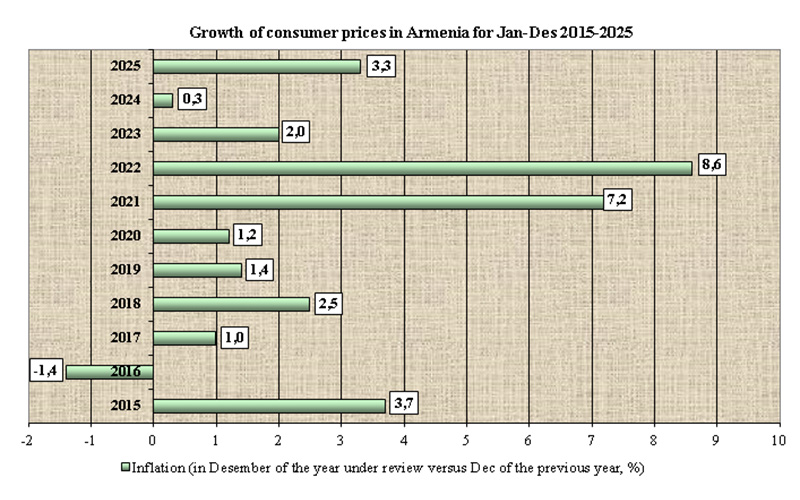
Fitch forecasts, that the coronavirus shock will drag down GDP growth from 7.6% in 2019 to 0.5% this year (a 4.4pp downward revision since our last review six months ago). Growth accelerated in 2H19 to 7.9%, and momentum remained strong in 2M20, providing some offset to the sharp contraction expected in 2Q20. The government has announced a state of emergency, with a support package totalling 2.3% of GDP, and the central bank has cut interest rates by 25bp to 5.25% (CBA decision on March 17- ed.note) following a fall in inflation to an average -0.1% in the first two months of 2020.
Fitch projects that GDP growth partially recovers in 2021, to 5.5%, supported by a rebound in external demand, investment catch-up, and revival of private consumption and employment growth, with a moderate drag from fiscal tightening. However, in line with our global macro-economic forecasts, the pace of recovery will be highly dependent on the path of the health crisis and the extent to which the coronavirus outbreak can be contained in 2H20. If a second wave of infections materialises and lockdown measures have to be re-introduced, our economic and fiscal forecasts for Armenia could be subject to material negative adjustment.
Fiscal stimulus and weak growth will push out this year's general government deficit to a forecast 5.0% of GDP in 2020, up from 1.0% in 2019. The government's coronavirus stimulus package has a focus on social support, subsidised lending, and loan refinancing and risk-sharing, with a high degree of uncertainty over how much will ultimately fall on the government balance sheet. Fitch anticipates additional fiscal measures including to directly support employment, partly offset by under-execution on capital projects and some reprioritisation of non-essential recurrent spending this year. Fitch forecasts that the general government deficit will narrow to 3.5% of GDP in 2021, on the back of stronger GDP growth and a partial unwinding of support measures, underpinned by the government's strong commitment to its medium-term fiscal targets.
General government debt is projected to rise from 53.6% at end-2019 to 59.2% of GDP in 2020 before falling back to 56.0% in 2021. A high share of government debt is foreign currency-denominated (79% versus the 'BB' median of 56%) giving rise to exchange rate risk.
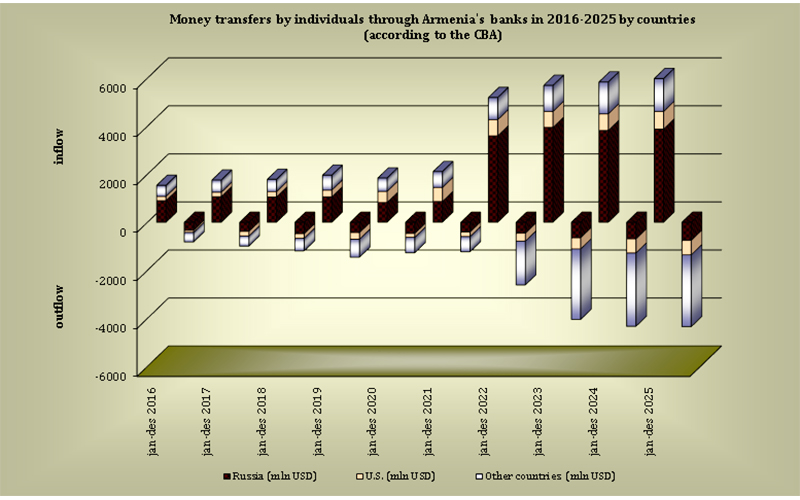
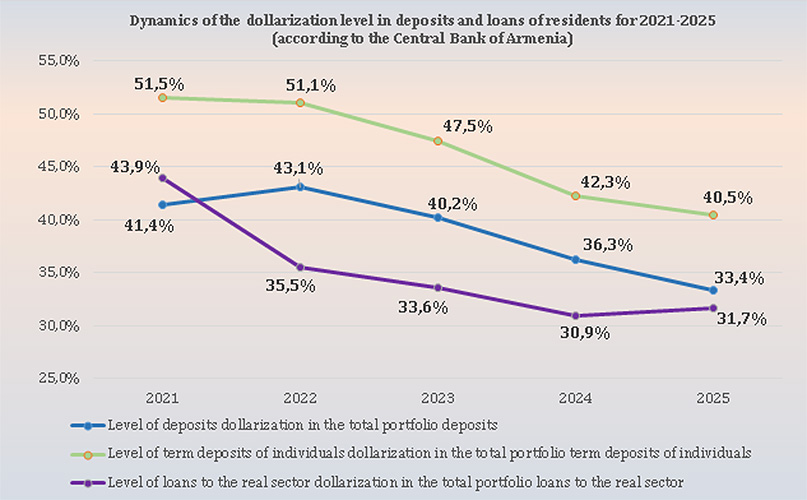
The coronavirus shock has increased external risks to the Armenian economy. Fitch forecasts the current account deficit remains high, at 8.5% of GDP in 2020 and 8.1% in 2021, compared with the 2018-2019 average of 8.8% and the current 'BB' median of 2.9%. Allowing for statistical discrepancies, the actual deficit could be closer to 5% of GDP, but only around a third of this is covered by non-debt creating capital inflows. The current account will be negatively affected this year by a collapse in tourism (which contributed 0.7pp to last year's balance), the fall in prices of commodities and lower remittances from Russia. We expect this to be largely offset by import compression and lower energy costs. Fitch forecasts that net external debt will increase to 52.9% of GDP in 2021 from 46.7% in 2019, well above the 'BB' median of 19.4%, and the relatively high bank deposit dollarization ratio, at 52%, adds to risks.
Among key rating drivers Fitch considers the following ones: Armenia has a high reliance on Russia, borders are closed with two neighbours, and the long-standing conflict with Azerbaijan over Nagorno-Karabakh has the potential to escalate.
An increase in foreign exchange reserves, and the availability of IFI financing mitigate near-term balance of payments risks. FX reserves have increased to 4.4 months of current external payments, from 3.5 months at end-2018.
Fitch anticipates broad continuity in macroeconomic policy, and a quickening of structural reform from next year, building on efforts to tackle corruption and strengthen institutions and public financial management. The government's Medium-Term Expenditure Framework targets a 2.2% of GDP increase in capex (to 5% of GDP) in line with a more growth-enhancing expenditure mix, and the government lowered corporate tax and introduced a flat income tax rate this year. The initial coronavirus response has been designed with a view to also limiting negative impacts on the government's tax compliance drive. These factors underpin our forecast of a post-coronavirus fiscal adjustment. Under our longer-term debt projections, which assume average GDP growth of 4.1% from 2020-2029 (close to the current 'BB' median) and a 0.8pp improvement in the primary surplus, general government debt declines steadily to 47% of GDP in 2029.
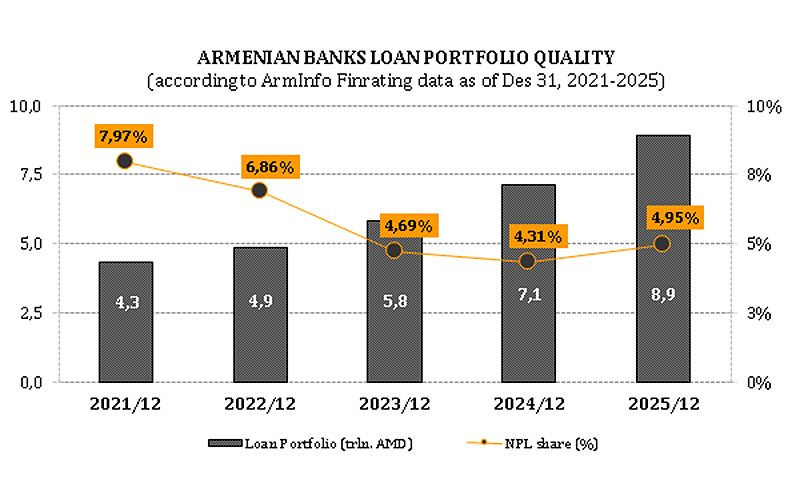
Banking sector fundamentals will weaken as a result of the coronavirus shock, captured by the negative banking sector outlook for 2020. Fitch anticipates a marked worsening in asset quality, although regulatory forbearance should help banks manage NPL and capital metrics and avoid statutory limit breaches. At end-February, the sector NPL ratio was 5.7% and Tier 1 capital ratio 15.2% (but unevenly distributed within the sector). Profitability is lower than in similarly rated peers and is expected to come under pressure due to weaker economic growth and higher risk costs. Government subsidies and co- financing under the coronavirus response package will help support the supply of credit this year. Bank deposits grew 12.2% last year and so far Fitch does not observe sizable outflows as a result of stressed market conditions.
In its key assumptions Fitch assumes that Armenia will continue to experience broad social and political stability and that there will be no prolonged escalation in the conflict with Azerbaijan over Nagorno-Karabakh to a level that would affect economic and financial stability. Fitch expects macroeconomic indicators to move in line Fitch's Global Economic Outlook forecasts, but acknowledges that these are likely to be subject to frequent and possibly significant downward revisions given the evolving nature of the global crisis.
It should be noted that according to the forecast of the Central Bank of Armenia, the impact of coronavirus on the economy will slow down the growth of Armenia's GDP in 2020 to a stagnant 0.7% (from the actual 7.6% growth in 2019). According to the forecasts of the Asian Development Bank (ADB), in Armenia, reflecting the impact of COVID-19 on the economy, GDP growth will slow down to 2.2% in 2020.
To recall, from March 16 to April 12 a state of emergency was introduced in Armenia in order to prevent the spread of coronavirus infection. In this regard, a temporary ban has been established for certain types of activities, including restaurants, cafes, bars, casinos, hotels, canteens, retail facilities and industries not related to food and medical products.