

ArmInfo. In Armenia, economic activity in the first quarter of 2021 decreased by 2% compared to the same period in 2020 (compared to 4% growth in the first quarter of 2020). According to the preliminary data of the RA State Committee, only the construction sector and the energy complex were in the growth, while the industrial sector,the agricultural sector, trade, and the service sector are still in the red.
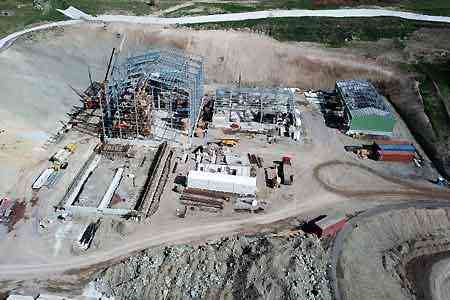
Thus, the growth of the construction sector by 4.7% and the energy complex by 1.4% was accompanied by a decline in the industrial sector by 3.9%, the agricultural sector - by 1%, the trade sector - by 5.6%, and the service sector - by 8.1%. As a comparison, we note that a year earlier in the first quarter, only the construction sector was in decline (9.4%), while the rest of the industries showed growth: the energy complex - 14.8%, the industrial sector - 8.7%, the service sector - 5.5%, the agricultural sector - 4.5%, the trade sector - 0.2%.
Meanwhile, in March 2021, compared to February (on a monthly basis), economic activity increased by 9.6% (against a 0.2% decline in March 2020). Moreover, the upward trend is recorded in all areas, and the most significant growth is shown by the construction sector and the energy complex - 23.5% and 16%, respectively, followed by trade and services with the same 9.5% growth, and the industrial sector with 9.1% growth. A year earlier, in March 2020, compared to February, only the construction sector was growing (14%), while all other industries went into decline: the energy complex - 15.4%, the service sector - 5.8%, the trade sector - 3.5% and the industrial sector - 2%. For the agricultural sector, statistics for the month are not specified.
On an annual basis (March 2021 to March 2020), economic activity turned from a 4.9% decline to a 3.8% growth. This is due to the reversal of the trend in all sectors from downward to upward, with the most noticeable growth recorded by the energy complex-18.3% and the construction sector-10.8%, with a more modest 3.8% in the industrial sector, 4.6% in trade, and a meager 0.9% in services. A year earlier, in March 2020, by March 2019, these industries were in decline: the construction sector - 26.2%, the trade sector-9.9%, the service sector-4.8%, the industrial sector-1.9%, the energy sector-1%.
According to statistical data in the first quarter of 2021, the trade sector with a volume of 664.8 billion drams ($1.3 billion) holds the lead in absolute terms. In the second place in terms of volume, the industrial sector - 470.4 billion ($897.5 million), in the third - the service sector - 403.98 billion drams ($770.7 million), in the fourth - the agricultural sector - 75.4 billion drams ($143.9 million), and in the fifth - the construction sector - 48.8 billion drams ($93.1 million). The volume of electricity generation in January-March 2021 amounted to 2112.9 million kWh, of which only in March - 736.1 million kWh.
The industrial product price index increased in January-March 2021 by 7.1% compared to the same period last year, only in March - increased by 1.8%, and in comparison with March 2020 - increased by 9.3%, while a year earlier the dynamics was negative: in January-March 2020 - a decline of 0.1% per annum, in March - a decline of 0.4%, in comparison with March 2019 - a decline of 1.7%.
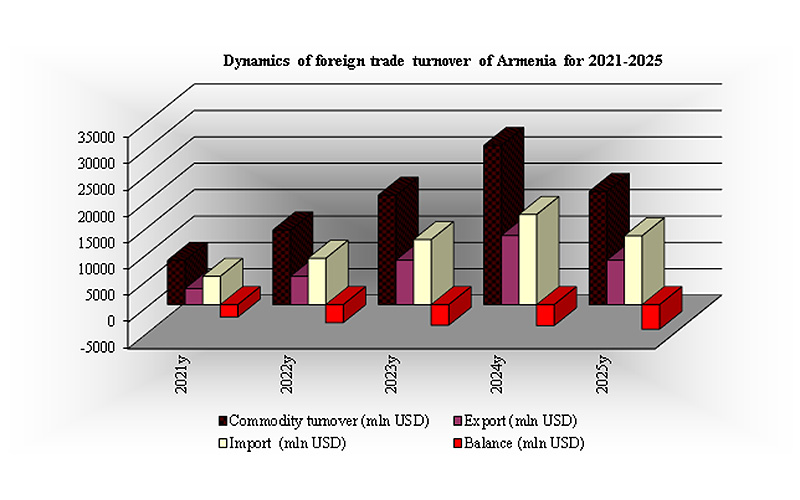
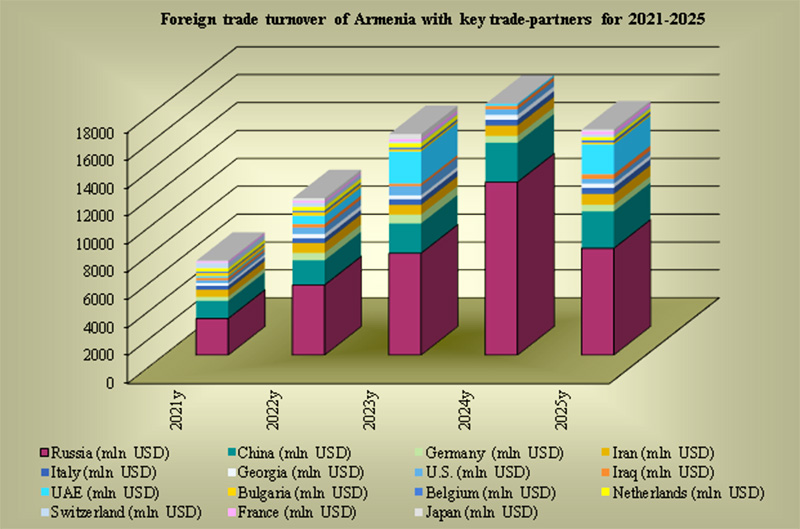
At the same time, Armenia's foreign trade turnover in January-March 2021 amounted to 791.3 billion drams ($1.509 billion) with an annual decline of 4.4%. In its structure, the volume of exports underwent an annual growth of 3.4% to 300.4 billion drams ($572.9 million), and imports - a decline of 7.7% to 490.9 billion drams ($936.4 million). Only in March 2021, foreign trade turnover increased by 12.8% due to an increase in exports by 11.6% and imports by 13.5%. In March 2021, by March 2020, the growth of exports by 21.8% and imports by 5% turned the dynamics of foreign trade turnover towards 10.7% growth. A year earlier, in January-March 2020, foreign trade turnover suffered an annual decline of 4% due to a decline in imports by 6.2% with a stagnant export growth of 0.2%, in March 2020, a decline in exports by 13.3% and imports by 4.9% turned the dynamics of foreign trade turnover towards a decline of 7.9%, and compared to March 2019, a decline in foreign trade turnover by 16% was triggered by a decline in both exports by 17.4% and imports by 15.3%. The average settlement rate of the dram was 527.67 DR/$1 in March 2021, and 524.14 DR/$1 in January-March, compared to 489.01 DR/$1 in March 2020 and 482.32 DR/$1 in January - March 2020. It should be noted that the RA state budget for 2021 provides for GDP growth of 3.2%. The Central Bank of Armenia forecasts GDP growth of 1.4% for 2021. The IMF's forecast for Armenia's GDP growth in 2021 looks more conservative - 1%. And the World Bank predicted 3.4% GDP growth in Armenia in 2020. Recall that in 2020, as part of measures to prevent the spread of the coronavirus pandemic, a state of emergency was introduced in Armenia from March 16, which lasted until September 12, but security measures were maintained even after the state of emergency was lifted. In this regard, a temporary ban was imposed on many types of economic activity in the first month of the emergency, which was partially lifted in the second half of April, and the complete lifting of the ban followed from May 18. From the same day, public transport began to work (including metro) and many public catering and service facilities, but international air, rail, and bus services were still restricted, but restrictions on entry and exit to Armenia across the air borders were lifted on September 2.