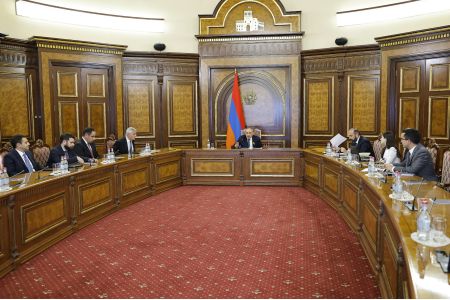



ArmInfo. Iranian Minister of Petroleum Javad Owji received the Advisor to the Prime Minister of Armenia for a meeting in Tehran on Monday to discuss cooperation in the field of energy, the Mehr News Agency reports.
According to the news service of the Iranian oil ministry SHANA, Armenia has low hydrocarbon reserves and relies on imports of fuel and a nuclear power plant that was built during the former Soviet Union to provide the energy it needs.
Due to political differences with Azerbaijan, the oil-rich neighbor of the east, and Turkey, the western neighbor of Armenia, Yerevan supplies its energy needs from Iran and Georgia.
Earlier, Armenian sources reported that the two countries agreed to enhance Iranian gas exports to Armenia. Russia now supplies about 80 percent of Armenia's gas.
In 2004, Tehran and Yerevan signed a 20-year gas for electricity barter agreement, according to which Iran's exported gas will be consumed by power plants in Armenia, and in return, Iran imports electricity from Armenia. Armenia has been importing gas from Iran since the middle of 2009.
It should be noted that Armenia is carrying out a "gas in exchange for electricity" barter deal with Iran at the rate of 1 cubic meter of blue fuel from Iran in exchange for 3 kWh of electricity from Armenia. Gas supplies are carried out via the Iran-Armenia gas pipeline, and electricity from Armenia is sent to Iran via two power lines. In order to strengthen the possibilities of commercial regional trade and the operation of power systems in parallel mode, a decision was made to build a third Iran-Armenia power line with a voltage of 400 kilovolts and an Armenia-Georgia 400/500-kilovolt power line. However, if the construction of the power transmission line in the Iranian direction is only 20-25% completed, then the parties have not yet started the construction of the Armenia-Georgia power transmission line. At the same time, the cost of the Iran- Armenia power transmission line project is $107 million and is fully financed by the Iranian side. As for the Armenia-Georgia power transmission line, including the two Ddmashen and Ayrum substations, its cost exceeds $330 million. KFW, the European Investment Bank and the EU agreed to provide a significant part of these funds in the form of a loan. As for the Meghri hydroelectric power station, it should have been operational since January 2018. Negotiations on investors and financial issues are still ongoing.