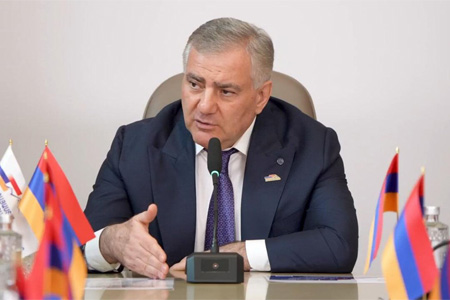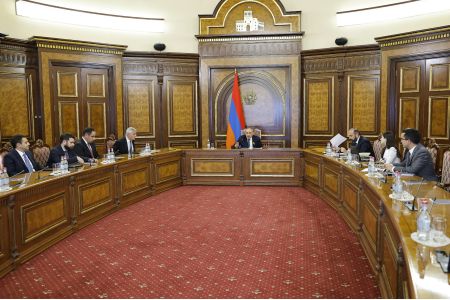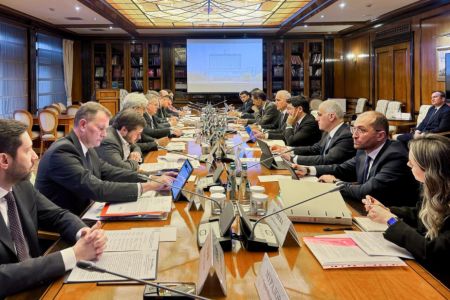



ArmInfo. The prospects for cooperation in areas consonant with the policy pursued in the field of agriculture in Armenia were discussed at the Ministry of Economy of Armenia, with the participation of the World Bank delegation headed by director of the World Bank (WB) Office in Armenia Carolyn Geginat.
According to the press service of the economic department, issues of food security, increasing the productivity of the agricultural sector, the use of state assistance tools, resolving logistical problems, efficient organization of exports and diversification of export markets were also touched upon.
One of the main topics of discussion was the result of the CARMAC2 program implemented since 2015 with the assistance of the WB in Armenia (II program of "Agricultural Resource Management and Community Competitiveness").
According to the head of the program David Mejlumyan, as a result of the implementation of the program, consumer cooperatives were founded in 109 communities of 8 regions of Armenia, uniting pasture users, in which 10,600 farms are involved. Under this program, irrigation networks with a length of 250 km were built in 95 communities on pastures and 235 places to provide drinking water for cattle. 1000 units of agricultural machinery were provided to cooperatives. In addition, 3,500 members of cooperatives were trained in a number of agricultural areas.
David Mejlumyan said that as a result of the work carried out, roads leading to pastures were also improved, and about 130 thousand hectares of unused or underused pastures were irrigated.
It should be noted that according to the Ministry of Economy, the total cost of the CARMAC2 program is $42.67 million, of which $9.67 million is a loan from the International Development Association (IDA), $23 million is IBRD borrowing, $2.275 million is government co-financing and $7.725 million - beneficiaries. The main objectives of the program are to improve pastures, increase the productivity of livestock systems, increase the level of sustainable development of communities, and increase the volume of produced and exported products.