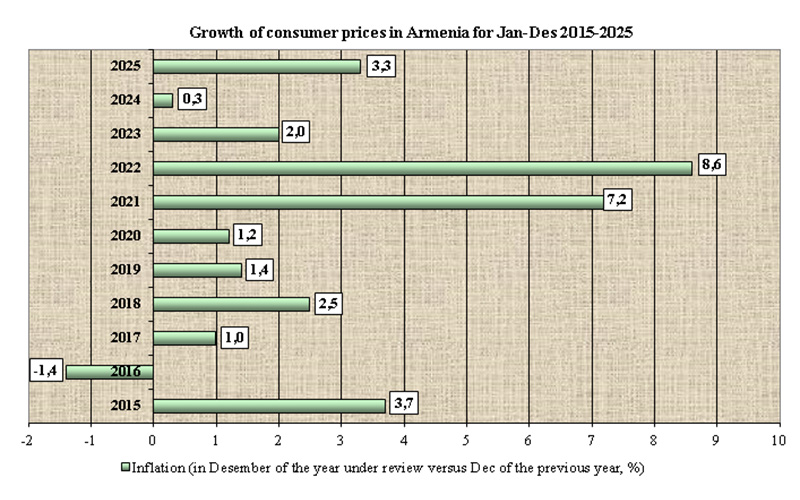



ArmInfo.The 1.2% deflation in the consumer market of Armenia in March 2024 compared to March 2023 (compared to the 5.4% inflation recorded a year ago) was caused by the drop in food prices. In Q1 2024, inflation was slightly lower than last year's quarterly level - 0.2% versus 0.8%, which was the result of cheaper non-food products.
According to the RA Statistics Committee, 0.2% deflation recorded in March of this year alone, (against 0.7% deflation a year earlier in the same month), was provoked by a more noticeable reduction in the price of non-food products (by 0.6%) rather than food products (by 0.2%). In Yerevan, consumer prices decreased by 0.2% in March, against a 0.7% decline in March 2023.
For the first quarter of this year the decrease in inflation was mainly provoked by a reduction in the prices of non-food products by 1.4%, a weaker rise in prices for food products - by 0.5% and an increase in tariffs for services by 0.7%, while a year earlier in Q1 2023, a decrease in the prices of non-food products by 1.1% was accompanied by a more noticeable rise in prices for food products by 1.4% and an increase in tariffs for services by 1.2%. In Q1 2024, compared to the same period in 2023, deflation was recorded at 1.2%, against inflation of 7.2% a year earlier. Moreover, food products fell in price on y-o-y terms by 4.9% (versus 8.1% growth a year earlier), non-food products rose in price by 0.4% (versus 5.4% growth a year earlier), and tariffs for services increased by 3% (versus 6.9% growth a year earlier).
In March 2024 to March 2023, deflationary 1.2% was due to a reduction in the price of food products by 4.3% and non-food products by 0.1%, with an increase in tariffs for services by 2.5%, while a year earlier in March 2023 to March 2022, an increase in prices for food and non-food products was recorded by 5.4% and 4.6%, respectively, and an increase in tariffs for services by 6%.
The price of vegetables in the food market decreased by 13.8% y-o-y (against a meager 0.7% decline a year earlier), while in March they rose in price by 1.2% (against a price decline of 5.3% in March 2023 ). Fruits fell in price by only 2.7% y-o-y (after a price increase of 8.7% a year earlier), while in March alone the price remained unchanged, falling in price by 1.8% (versus a decline of 1.8% in March 2023). But in y-o-y terms, among food products, sunflower oil fell in price more significantly - by 23.6%, margarine - by 22.3% and buckwheat - by 21.4%. A slightly smaller decline was recorded in prices for flour - by 14.3%, peas - by 13.2%, pasta - by 13.1%, lentils - by 10.1%, cheeses - by 8.1%, trout - by 7.7%, spelled - by 7.5%, dzavar - by 7.1%, butter - by 7%, crushed wheat (bulgur) - by 6.2%, bread - by 5.3%, chocolate - by 5%. And prices for sugar and granulated sugar fell more modestly - by 4.6%, cocoa - by 4.2%, poultry meat - by 3.3%, rice and beans - by 3%, flour - by 1.8%, beef - by 1.7%, tea - by 1%. At the same time, there was a y-o-y increase in prices for the following food products: eggs - by 3.5%, coffee - by 1.8%, milk - by 1%, pork - by 0.3%.
Cigarettes increased in price by 8.2% per annum, against almost the same increase of 8.8% a year earlier. Among alcoholic beverages, vodka and beer rose in price year-on-year by 10.1% and 5.1%, respectively, repeating last year's growth of 10.5% and 4.7%, while wine fell in price by 1.2% (against an increase of 1. 9% a year ago). Bottled mineral water rose in price on y-o-y terms by 1% (versus 8.2% growth a year earlier). In the non-food market, jewelry prices increased by 6.4% year-on-year (against a decline of 14.5% a year ago), and the growth in prices for large and small household electrical appliances and equipment slowed down - from 6.2-5.5% up to 3.1-3.9%, furniture - from 7.2% to 3.7%, dishes and kitchen utensils - from 8.2% to 1.8%, clothes and shoes - from 6.7-8, 8% to 0.2-2.9%, hand tools and devices - from 4.8% to 0.4%. Disposable household goods fell in price by 1.7% (versus a 15.4% rise in price a year ago), and the price of gardening equipment accelerated its decline to 8.7% (from last year's 1.6%). Gasoline rose in price (March 2024 to March 2023) by 35.8%, and diesel fuel by 2.1% y-o-y, whereas a year ago both gasoline and diesel fuel fell in price by 26.9% and 2.8%, respectively. In Jan-March 2024, gasoline and diesel fuel prices fell by 6.6% and 4.3%, respectively, which was also recorded a year ago, when gasoline and diesel fuel prices fell more noticeably by 14.4% and 6.1%, respectively.
As for tariffs for services, a significant y-o-y increase was recorded in the sectors of comprehensive services for recreation - by 19.5%, transport - by 9.9%, in the furniture and household appliances repair segment - by 5.2-5.3 %, and services in the home repair sector grew slightly less markedly by 2%. Services in the hotel business also increased in price - by 1.6%, hairdressing and spa salons - by 3.3%, and medical services increased in price by 1.1%. Dry cleaning and clothing repair services, as well as clothing rental salons, have risen in price by 3.1%, shoe repair - by 2.7%. Financial services rose in price by 7.7% y-o-y. A year earlier, tariffs for the listed services showed higher growth.
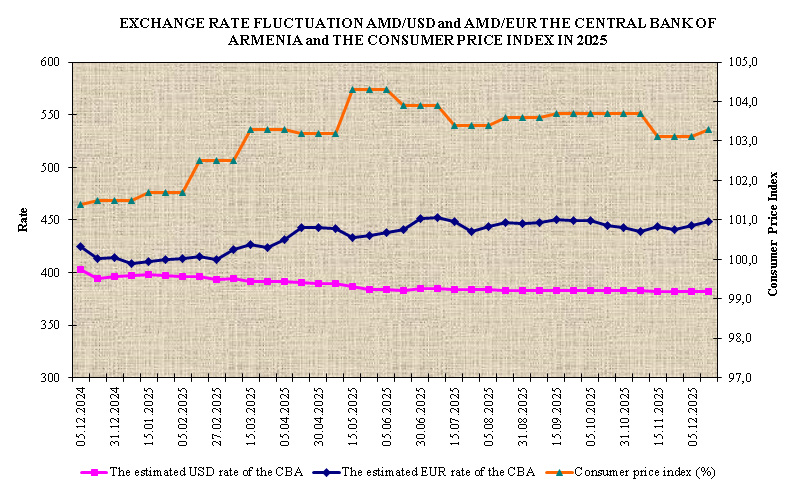
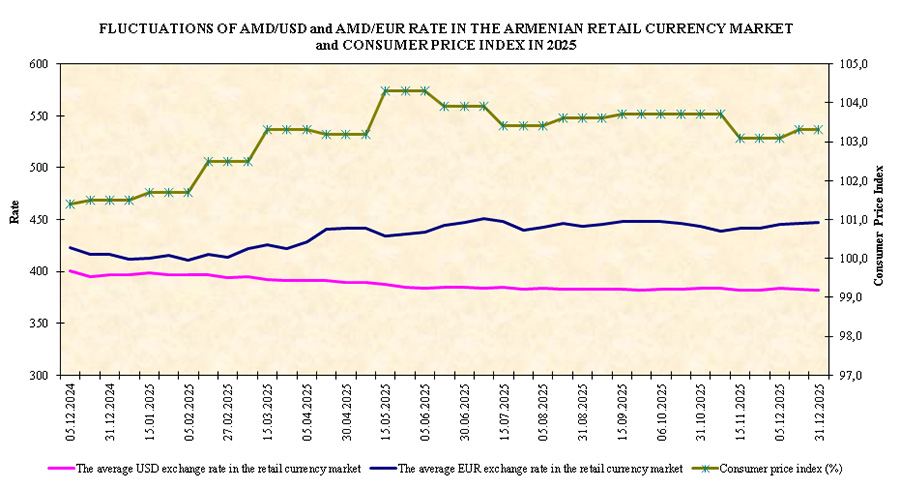
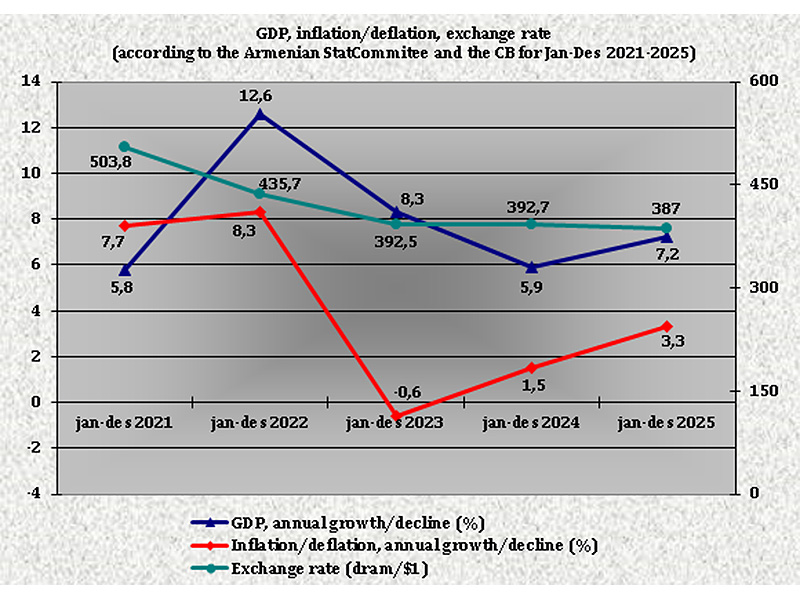
The March deflation of 0.2% was accompanied by a revaluation of the dram against the dollar by 1%, and in Q1 2024, with inflation of 0.2%, the dram revalued against the dollar by 1%. As a comparison, we note that a year earlier, the March deflation of 0.7% was accompanied by a revaluation of the dram against the dollar by 1.3%, and in Q1 2023, inflation in the consumer market of 0.8% was accompanied by a revaluation of the dram against the dollar by 1.5%. In March 2024, the dram devalued against the dollar by 3.1% per annum - from 388.4 to 400.4 AMD/$1, while in March 2023 a revaluation of 21.8% was revcorded.