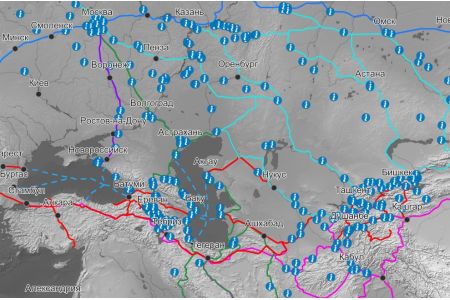


ArmInfo. According to the Atlantic Council article on TRIPP, the successful implementation of TRIPP would make it cheaper and faster to ship products and critical raw materials from Central Asia to Europe and beyond. "But cheaper, faster, better connectivity also carries some risks."
The Center's analysts write that the South Caucasus has at times swelled into a hotbed for sanctions evasion to both Russia and Iran, and possibly even evasion schemes between Moscow and Tehran. "TRIPP can be a success as regional trade route, but realizing its full potential relies on demand for trade between Europe and Asia. High transport costs along the Middle Corridor due to geopolitical instability or project's economics-or an unexpected increase in willingness to ship goods via Russia or Iran-could derail TRIPP's prospects," the article states.
It also points out that the finalization of TRIPP is not only an achievement of the Trump administration, but also a new peak of Nikol Pashinyan's shift away from Russia. "For thirty years, Armenia relied solely on Moscow for security, leading to Russian domination of the country's internal and foreign policies. When Russia failed to intervene during the 2020 Karabakh War, Pashinyan made a change. Understanding that a peace deal with Azerbaijan was the only way to remove Russian leverage and, therefore, achieve true independence, the Armenian prime minister staked his political future on such a deal. At the same time, he inked major defense deals with India, France, Greece, and Cyprus, among others," the Center's analysts state.
The article also emphasizes that the United States is the only power capable of truly offering Armenia an exit ramp from Russian domination. "By conducting peace negotiations under US auspices and placing US interests directly over TRIPP, Pashinyan and Aliyev have protected the most sensitive part of the deal with a US deterrent. But more than that, they tied the success of the peace process to closer relations with Washington," the article continues.
At the same time, the Center's analysts write that Russia is not the only neighbor disturbed by a growing US presence in the South Caucasus. "Iran has consistently called any change of the status quo to its northern border with Armenia a "red line." In 2022, Tehran even staged large-scale military exercises on the Azerbaijani border when it thought Baku may try to take over the area by force. Recently, Ali Velayati, a senior advisor to Ayatollah Ali Khamenei, threatened to turn the South Caucasus into a "graveyard for the mercenaries of Donald Trump." However, Iran is weaker than it has been in decades, and Pashinyan has taken advantage," the article continues.
The Center's analysts write that as protests threaten the stability of the Iranian regime, Tehran weakly voiced concern that Washington could use TRIPP "within the framework of its security policy," a far cry from red lines, graveyards, and military exercises.
"Last month, Pashinyan sent Deputy Foreign Minister Vahan Kostanyan, responsible for TRIPP coordination with Washington, to Israel to discuss the corridor. Kostanyan's visit showed that Pashinyan would not make the same mistake with Iran as it did with Russia, instead choosing to align with the US- backed regional order. Such moves come at a key time. With parliamentary elections set for 2026, Pashinyan needs to show that his pursuit of peace and ties with the West have been successful," the article continues. It emphasizes that incoming stability and regional integration with Azerbaijan and Turkey have the potential of transforming Armenia into a transit country and providing easy access to the European market. It is also argued that Russia has organized against Pashinyan ahead of the elections in the way it knows best-information operations.
"Nonetheless, the coming implementation of the TRIPP route looks like a major success in the Trump administration's commercially focused foreign policy, and it is a model of constructive partnership that the White House should use elsewhere around the world. The project promises openings for American companies to build a small but crucial link to knitting the Middle Corridor together, a boon for the United States, as well as its partners in the South Caucasus and Central Asia. Sidelining Russia and Iran in the process may also decrease their ability to exert economic pressure in the region, giving leaders such as Pashinyan and Aliyev a freer hand to exercise their sovereignty and pursue their countries' best interests," the Center's analysts added.