


ArmInfo. In Armenia, economic activity growth accelerated to 9.1% in January-December 2025 (from 8% in 2024). During this period, foreign trade experienced a double-digit decline, contrasting with the high growth recorded a year prior. According to preliminary data from the RA Statistics Committee, the construction and services sectors were the main growth drivers, while the industrial and agricultural sectors provided more moderate contributions.
According to statistics, this economic activity in January-December 2025 was largely due to a significant increase in the construction sector (from 14.5% to 20.2%), in the agricultural sector (from 1.6% to 5.6%), and a subtle slowdown in annual growth in the services sector (from 10.6% to 10.5%). The industrial sector managed to maintain growth at 4.7%. A slowdown in annual growth was recorded in the energy sector (from 6.5% to 3.4%), and in the trade sector (from 17% to 3%).
The leading sectors by total volume for January-December 2025, were as follows: trade: 6.8 trillion drams ($17.5 billion), services: 4.1 trillion drams ($10.6 billion), industry: 3.3 trillion drams ($8.6 billion), agriculture: 1.1 trillion drams ($2.7 billion) and construction: 810.7 billion drams ($2.1 billion). Electricity generation for the year totaled 9,195.3 million kWh, with 970 million kWh produced in December alone. In December 2025, economic activity accelerated more sharply compared to December 2024, rising from 4.7% to 14%. Monthly performance jumped from a stagnant 0.3% to 23.4%. Specifically, the industrial sector's growth reached 38.6% year-on-year in December. Other year-on-year growth rates for the month of December included: construction: 20.5%, energy Complex: 8.5%, services: 6.9% and trade: 3.2%. Improved growth dynamics were observed in the services sector during the reporting month, from a 2.3% decline to 11.9% growth. The energy sector, however, managed to maintain growth, albeit at a slower rate from 7.9% to 3.9%.
Year-on-year (December 2025 to December 2024), all sectors demonstrated growth, with the industrial sector leading at 38.6%, followed by construction at 20.5%. The next highest growth rates were in the energy sector at 8.5%, the services sector at 6.9%, and the trade sector at 3.2%. A year earlier, in December 2024 compared to December 2023, only the industrial sector recorded a decline (14.8%), while other sectors demonstrated double-digit growth: services - 19.4%, construction - 12.9%, energy - 12.8%, and trade - 10.3%.
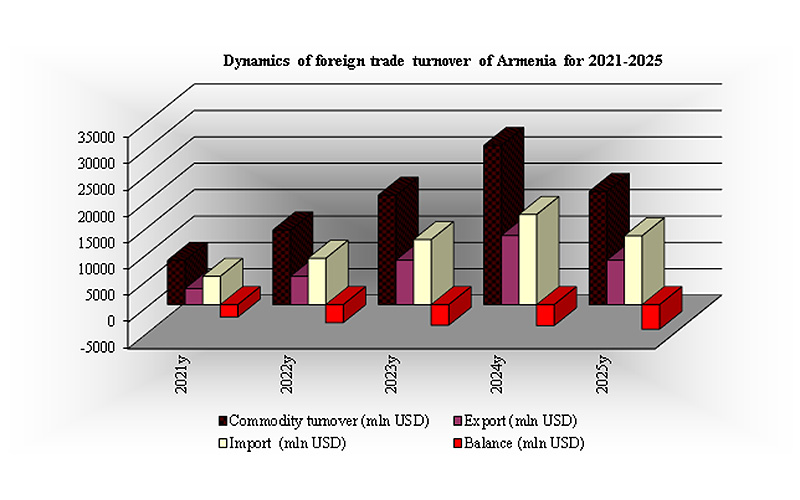
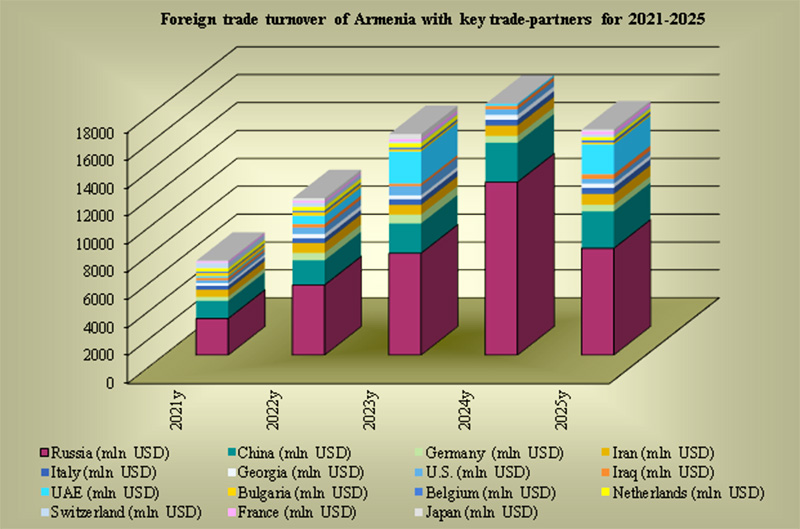
Armenia's foreign trade turnover in January-December 2025 reached 8.2 trillion drams ($21.4 billion), deteriorating from a 29,5% annual decline (from 41.5% growth in 2024). This is due to a significant decline in both exports and imports - by 36.1% and 23.6%, respectively, annually, while last year both indicators demonstrated significant growth - by 53.1% (exports) and 33.8% (imports). As a result, the absolute value of exports for January-December 2025 amounted to 3.2 trillion drams ($8.4 billion), and imports - 5 trillion drams ($13 billion). However, in December 2025, compared to December 2024, foreign trade turnover demonstrated a 32% increase due to both export growth of 34.3% and import growth of 30.4%. A year earlier, in December 2024, compared to December 2023, foreign trade turnover declined by 37.3% due to a 48.6% decline in exports and a 26.5% decline in imports.
It should be noted that the Central Bank of Armenia, in its December forecast, predicted GDP growth of 6.3-4.1% for 2026 and then 4.9-5.3% in 2027. In 2025, according to the Central Bank's estimates, GDP growth will be 5.9% (similar to the actual 5.9% growth in 2024). According to the Central Bank's updated forecast, export and import dynamics, after nearly flat growth in 2023 of 30.7-30.2% and a decline of 11- 3.2% in 2024, will deepen into negative territory in 2025, falling to 37.3-36.1% (for exports) and 32.7- 32.5% (for imports). However, by 2026, the Central Bank expects both export dynamics to improve, with growth of 4.5-3.4% and import dynamics to improve to 3.1%, with this trend continuing in 2027 to 3.9- 4.1% (for exports) and 4.2-3.8% (for imports).
According to the IMF's updated forecast in December, Armenia's GDP growth will be 5% and 5.5% in 2025 and 2026, respectively. According to the IMF forecast, Armenia's foreign trade indicators will decline by 31.1% in 2025 for exports and 28.1% for imports, with growth returning to a nearly flat 2.2-2.1% in 2026 and then moderately accelerating to 3.4-3.7% in 2027. In its January forecast, the World Bank (WB) predicts a slowdown in Armenia's GDP growth in 2026-2027 to 4.9-4.7% from an estimated 5.2% in 2025.
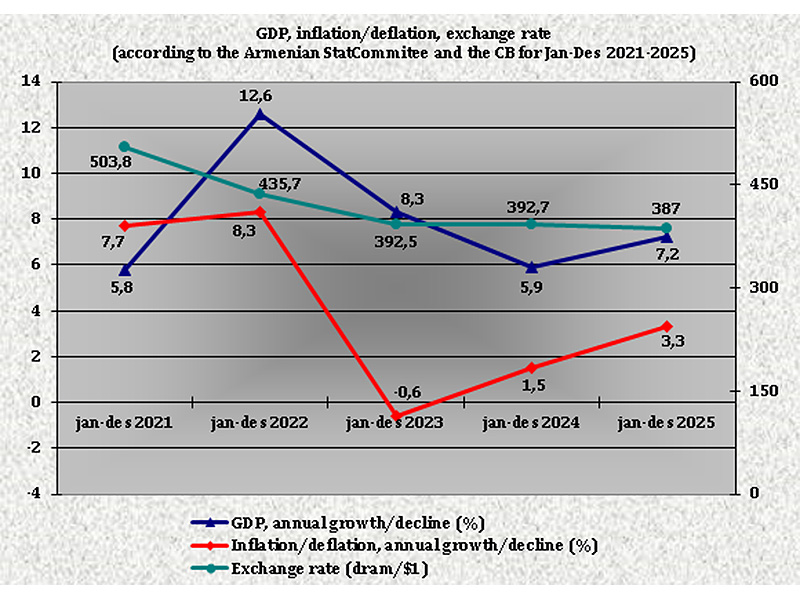
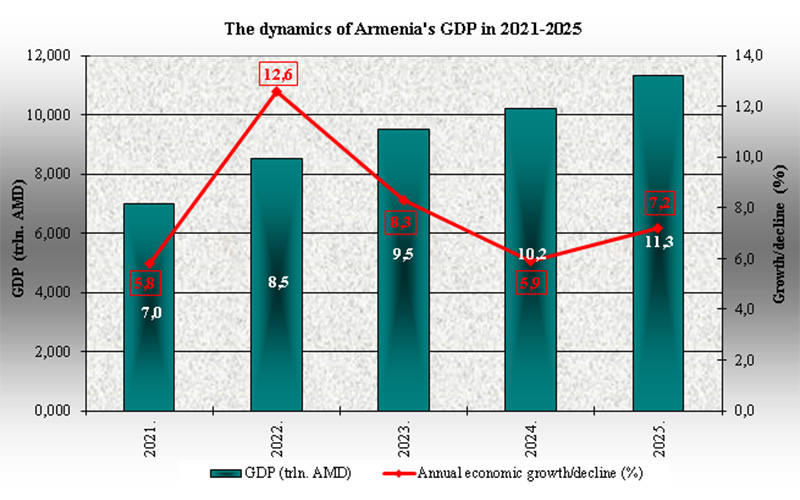
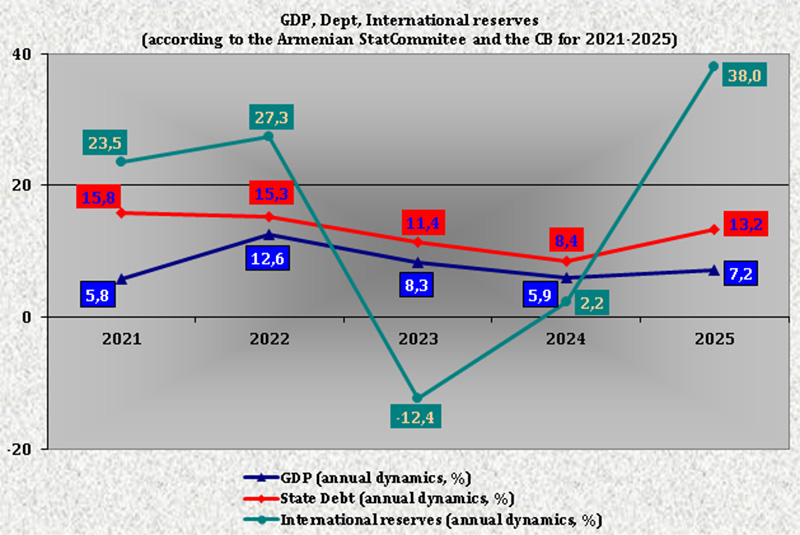
The draft Armenian state budget for 2025 projected GDP growth of 5.1%, while the 2026 state budget projects 5.4% economic growth. According to the Statistical Committee of the Republic of Armenia, Armenia's GDP growth, after accelerating in 2022 from 5.8% to 12.6%, began to slow in 2023 to 8.3% and then to 5.9% in 2024, reaching 10.2 trillion drams (approximately $26 billion) in absolute terms. The GDP deflator index also began to decline to 103.1% in 2023 and 101.4% in 2024 after growing from 106.9% to 108% in 2022.