


ArmInfo.There are currently no signs of "overheating" in Armenia's economy, as stated by Martin Galstyan, Governor of the Central Bank of Armenia, at a press conference on February 3.
"We are closely monitoring the development of the situation (we are talking about high growth in consumer loans and low wage growth, which imply an increase in the debt burden of citizens and a possible overheating risk for the economy - Ed.), and if necessary, we will be able to intervene not with monetary tools, but with macroprudential ones - we will tighten buffer standards." He noted that at the last meeting of the Central Bank Council, there was a debate about whether to increase the buffer standards or leave them as is, and ultimately they decided to keep them at the same level (for example, the counter cyclical capital buffer was maintained at 1.75% - Ed.). The Central Bank Council, having reviewed the entire financial cycle, decided that the financial sector is not yet in a cycle where it needs to be influenced through macroprudential instruments," Galstyan clarified.
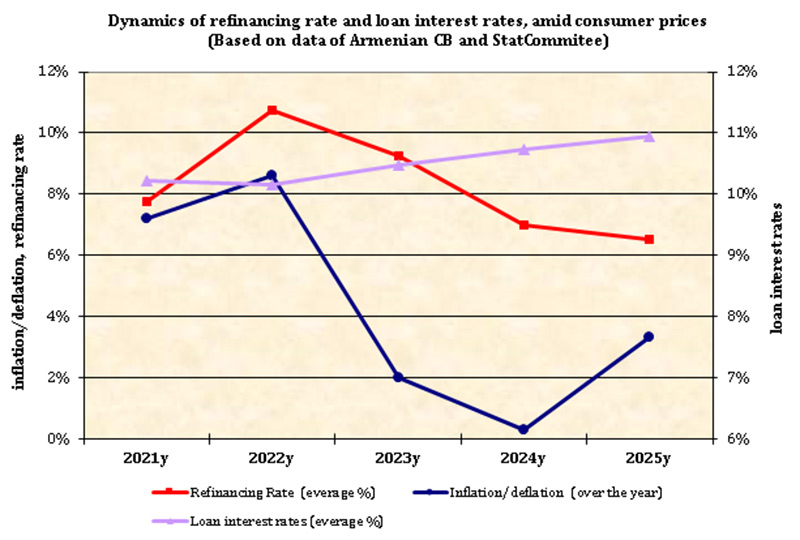
According to the Central Bank of Armenia, consumer loans to Armenian banks accelerated in growth by 2025 from 28% to 30%, amounting to 1.8 trillion drams or $4.7 billion. Including mortgages, the volume reaches 3.5 trillion drams or $9.1 billion (an annual increase of 21%). According to the RA Statistics Committee, nominal wage growth slowed in 2025 from 6.4% to 5.6% (amounting to 303.1 drams), while in the private sector, it slowed from 5.7% to 5.1% (amounting to 327.6 drams).
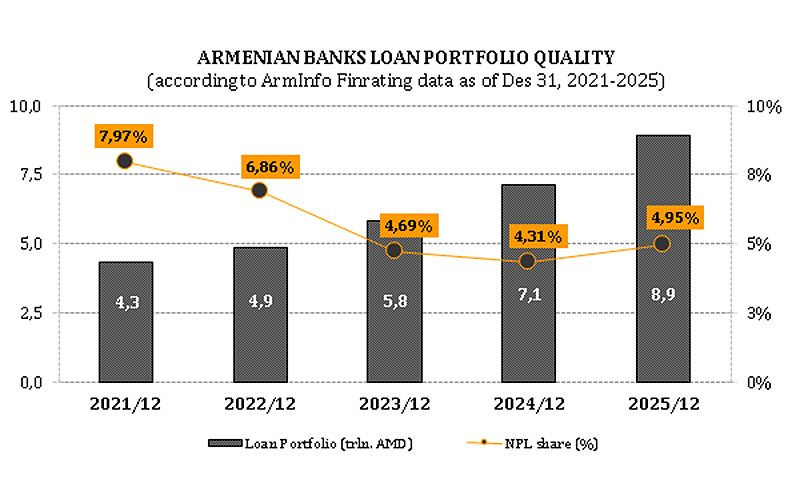
According to the Financial Rating of Armenian Banks as of September 30, 2025, prepared by ArmInfo Investment Company, consumer loans account for the largest share of NPLs (non-performing loans) - approximately 40%, with a significant portion of high-risk categories (doubtful and hopeless). The total volume of overdue loans increased by 35% year-on-year, with consumer loans accounting for the largest share.