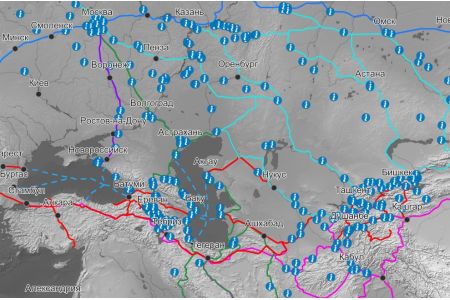


ArmInfo. The Trans-Caspian orridor, a route of railways and ports linking Europe, Turkiye, the rest of the Black Sea, Armenia, Azerbaijan, and Central Asia is becoming an alternative trade route connecting both continents. Since 2022, trade on the route has quadrupled and with the right investments, it can triple by 2030.
To help turn this momentum into practical projects, the European Commission has published today an EU- funded meta-study that highlights where investment is needed to strengthen transport, trade, energy and digital connections along the corridor.
The study highlights key stretches where infrastructure is missing, outdated or not fit for today's volumes. It provides a solid basis for setting investment priorities in line with the EU's plans to rebuild trade routes to Central Asia via the South Caucasus. Practical guidance for investment will give governments and the private sector a clear picture of where their capital can make the biggest difference in building modern and reliable infrastructure.
European Commissioner for Enlargement Marta Kos said: "Cargo on trade routes linking Europe and Asia via the South Caucasus and Turkiye is rising fast. But much of the infrastructure is old and outdated, so investment is urgently needed. That investment will only come if governments and businesses are clear on where it will pay off. The study we publish today shows where upgrades to rail, ports, border procedures, energy links and digital connectivity will make the biggest difference."
Trasport, trade, energy and digital links in focus
The meta-study is structured around three core pillars: transport and trade, energy, and digital.
Transport and trade
The study highlights the strategic importance of the Trans-Caspian Transport Corridor as a reliable alternative trade route to Asia. To keep goods moving faster, it recommends smoother, more aligned border rules. And because the investment needs are too large for public budgets alone, it points to public-private partnerships as essential to modernising infrastructure along the corridor. The study also notes the growing role of Ukraine and Moldova in Europe's efforts to diversify and strengthen its wider transport network.
Energy
The study identifies opportunities to diversify energy links, ensure reliable electricity connections, and support decarbonization efforts. It argues that stronger, modernized grids, alongside greater use of renewables, are essential to increase energy security in a changing geopolitical environment. It also encourages cooperation with experienced private-sector partners to deliver large-scale, reliable infrastructure.
Digital
The study underlines the growing strategic importance of secure data routes. It calls for alternative fibre-optic corridors, fibre installation alongside energy and transport projects, and the creation of new internet exchange points. Satellite links are also highlighted as a resilience tool in areas where ground networks are weak. The study stresses working with trusted tech partners, improving cybersecurity, following European and international standards, and supporting for emerging technologies, such as AI and local start-ups.
Background
Under the EU's Global Gateway strategy, the Cross-Regional Connectivity Agenda aims to improve links between the EU and Central Asia through Turkiye and the South Caucasus by coordinating strategic investments and regulations. The objective is to boost trade and socio-economic development through resilient and efficient transport, energy, and digital networks.
The Connectivity Agenda was launched at the Cross-regional Security and Connectivity Ministerial Meeting in Luxembourg on 20 October 2025 and further advanced at the Trans-Caspian Transport Corridor and Connectivity Investors Forum in Tashkent, Uzbekistan, on 27 November 2025. Participants to both meetings confirmed the importance of deepening cooperation in areas of common interest, enhancing mutual resilience and promoting more connected, secure and prosperous regions. They also confirmed that the Trans-Caspian Transport Corridor has transitioned from an aspirational route to a strategically essential one, reflecting geopolitical shifts and vulnerabilities in the Northern Corridor.
The EU4Digital Initiative is the EU's regional programme supporting digital transformation and the harmonisation of digital markets in countries included in the Eastern Partnership. It aims to support interoperability, cross border data exchange and regulatory harmonisation in alignment with EU standards.
Following the European Council conclusions of June, October and December 2024 on political developments in Georgia, the European Commission suspended financial bilateral assistance directly benefiting Georgian authorities, whilst projects related to regional connectivity are being assessed on a case-by-case basis.
More information: https://enlargement.ec.europa.eu/document/download/9f40a883-2489- 4d40-8115-948e840ceca5_en?filename=Meta%20Study%20- %20Advancing%20a%20Cross-Regional%20Connectivity%20Agenda.pdf&prefLang=ru