


ArmInfo. In the Armenian plastic card market, cashless transactions have exceeded cash transactions, accounting for 56% of the total volume (compared to 52.3% in 2024, 51% in 2023, and 40% in 2022), totaling 4.2 trillion drams ($11 billion) in absolute terms, according to data from the Central Bank of Armenia.
This result was achieved despite the annual growth rate of non-cash card payments returning to a more typical range, following a surge in 2022 due to legislative restrictions on cash transactions introduced on July 1 of that year. Moreover, impressive growth rates for non-cash transactions continued in 2023, then gradually returned to a double-digit growth rate in 2024, with a trend towards accelerating to 17% in 2025.
It is worth noting that the share of non-cash transactions through virtual vPOS has already exceeded 60% (compared to 58% in 2024 and 55% in 2023), exceeding 2.5 trillion drams ($6.6 billion), with double-digit growth accelerating from 17% to 20% (compared to a jump of 85% in 2023). The share of vPOS transactions in the total volume of plastic transactions also continues to grow, reaching 34% in 2025 (compared to 31% in 2024 and 28% in 2023).
Supported by the dynamics of cashless transactions, the total volume of plastic transactions also slowed down, maintaining growth at 9% (after accelerating in 2023 from 35% to 43%). As a result, by the end of 2025, the total volume of plastic transactions was 7.5 trillion drams or $19.7 billion (including transactions abroad using cards issued by Armenian banks). Moreover, the volume of transactions abroad using cards from Armenian issuing banks, after slowing in 2024 from 54% to 14%, accelerated to 28% in 2025, exceeding 1 trillion drams ($2.7 billion), thereby accounting for a 14% share of total plastic transactions (after an insignificant change in 2024 from 11% to 12%).
International cards demonstrated the highest growth rates in plastic transactions. Visa cards retained the lead in transaction volume, with 4.8 trillion drams ($12.5 billion) in 2025, with a slight slowdown in annual growth from 17% to 14% (compared to 76% growth in 2023). Second place was secured by Mastercard cards - 1.7 trillion drams ($4.5 billion), whose growth was insignificant - 1.4% (after a sharp slowdown in 2024 from 55% to 5%). Local ArCa cards are at fourth place - 854.7 billion drams ($2.2 billion), with the annual dynamics changing from a 9% decline to 10% growth (against 24% growth in 2023). The fifth place is occupied by other foreign cards (AmEx, Diners Club, MIR, UPI) - 163.8 billion drams ($429.4 million), with a deterioration in dynamics from 27% growth to a 32% decline (against 86% growth in 2023). Moreover, the latter managed to avoid a greater decline thanks to the activity of American Express (AmEx) cards issued by Acba Bank.
However, the recorded decline in transactions for other international cards is to some extent due to HSBC Armenia Bank's exit from Armenia through a merger with Ardshinbank, which transferred its client base, including HSBC cardholders who were subsequently migrated to Visa. Since the merger was completed on November 29, 2024, the growth of other international cards was only affected by this at the time, but in 2025, with Ardshinbank's migration of HSBC cardholders to Visa, the growth of other international cards declined. It is worth recalling here that HSBC cards were initially Visa-based, but in the Central Bank's reports they were included among other international cards, of which they constituted the majority for many years.
However, this circumstance had a lesser impact on the dynamics of other international cards than the situation with MIR cards, whose transactions have been declining significantly for the second year in a row, accelerating from 2.3 times to 2.7 times, amounting to 22.6 billion drams ($59.3 million) by the end of 2025. In particular, such a significant decline in MIR card transactions was due to the inclusion of NSPK MIR on the sanctions list in February 2024 and the subsequent suspension of the linkage between the ArCa and MIR national card systems in March. As a result, Armenian banks stopped servicing MIR cards in April 2024. Only VTB Bank (Armenia), which became the issuer of these cards in July 2022 and managed to issue almost 206,000 cards by October 2025, continued to service them through its network of ATMs and POS terminals. In terms of share of the total volume of plastic transactions, Visa cards hold the lead - 63.4% (versus 60.5% in 2024), Mastercard is in second place - 23% compared to 24.7% in 2024), followed by ArCa - 11.4% (compared to 11.3% in 2024). The remaining 2.2% (compared to 3.5% in 2024) are transactions with other foreign cards. The share of transactions using MIR cards was 74% in 2023, and in 2024 their share decreased to 26% and further in 2025 to 13.8%. In the total volume of plastic transactions, the share of MIR cards has become even more minimal - 0.3% (after decreasing in 2024 from 2.2% to 1%). Visa also retains the lead in the total number of bank cards, accounting for 54%, followed by Mastercard at 23% and ArCa at 16%. Other international cards (AmEx, Diners Club, MIR, UPI) account for the remaining 7%. In terms of annual growth, international Visa cards demonstrated the highest rate of growth in the reporting year, accounting for 22%, while Mastercard and other international cards also recorded a similar 16%. While local ArCa cards recovered from a 6.5% decline, growth for 2025 was minimal, at only 0.3%. By 2026, there will be over 5 million cards in circulation, with annual growth of 15.8% (compared to 16.3% growth in 2024).
According to ArmInfo financial analysts, the Armenian card market, which has received a significant quantitative boost in its development over the past three years, including thanks to the law on non-cash payments adopted in 2022, is entering a new period of qualitative growth amidst fierce competition. The market continues to experience growth in non-cash payments and online transactions, which in 2023, for the first time, exceeded cash transactions in both volume and quantity. This trend is expected to continue in 2024-2025. However, the return of the upward dynamics of transactions over the past two years to a natural rate and the slowing growth in the number of cards have affected transaction activities (the activity coefficient by transaction volume). Given the transaction volume and the number of cards of all 17 banks, after growing by 23% in 2023, it decreased in 2024 and 2025 by the same 6% - to 0.125, i.e. The average monthly transaction volume per card now stands at 125,000 drams or $328 (compared to 141,000 drams or $348 in 2023).
The market's quantitative growth is accompanied by qualitative and innovative developments. The number of new-generation contactless ATMs is increasing. The growth of the POS network is supported by a significant increase in the number of virtual and mobile POS terminals (vPOS and mPOS). In terms of technological development in the card segment, e-commerce and contactless card offerings remain active. Banks are increasingly offering Apple Pay and Google Pay apps for Visa and Mastercard, certified by the Armenian Card National Payment System, for contactless payments. With the launch of the ArCaPay (since November 2024) and ArCaQR (since October 2025) systems, the same technological capabilities have become available for local ArCa cards. Additionally, the planned 2026 release of co-branded ArCa cards with international payment systems Mastercard and UPI, with the possibility of servicing them abroad, will strengthen the position of local cards.
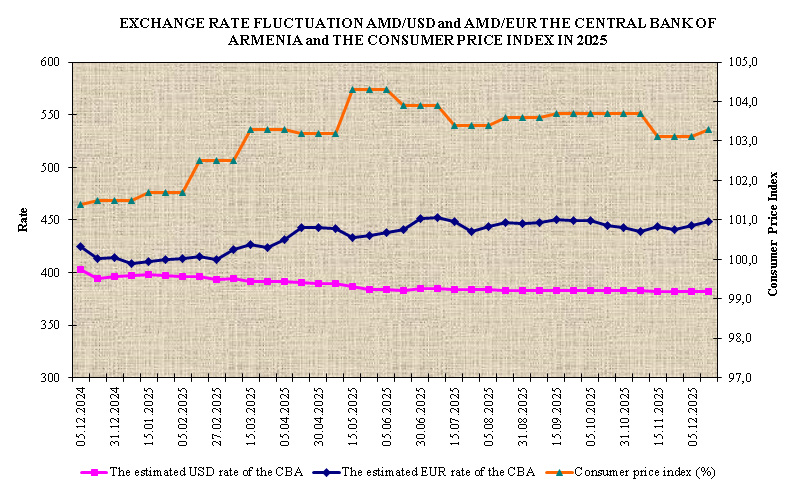
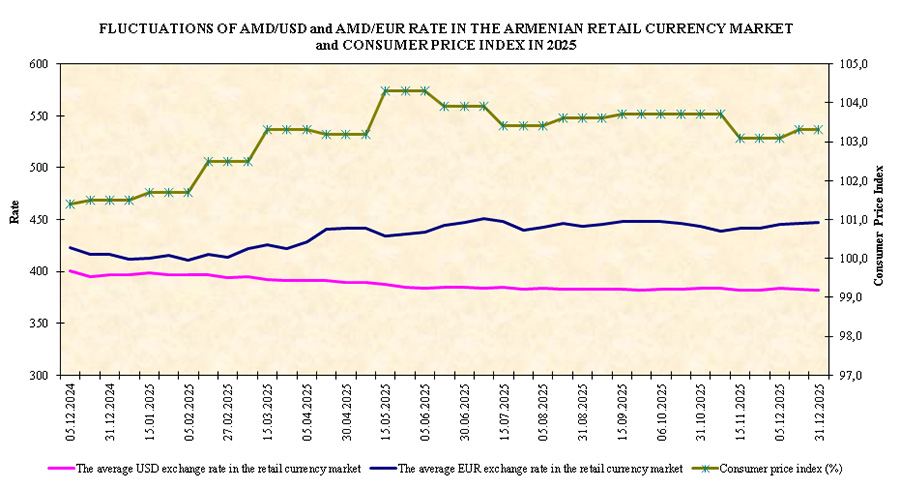
Recall, all 17 banks operating in the country are involved in Armenia's plastic card market. One of the newer entrants is Fast Bank, which issues both local ArCa cards and international Visa and Mastercard. (The established exchange rate of the dram against the US dollar on December 31, 2025, was AMD 381.36/$1, compared to AMD396.56 $1 on December 31, 2024, and AMD 404.79/$1 on December 31, 2023.)