


ArmInfo.In Armenia, the per capita debt burden reached $4.700 by January 1, 2026 (compared to $4.200 in 2024). Moreover, the per capita debt burden from external debt increased from $2.100 to $2.300 (by 9.5%) in 2025, and from domestic debt from $2.1 thousand to $2.400 (a 14.3% increase).
The increase in the per capita debt burden was observed against the backdrop of weak population growth in Armenia. Over the year, the indicator increased by 0.7%, or by 20.800 people. - to 3.097 million people by January 1, 2026. In 2024, a moderate increase in the per capita debt burden ( 5%) was accompanied by a more pronounced population growth of 2.8%, or 85,000 people.
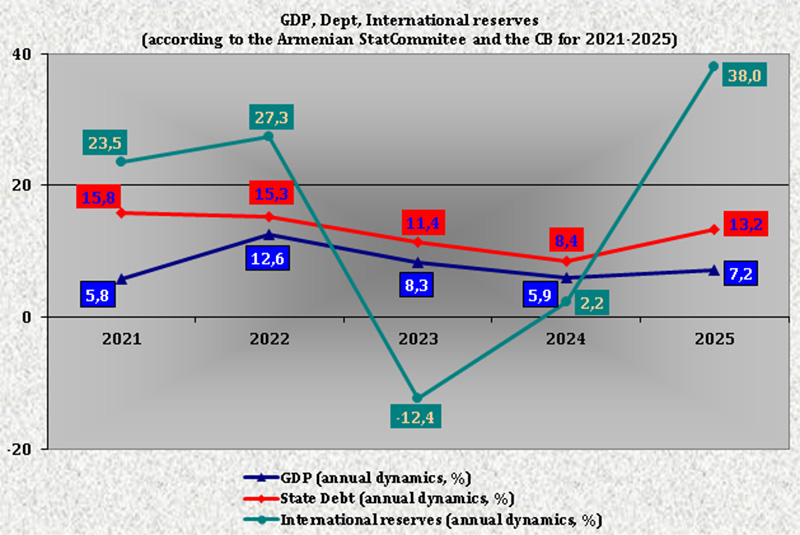
Additionally, the coverage of external debt by gold and foreign exchange reserves for 2025 increased from 57.1% to 72.3%, amid a significant annual growth of reserves of 38% and a moderate growth of external debt of 9%. For comparison, in 2024, external debt decreased by 1%, while reserves increased by a modest 2.2%. It is worth noting that by the end of 2025, both gross international reserves and external debt reached new record levels - $5.1 billion and $7.04 billion, respectively.
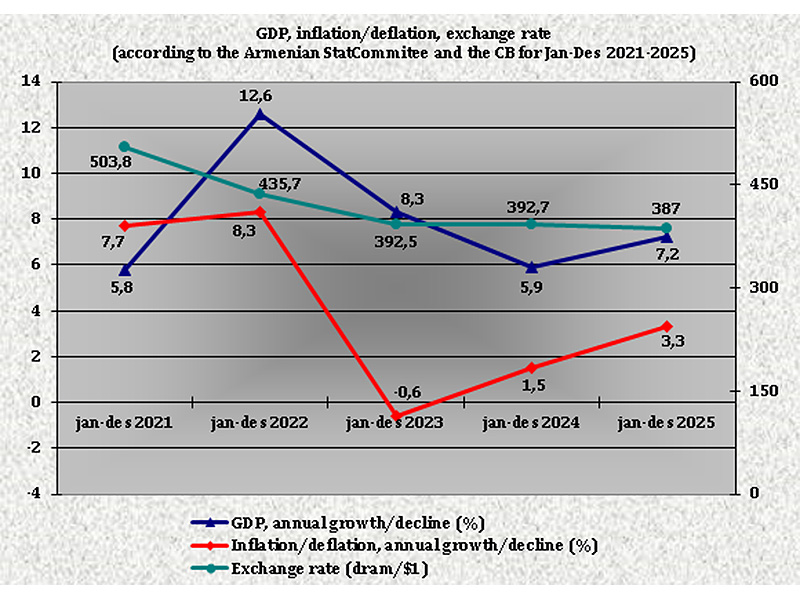
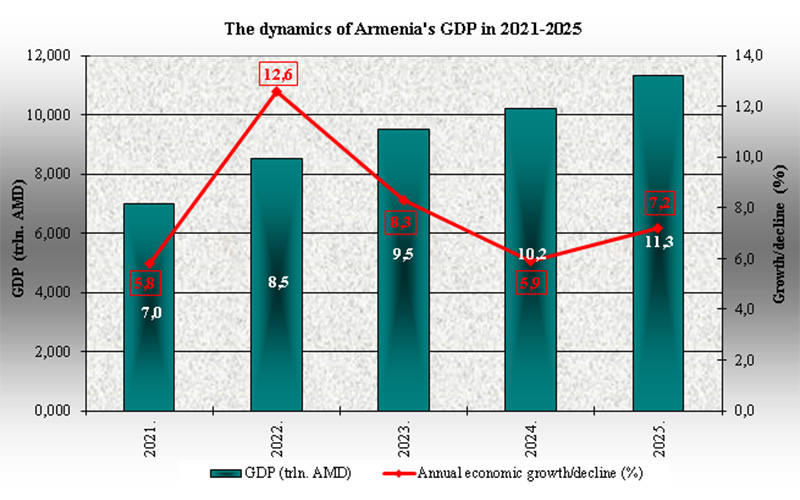
In July 2025, external debt gave way to domestic debt, leading to a gradual divergence in the following months. This resulted in their respective shares of public debt at 48.4% and 51.6% by January 1, 2026. However, according to the Ministry of Finance's plan, this ratio will be slightly adjusted in favor of external debt in the near future. This, as noted in the Ministry of Finance's document, will reduce pressure on Armenia's banking system from a liquidity perspective, allowing it to channel more investment into the country's economy. In 2025, the public debt-to-GDP ratio decreased from 50% to 49%, with both public debt and GDP growth accelerating from 8.4% to 13.2%, and from 5.9% to 7.2%. Meanwhile, the external debt-to-GDP ratio decreased further in 2025 from 25.1% to 23.7%, while domestic debt increased from 24.9% to 25.3%. External debt dynamics shifted from a 1% decline to a 9% increase, while domestic debt growth slightly slowed from 19.5% to 17.3%.
According to the Statistical Committee of the Republic of Armenia, Armenia's public debt exceeded $14.5 billion (over 5.5 trillion drams) as of January 1, 2026, accelerating its annual growth from 8.4% to 13.2%. This is due to improved external debt dynamics, while domestic debt growth continues to slow. Specifically, external debt reversed its annual trend from a 1% decline to a 9% increase, exceeding $7 billion (2.7 trillion drams), while domestic debt continued to stall, growing from 19.5% to 17.3%, reaching $7.5 billion (2.8 trillion drams). The government's share of external debt increased year-on-year from 92.2% to 93%, while the Central Bank's share declined from 7.8% to 7%, amounting to $6.5 billion and $490.6 million in absolute terms, respectively.
Moreover, the government's external debt reversed its decline, while the Central Bank's continued to decline. Specifically, the government's external debt trend reversed from a mere 0.01% decline to double- digit 10% growth, while the Central Bank's external debt remained in decline, decelerating from 8.5% to 2.7%. In the domestic public debt structure, government bonds dominate, with their share slightly decreasing for 2025 from 91% to 90% ($6.8 billion or 2.6 trillion drams), while annual growth in absolute value slowed from 20.7% to 16.2%. The share of Armenian Eurobonds for 2025 decreased from 8.7% to 8.1%, amounting to $607.4 million or 231.6 billion drams, with growth accelerating from 7.8% to 9.1%. The remaining 1.9% (versus 0.3% in 2024) came from internal guarantees - $136.4 million or 52 billion drams, the annual growth of which accelerated sharply from 36% to 5.7 times.
It should be noted that as of January 1, 2025, Armenia's public debt exceeded $12.8 billion, of which $6.454 billion is external debt and $6.388 billion is domestic debt. Moreover, according to a special note in the statistical report, the issue of benchmark long-term government bonds included in the structure of domestic debt, of which 206.358 billion drams (as of December 29, 2023) and 13.764 billion drams (as of December 30, 2024), by the Government's decision of December 28, 2023, was transferred to financial organizations as a concession for financial claims (property rights) that arose in 2023 as a result of the tragic September events in Artsakh.
Recall, on March 5, 2025, Armenia successfully placed a new tranche of Eurobonds in the amount of $750 million on international stock markets, with a yield of 7.1% and a maturity of 10 years (settlement date - March 12, 2025). The coupon yield of the new Eurobonds is 6.75%. The holders of the Armenian securities were institutional investment companies, pension funds, hedge funds and, to a lesser extent, banks. JPMorgan, Citibank and Credit Agricole Bank acted as underwriters. The Eurobonds were listed on the London Stock Exchange (LSE). International rating agencies assigned the following ratings to the Armenian sovereign securities: S&P - BB- (outlook 'Stable'), Fitch - BB- (outlook 'Stable'), and Moody's - Ba3 (outlook 'Stable'). This is the fifth tranche of Armenia's Eurobonds on the international capital market, the issuance of which was envisaged by the RA Law "On the State Budget for 2025" and outlined in the 2025 Borrowing Program. The net proceeds from the Eurobond issue will be used to finance the state budget deficit (609 billion drams - Ed.). Of the issued Eurobonds, the first $700 million tranche (issued in September 2013) was repaid in 2020, the second $500 million tranche (issued in March 2015) was repaid in 2025, and the remaining three mature in 2029, 2031, and 2035.
Earlier, Finance Minister Vahe Hovhannisyan stated that Armenia does not plan to enter the Eurobond market for the sixth time during 2026: "From now on, we will be guided by the situation. We are not currently considering a new Eurobond issue, despite the very successful placement of the 5th tranche in terms of international ratings. However, the nominal interest rate of 7.1% is high, and we must try to attract debt at lower interest rates. Our immediate plans include attracting loans from international institutions.