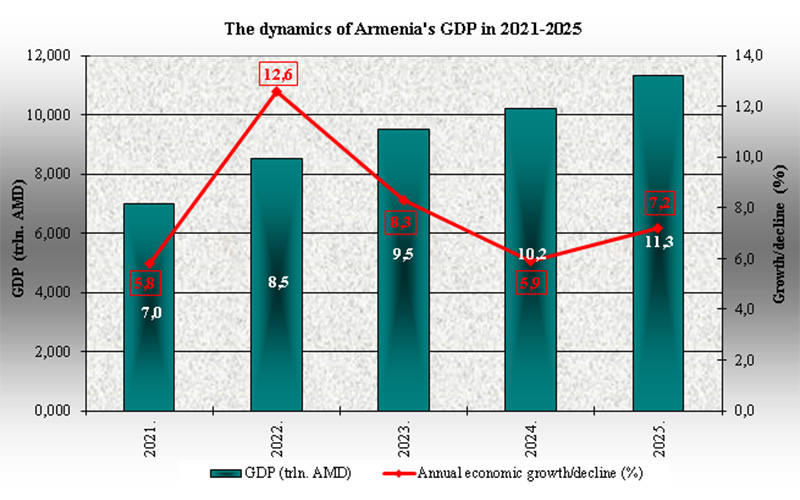



ArmInfo.The Central Bank of Armenia forecasts a GDP growth of 7.1-4.7% in 2026 and then 5.7-5.3% in 2027, also expecting an improvement in foreign trade dynamics. As a result, the absolute value of GDP will increase to 12.6-12.2 trillion drams (in 2026 from an actual 11.3 trillion drams in 2025), with subsequent growth to 13.8-13.3 trillion drams in 2027, as noted in the Central Bank of Armenia's March report, "Monetary Policy for Q1 2026."
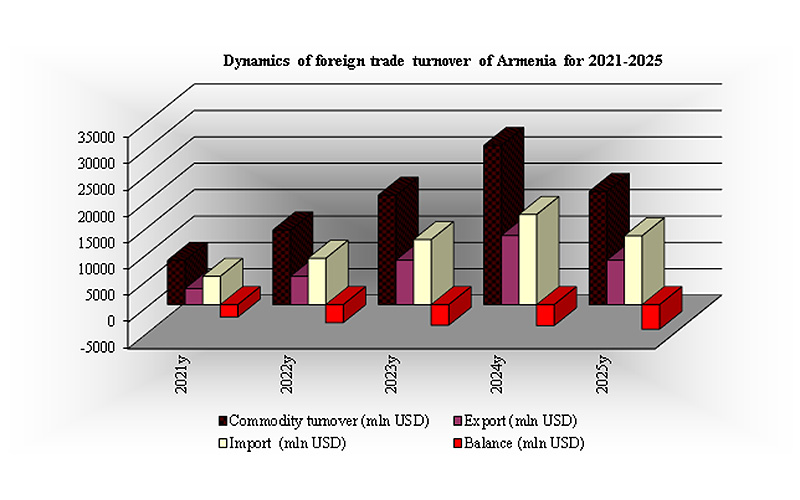
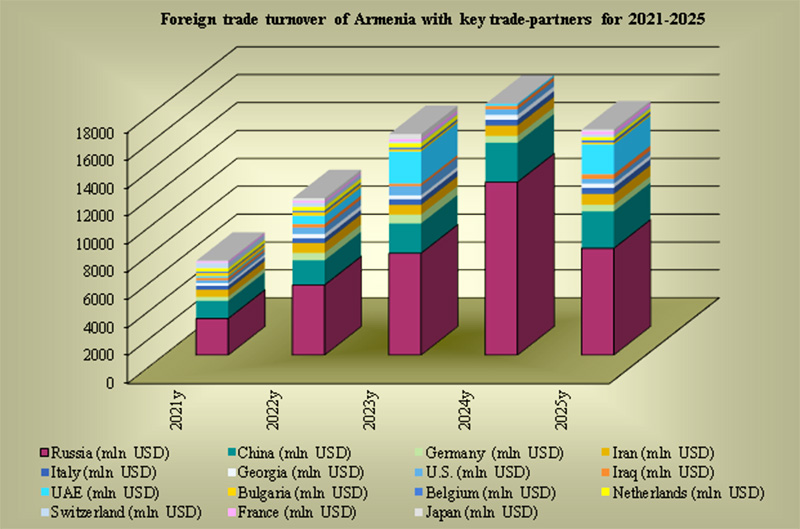
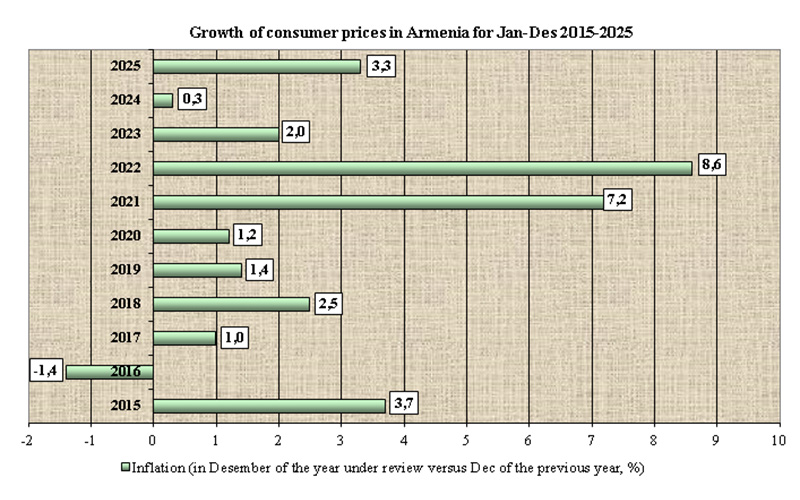
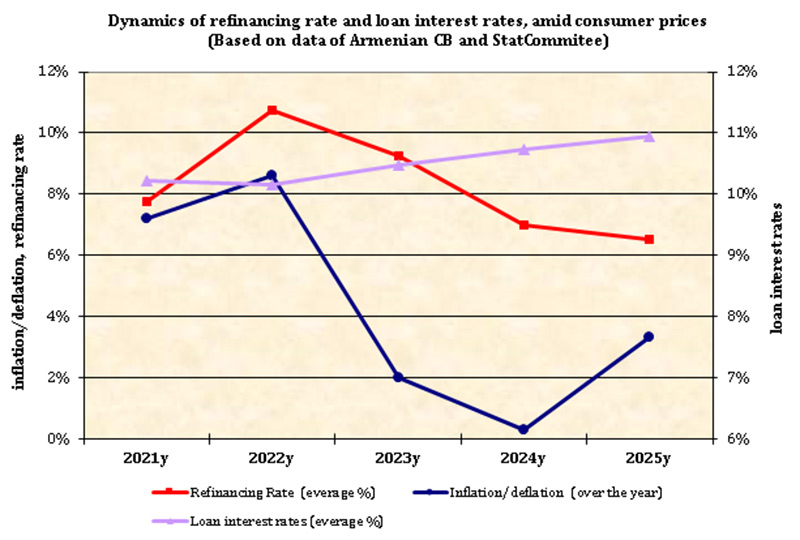
Thus, with the transition to a new, improved monetary policy development system (FPAS MARK II), the Central Bank has begun calculating its GDP forecast using Case A and Case B scenarios starting in 2024. Case A scenarios assume monetary policy rates above market expectations, given that risk and uncertainty factors could create a more inflationary environment in the economy. Case B scenarios, on the other hand, assume monetary policy rates lower than market expectations, given that risk and uncertainty factors could create either a deflationary or low-inflationary environment in the economy. Moreover, Case A scenarios envision expanding demand and curbing supply, while Case B scenarios, conversely, envision curbing demand and expanding supply. It is noteworthy that inflation under these scenarios is projected to be in the range of 4.4-3.3% for 2026 (compared to 3.3% inflation in 2025), with a target of 3% (+/- 1 percentage point), and 3.5-3.1% for 2027. Moreover, inflation in the segment of non-exportable goods, characterized by rigid prices, according to the new forecast, will increase in 2026 to 3.3-3% (from 2.2% in 2025), and will then continue to grow in 2027 to 4.1-3.3%. According to the Central Bank's updated forecast, export and import dynamics, after nearly flat growth in 2024 of 30.9-32.7% and a decline in 2025 of 30.5% (for exports) and 23.7% (for imports), will improve in 2026, with exports growing to 25.5-28.5% and imports growing to 36.7-34.9%, with this trend continuing in 2027, albeit at a slower pace, to 16-19% (for exports) and 11-14.3% (for imports).
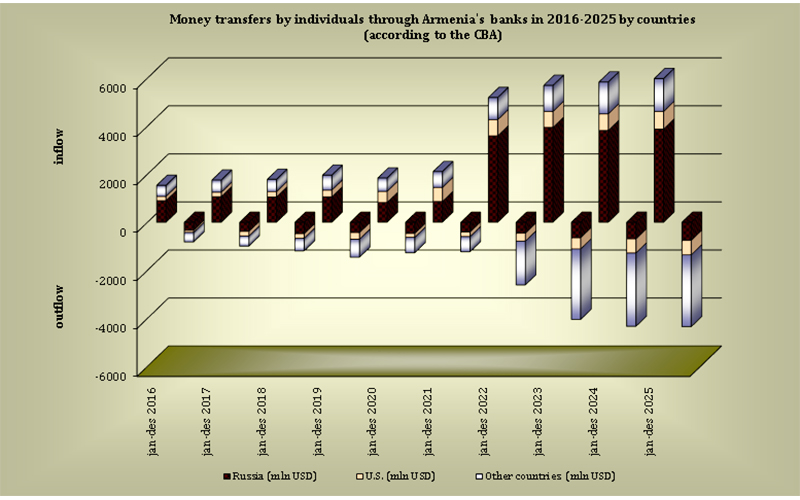
According to the Central Bank's new forecast, the current account deficit to GDP will reach 6.4% (Case A) or 5.4% (Case B) in 2026, compared to the actual 5.8% in 2025. Then, in 2027, this indicator will remain negative at 6.1% (according to Case A) or 4.9% (according to Case B). According to the Central Bank's updated forecast, the ratio of remittances to GDP will change slightly in 2026 to 2.9-3.1% (versus 3.2% in 2025), and a nearly identical level is expected in 2027 - 2.9-3%, thus indicating a weak economic effect in terms of the impact of remittances on the economy.
The Central Bank's 2026 forecast for budget revenues and expenditures is as follows: expenditures will grow more significantly-from 2.6 trillion to 3.6 trillion drams-than revenues-from 2.9 trillion to 3.1 trillion drams. As a result, the state budget deficit will increase from 419.3 billion to 536.7 billion drams. As a result, in 2026, the ratio of the state budget deficit to GDP will increase from 3.7% to 4.3-4.4%, with a slight decline in the share of revenues in GDP from 25.5% to 24.5-25.3% and an increase in the share of expenditures in GDP from 23.1% to 28.7-29.7%. In 2027, revenues will increase to 3.4 trillion drams, and expenditures to 3.8 trillion drams, reducing the deficit to 448.5 billion drams. The state budget deficit-to- GDP ratio in 2027 will decrease to 3.2-3.4%, while the share of revenue in GDP will remain in the range of 24.3-25.3% and the share of expenditures in GDP will decrease to 27.5-28.6%.
In this report, the Central Bank of Armenia also updated forecasts for economic development and inflation in the US, the Eurozone, and Russia, as well as for oil and copper prices and the FAO index. For the US economy, growth is expected to accelerate to 2.6% in 2026 (from 2.2% in 2025) and inflation will decline from 2.7% to 2.5%. In 2026, the Eurozone economy will slightly slow down in growth to 1.1% (from 1.4% in 2025), with inflation weakening from 2.4% to 1.8%. In 2026, the Russian economy will stall in growth to 0.9% (from 1% in 2025), with inflation decreasing to 5.8% (from 9% in 2025). In 2027, the US economy will slow to 2.4%, the Eurozone will accelerate to 1.2%, and Russia will also accelerate to 1.5%. Inflation in the US will weaken slightly to 2.3%, in the Eurozone it will remain at 1.8%, and in Russia it will weaken to 4.4%. The oil price, according to the new forecast, will increase from $69.1 in 2025 to $78.6 per barrel in 2026, but will decrease to $64.4 in 2027. The copper price will increase from $9947 per ton in 2025 to $12029.5 per ton in 2026 and further to $12623.9 in 2027. The FAO index, after decreasing in 2023-2024 from 124.5 to 122 and then increasing in 2025 to 127.2, will begin to decline in 2026 to 125.9, with this trend continuing in 2027 to 125.
It should be noted that, according to the IMF forecast updated in December, Armenia's GDP growth will amount to 5.5% in 2026. Regarding Armenia's foreign trade, according to the IMF forecast, exports and imports will reach almost the same growth rate of 2.2-2.1% in 2026, with a further moderate acceleration in 2027 to 3.4-3.7%. In its January forecast, the World Bank (WB) predicts a slowdown in Armenia's GDP growth in 2026-2027 to 4.9-4.7%. Fitch Ratings, in its forecast updated in January of this year, expects sustainable prospects for Armenian economic growth - above 5% in 2026-2027. S&P Global Ratings, in its February update, predicts a slowdown in Armenia's GDP growth in 2026 to 5.3% and then to 4.8% in 2027, after which the rate will accelerate slightly to 5% in 2028. At the same time, S&P predicts an improvement in export dynamics in 2026, with an exit from the recession to 2.2% growth, with a gradual acceleration to 3.7% in 2027 and to 4.4% in 2028. Armenia's draft state budget for 2026 projects GDP growth of 5.4%.
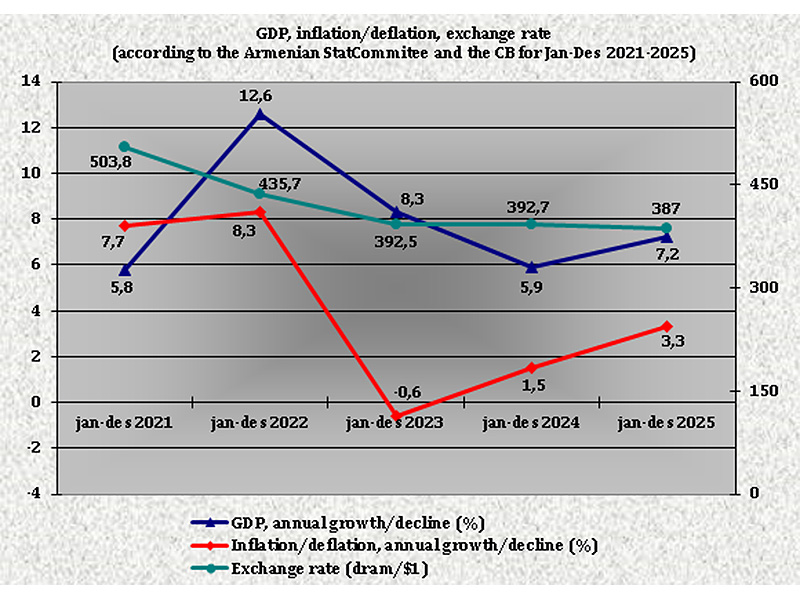
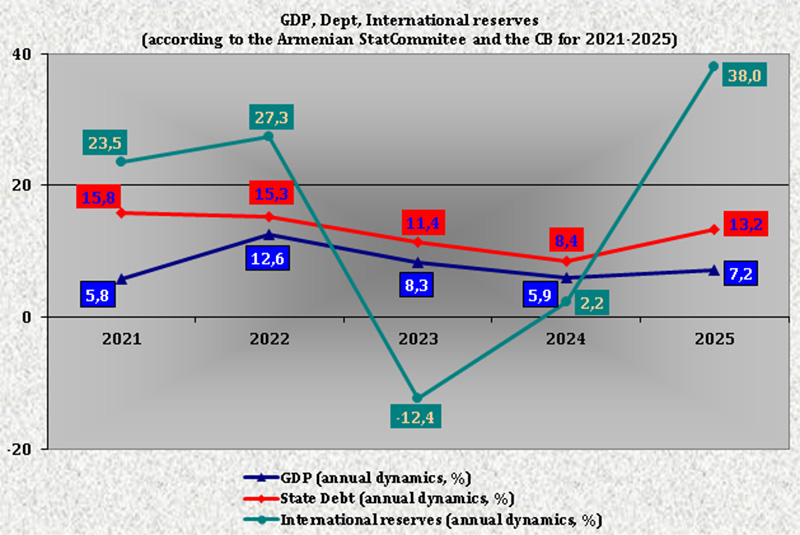
According to the Statistical Committee of the Republic of Armenia, Armenia's GDP growth, after accelerating from 5.8% to 12.6% in 2022, began to slow in 2023 to 8.3% and then to 5.9% in 2024. Growth accelerated to 7.2% in 2025, reaching AMD 11.318 trillion (over $29.2 billion) in absolute terms. The GDP deflator index also grew from 106.9% to 108% in 2022, then declined to 103.1% in 2023 and to 101.4% in 2024, before rising to 103.6% in 2025. (The average exchange rate of the dram against the US dollar for January-December 2025 was AMD 387.01/$1).
Recall. the new Forecasting and Policy Analysis System (FPAS) adopted by the Central Bank of Armenia serves to provide information and analytical support for decision-making on monetary policy and consists of all the elements necessary for inflation targeting: data collection and processing, monitoring the current economic situation, development and improvement of models, the decision-making process on monetary policy, as well as an open communication policy. The FPAS system includes the process of developing short-term and medium-term forecasts of macroeconomic indicators in order to assess the state of the economy and development prospects, which are used as the basis for making strategic decisions on monetary policy. FPAS consists of two main stages: the first is an analysis of current conditions and a short-term forecast; the second is a medium-term forecast. The model has the advantage of analyzing potential actions of the Central Bank depending on the domestic and external economic situation, allowing decisions on the key rate to be made based on the forecast level of inflation and other macroeconomic indicators.