

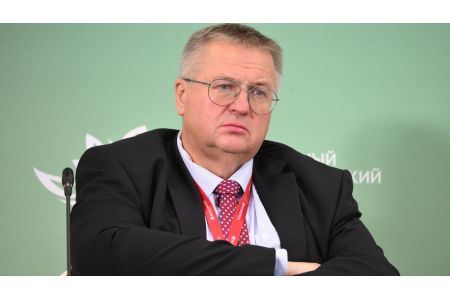
ArmInfo. Russian specialists can quickly restore sections of Armenia's railways for connections with neighboring countries. Russian Deputy Prime Minister Alexei Overchuk stated this in an interview with TASS.
The Deputy Prime Minister recalled that in December 2025, the Armenian side, at the highest level, requested Russia to restore two short sections of railway track near the Armenian-Azerbaijani and Armenian-Turkish borders, with a total length of 12-13 km. "This request was considered at the highest level in Russia, and a positive response was given. We support the friendly people of Armenia. The restoration of these two sections is in the interests of our country, and, of course, we are ready for the relevant negotiations," Overchuk said.
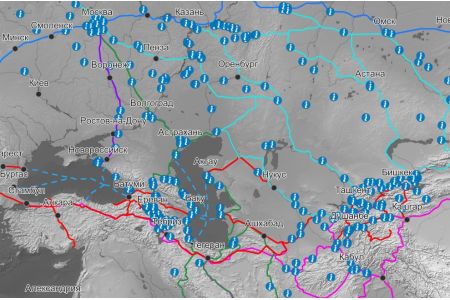
The Deputy Prime Minister explained in more detail the railway lines in question. "If you imagine a map of the region showing Azerbaijan, Armenia, Georgia, Iran, and Turkey, it becomes clear that the restoration of the Meghri section of the railway, now known as the 'Trump Route,' ensures the connection between the two parts of Azerbaijan," he noted.
"As you travel through Armenian territory along the northern bank of the Araks River, you enjoy the views of the Islamic Republic of Iran on the other bank. After traveling these 42 kilometers from east to west, you leave Armenia and enter Nakhichevan, Azerbaijan. There is a railway on Azerbaijani territory that allows you to continue traveling toward the other part of Armenia," Overchuk noted. However, according to him, at the border with Armenia, it turns out the train can't go any further.
"From the border to the Armenian settlement of Yeraskh, the railway tracks are dismantled for 1.6 kilometers. If this short section is restored, then we can continue until we reach the border with Turkey, which is currently blocked. Moreover, according to experts, part of this route from Gyumri to the Armenian-Turkish border also needs restoration or repair," the Deputy Prime Minister of the Russian Federation added.
He explained that this route hadn't been used for many years. "According to current estimates, approximately 12-13 kilometers of tracks need to be restored or repaired to ensure the connection of Armenian railways with Azerbaijani and Turkish railways, but experts need to confirm this," he stated.
As Overchuk pointed out, in response to Russia's offer to help restore these routes, Armenian Prime Minister Nikol Pashinyan said that "the Russian concession creates obstacles to Armenia's development; because of Russian control, no one will use the route," and suggested that Russia sell the concession to a country friendly to both Russia and Armenia.
"Why was it necessary to invite Russia to restore these routes if you don't see its further participation in developing transport connectivity in the region? Saying one thing and doing another, you'll agree, isn't the best way to develop relations," the Deputy Prime Minister asked.
He added that Pashinyan's interview revealed "that the presence of a Russian railway company in Armenia prevents his country from realizing its competitive advantages, as some other countries don't want a Russian company there." "Supposedly, Russia is scaring someone off, and this will result in cargo from Azerbaijan's Nakhichevan going directly to Turkey, rather than first stopping in Armenia and only then proceeding to Turkey," Overchuk explained.
"Russian railway workers know how to build and restore railways; they do it professionally, quickly, and efficiently. Armenia saw this for themselves in May-June 2024, when a natural disaster washed away a section of the only railway connecting Armenia with the outside world," the Deputy Prime Minister recalled. He noted that Armenia was in trouble at the time, and by decision of Russian President Vladimir Putin, Russia immediately came to the rescue-rail service was restored within three weeks.
"So these 10-15 kilometers can be restored very quickly," the Deputy Prime Minister continued.
Overchuk also spoke of the modest prospects for the connecting railway sections leading from Armenian settlements to the borders of Azerbaijan and Turkey, which Armenia wants to restore.
He recalled that a Russian delegation recently returned from Yerevan, where they discussed the terms of raising and repaying funds for the restoration of these two sections. Overchuk noted that, according to Russian experts, the restoration of these short sections is a commercial project.
"We exchanged opinions, conveyed the Russian proposals to our Armenian colleagues, and negotiations are ongoing. We have our own opinion regarding the modest prospects for utilizing these sections and generating a cash flow capable of ensuring the return on even these small investments," the Russian Deputy Prime Minister stated.
Furthermore, Overchuk emphasized that this is not due to the fact that Armenia's railways are under Russian concession, but rather due to objective reasons such as the availability of alternative routes through Georgia, Iran, or Russia, as well as the state of the Caspian Sea. "The fact that, given current circumstances, the Meghri section, which is directly adjacent to the border with the Islamic Republic of Iran, is being transferred to American control also does not inspire investment optimism," he concluded.