

ArmInfo. Armenia's primary exports are mineral raw materials, precious metals/stones, machinery and equipment, and finished food products, totaling $1.4 billion, or 79% of the total. This same category of goods dominates imports, totaling $1.9 billion, or 65% of the total, as evidenced by data from the RA Statistical Committee for January-March 2026.
During the reporting period, mineral raw materials worth $434.7 million (25% of the total), precious metals/stones worth $364.8 million (21%), machinery and equipment worth $294.8 million (17%), and finished food products worth $286.6 million (16%) were exported. Machinery and equipment led imports at $717.4 million (24%), followed by mineral raw materials at $344.3 million (12%), land/air/water vehicles at $325.2 million (11%), finished food products at $263.6 million (9%), and precious metals/stones at $260.3 million (less than 9%). However, it is worth paying attention to the annual dynamics of these goods in terms of exports and imports. Specifically, mineral raw material exports jumped by 96%, while imports grew by 10.4%. Finished food products saw a significant increase in imports, up 58.1% compared to a 5.6% increase in exports. Machinery and equipment increased imports by 16.4%, while exports decreased by 11.4%. Precious metals and stones significantly decreased in both exports and imports, ranging from 26.4% to 43.3%. Imports of land/air/water transport increased by 15.9% year-on-year.
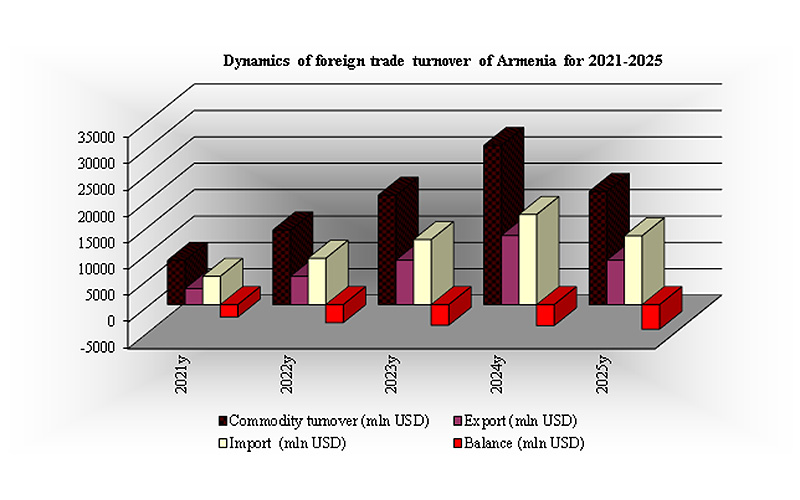
According to statistics, total exports in January-March 2026 amounted to $1.8 billion, while imports exceeded $2.9 billion, with the annual dynamics of these indicators improving from a 61.8%-47.9% decline to a 4.5%-4.6% growth. Exports and imports to the EAEU decreased by 6.5-22.6% by country, while significantly increasing to the EU by 89.8-41.5%. During the reporting period, export and import growth was also recorded to the United States, Switzerland, Brazil, and the United Kingdom, while a significant increase in exports to China was accompanied by a decrease in imports.
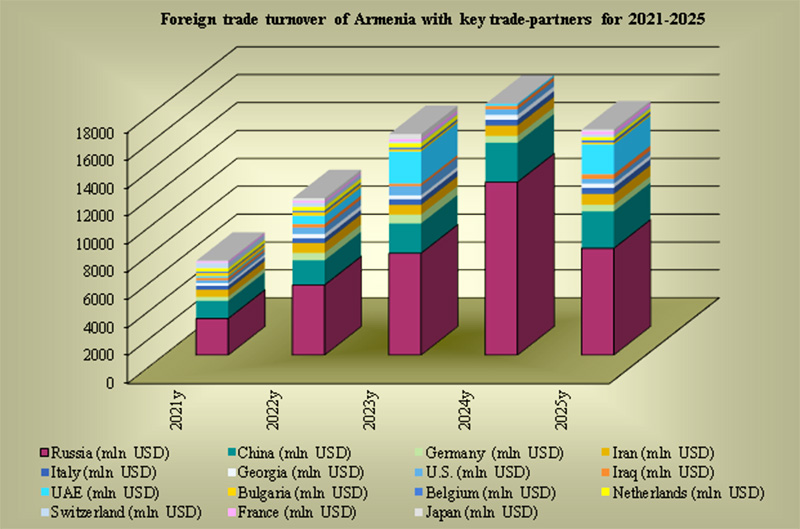
Russia and China hold the top two positions in exports and imports. The UAE, Bulgaria, and Iraq are next in the top five for exports, while Iran, Germany, and the United States lead in imports.