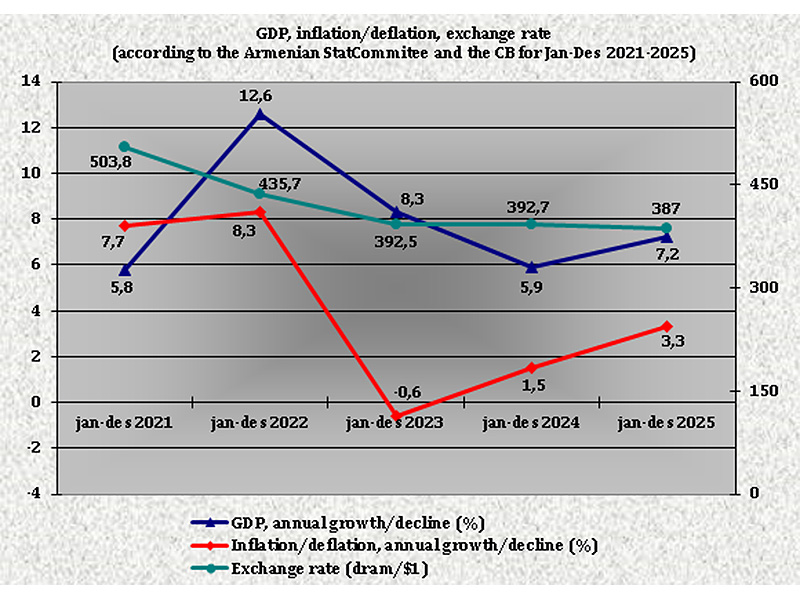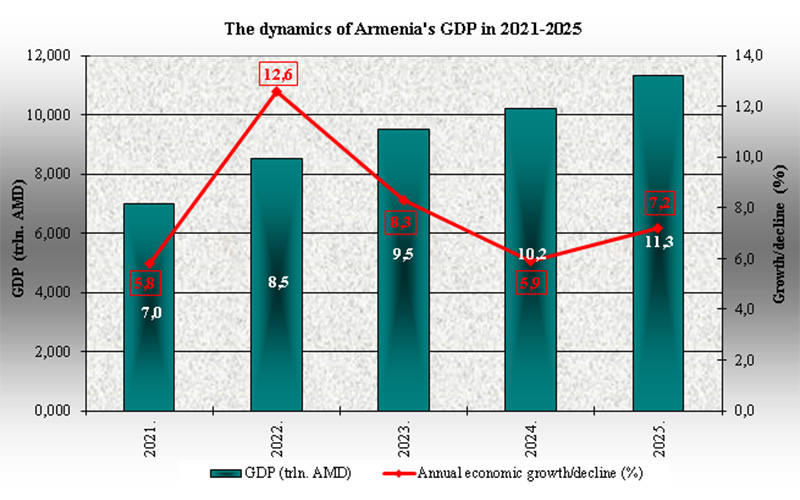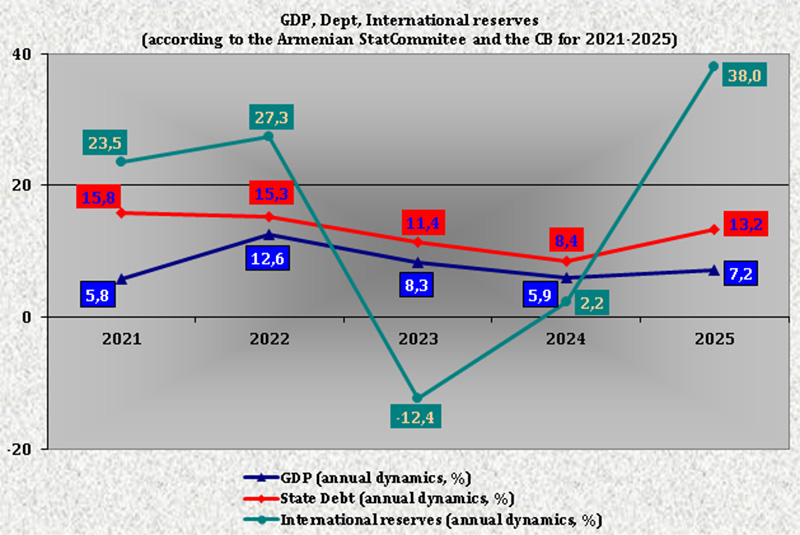



ArmInfo.In Armenia, economic activity growth accelerated to 7.9% annually in the first half of 2026 (up from 6.3% in the same period of 2025). urthermore, the industrial sector managed to recover from a downturn into double-digit growth, re-establishing itself as one of the key drivers of economic growth.
According to preliminary data from the Statistical Committee of the Republic of Armenia, foreign trade remains in decline, though the drop is now minor, unlike the significant slump recorded a year ago.
According to the statistics, the acceleration of economic activity growth in the first half of 2026 was driven by an improvement in the annual dynamics of the industrial sector—shifting from a 12.1% decline to a 10.8% growth—as well as a surge in construction sector growth from 18.5% to 24.5%. Growth in the energy sector noticeably accelerated, rising from 4% to 10%. Meanwhile, the trade sector, which leads in volume, continued to lose momentum, with its growth rate slowing from 3.9% to 0.9%. At the same time, the services sector, which holds the second-largest volume, accelerated its growth from 9.8% to 11%. The performance of the agricultural sector deteriorated, reversing from a 7.3% growth into a double-digit 11.9% decline.
According to statistical data for the first half of 2026, the trade sector maintains its leadership in absolute volume with 3.2 trillion drams ($8.4 billion). The services sector ranks second in volume at 2.2 trillion drams ($5.7 billion), followed by the industrial sector in third place at 1.5 trillion drams ($4.1 billion). The agricultural sector occupies the fourth position with 310.1 billion drams ($828.3 million), and the construction sector ranks fifth with 282.2 billion drams ($754 million). Electricity generation volume in the first half of 2026 totaled 5,163.7 million kWh, of which 782.8 million kWh was generated in June alone.
Moreover, in June 2026, the dynamics of the industrial sector worsened from 1.2% growth to a 3.1% decline, while a year earlier in the same month there was an imperceptible slowdown in growth from 2.9% to 2.5%. At the same time, growth in the construction sector stalled in June of this year - from 27.2% to 19.5%, and in the service sector - from 6.9% to 5.7%. At the same time, the improvement in dynamics for June of this year was observed in the trade sector - with an exit from a 1.6% decline to a 6.3% growth, and in the energy complex - with an exit from a 2.3% decline to a 1.6% growth.
On an annual basis (June 2026 compared to June 2025), an upward trend was demonstrated by all sectors except the trade sector, which contracted by 0.1%. In particular, the highest annual growth was recorded by the construction sector at 25.4%, followed by double-digit growth in the services sector at 19.7% and the energy complex at 11.5%, while the industrial sector managed to emerge from a downturn into a 4% growth. A year earlier, in June 2025 compared to June 2024, with the exception of the industrial sector which dropped by 1.2%, all other spheres maintained growth: the construction sector at 22.6%, the services sector at 8.2%, the energy complex at 6.6%, and the trade sector at 2.8%.
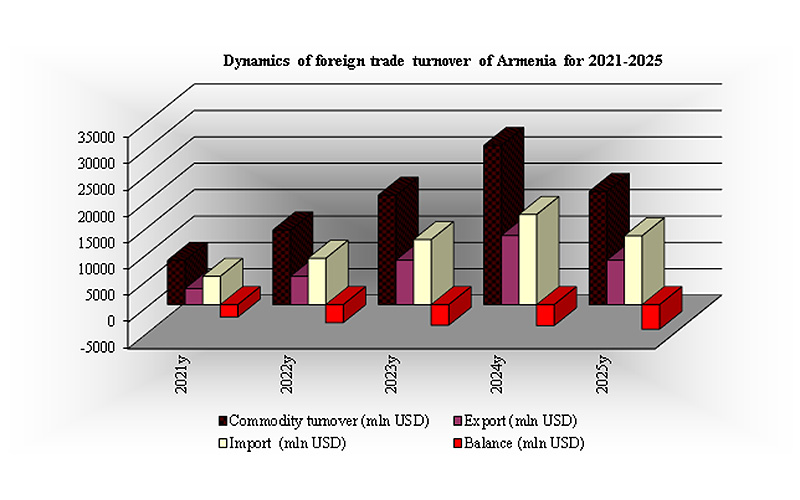
Against this backdrop, Armenia's foreign trade turnover in the first half of 2026 totaled 3.6 trillion drams ($9.6 billion), declining by a mere 0.1% per annum (compared to a 45% slump a year ago). This sharp deceleration of the decline stemmed from an improvement in import dynamics—shifting from a 38.6% drop to 4% growth—and a noticeable slowdown in export contraction from 52.8% to 6.7%. As a result, the absolute volume of exports for the first half of 2026 amounted to 1.3 trillion drams ($3.4 billion), while imports reached 2.3 trillion drams ($6.1 billion).
In June 2026, compared to June 2025, foreign trade turnover also remained in a decline, though with a deceleration of rates from 16.6% to 3.3%. Specifically, the improvement in import dynamics—shifting from a 17.1% drop to an 8.6% growth—was accompanied by an acceleration in the export decline from 15.9% to 20.5%. In June of this year alone, foreign trade turnover moved out of a 3.4% decline into a 7.3% growth, resulting from a similar improvement in the dynamics of both exports and imports—shifting from a 3.5–3.4% drop to a 5–8.5% growth. A year earlier, in June 2025, a similar pattern was observed, but back then the growth of foreign trade was more noticeable at 9.4% and stemmed primarily from a double-digit 23.6% increase in exports, rather than from imports, which grew by only 0.9%, compared to double-digit declines of these indicators in May 2025 of 14.8%, 19%, and 12%, respectively.
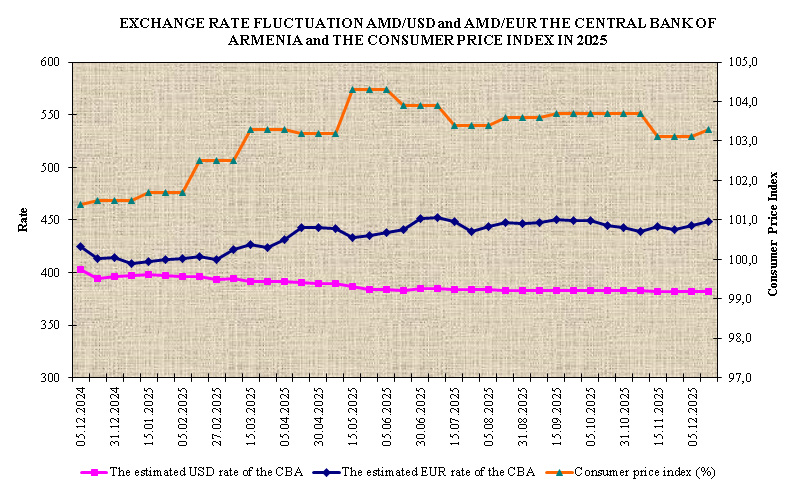
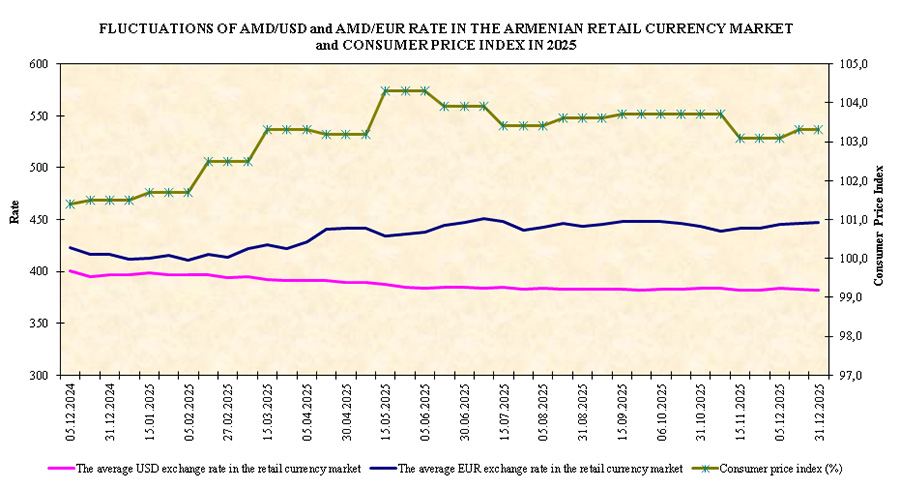
Note, starting in 2023, the methodology for calculating electricity generation volumes in statistical reports changed to include electricity generated by autonomous producers. Data for the agricultural sector are published only in quarterly and annual statistical reports. (The average calculated exchange rate of the dram in the first half of 2026 was 374.32 AMD/$1, compared to 391.31 AMD/$1 a year ago).