

ArmInfo. In Armenia, economic activity growth accelerated to 7.7% annually in January-July 2026 (from 7.1% in the same period of 2025). Moreover, the industrial sector, having managed to turn from recession to growth, has recovered its position as one of the drivers of economic growth. According to the final data of the RA Statistics Committee, foreign trade also turned from recession to growth, supported mainly by an improvement in import dynamics (upward) and, in part, by a sharp slowdown in the decline in exports.
According to statistics, the acceleration of economic activity growth in January-July 2026 was due to an improvement in the annual dynamics of the industrial sector, with a return from a 9.8% decline to 9.5% growth, and accelerated growth in the construction sector from 20.2% to 25%. Growth in the energy sector also accelerated, from 5.6% to 9.4%. Meanwhile, the leading trade sector by volume continued to slow, from 4.2% to a nearly stagnant 0.8%. Meanwhile, the services sector, which ranks second by volume, accelerated its growth from 10.6% to 13.2%.
According to statistics for January-July 2026, the trade sector retains the lead in absolute value, with a volume of 3.8 trillion drams ($10.1 billion). The services sector ranks second, with 2.6 trillion drams ($6.9 billion), and the industrial sector ranks third, with 1.8 trillion drams ($4.8 billion). The construction sector ranks fourth, with AMD 369.2 billion ($989.2 million) due to the lack of agricultural sector data in the report for this period. Electricity generation in January-July 2026 amounted to 6,077.9 million kWh, of which 914.2 million kWh was generated in July alone.
Moreover, economic activity growth slowed from 8.9% to 6.5% in July 2026 compared to July 2025, with growth accelerating slightly in July alone, from 4.4% to 4.6% (compared to a slowdown in July 2025 from 8.8% to 5.3%). Specifically, in July 2026, the industrial sector's dynamics reversed a 3.1% decline to 5.5% growth, while a year earlier in the same month, growth accelerated significantly, from 2.5% to 7.4%. At the same time, growth in the construction sector stalled in July of this year, from 19.5% to 16.1%, and in the services sector, from 5.7% to 2.8%. Meanwhile, the retail sector's growth accelerated only slightly in July of this year, from 6.3% to 7%, while the energy sector accelerated from 1.6% to a double-digit 16.8%.
On an annual basis (July 2026 vs. July 2025), all sectors demonstrated an upward trend, except for the retail sector, which declined by 0.1%. In particular, the construction sector demonstrated the highest annual growth rate at 26.5%, followed by the services sector at 17%. The energy sector had the lowest annual growth rates at 5.9% and the industrial sector at 3.1%. A year earlier, in July 2025 compared to July 2024, all sectors were growing: the construction sector grew by 26.1%, the energy sector by 14.8%, the services sector by 11.1%, the industrial sector by 4.2%, and the trade sector by 3%.
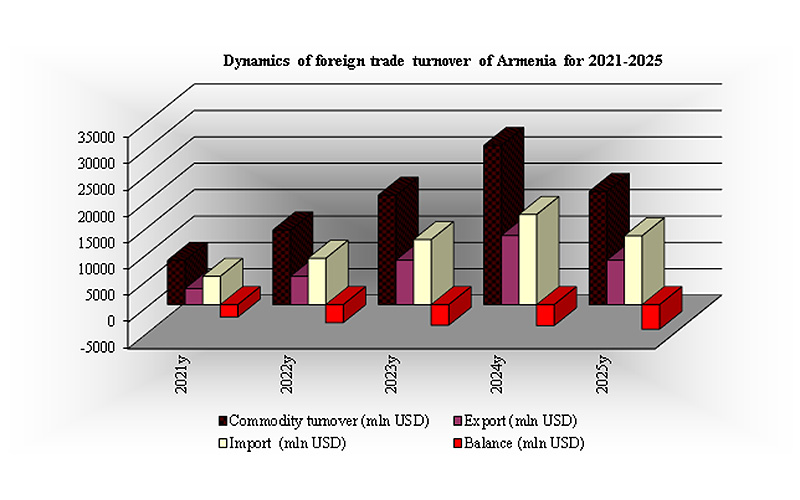
Against this backdrop, Armenia's foreign trade turnover in January-July 2026 amounted to 4.3 trillion drams ($11.5 billion), an increase of 1.7% year-on-year (versus a 42% decline a year ago). This resulted from an improvement in import dynamics, from a 35.8% decline to 7.7% growth, and a sharp slowdown in export decline, from 49.6% to 7.9%. As a result, the absolute value of exports for January-July 2026 amounted to 1.5 trillion drams ($4 billion), while imports amounted to 2.8 trillion drams ($7.5 billion).
In July 2026, compared to July 2025, foreign trade turnover also recovered from a 16.1% decline to 6.7% growth. Specifically, the improvement in import dynamics, from a 16.5% decline to 21.5% growth, was accompanied by an acceleration in the decline in exports from 15.4% to 15.7%. In July of this year alone, Foreign trade turnover accelerated from 7.3% to 9.2%, driven by a more significant acceleration in import growth from 8.5% to a double-digit 11.1%, compared to export growth from 5% to 5.3%. A year earlier, in July 2025, foreign trade dynamics had only just reached a modest 0.1% growth, driven by a 3.7% increase in imports and a slowdown in export decline to 4.8%.
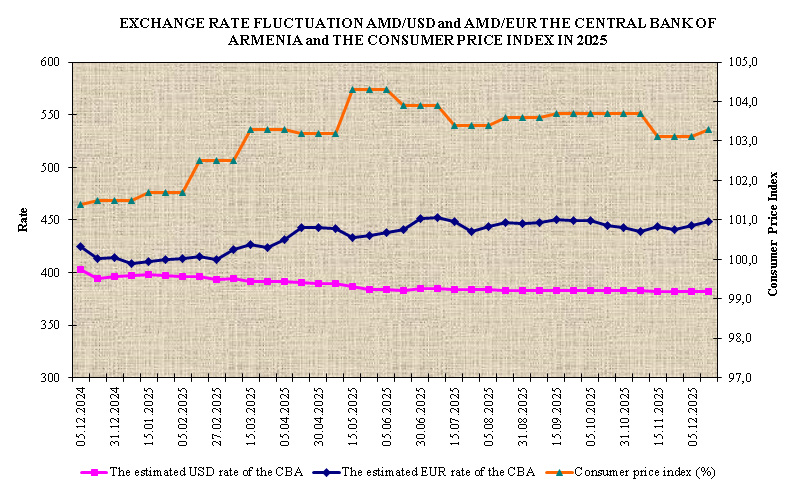
It should be noted that, starting in 2023, the methodology for calculating electricity generation volumes in statistical reports has changed; in particular, electricity generated by independent producers has now been included. For the agricultural sector, data is published only in quarterly and annual statistical reports. (The average dram exchange rate in January-July 2026 was 373.26 drams per US dollar).