

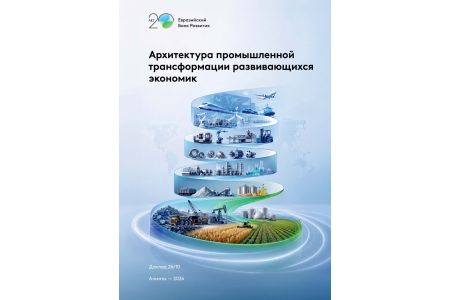
ArmInfo. The Eurasian Development Bank (EDB) has presented a new analytical report, «The Architecture of Industrial Transformation of Developing Economies,» analyzing how developing countries can move into the high-income category and establish themselves sustainably in this group.
Based on a study of the historical experience of industrialization, modern industrial policy theories, and the approaches of the World Bank and the IMF, EDB analysts propose a three-stage architecture of industrial transformation that makes it possible to turn external technologies and investment into domestic production capabilities, human capital, and innovation.
- Domestic industry is the foundation for transitioning to a high income level. Manufacturing accounted for 64% of economic growth episodes over the past 50 years, while one industrial job supports another 2.2 jobs in related sectors.
- Human capital turns industrial production into a source of innovation. Industry accounts for 53% of global R&D activity, while industrial companies own almost 60% of green patents.
- The state creates infrastructure conditions, while the private sector tests the commercial viability of projects. The state has a key role in developing energy, transport, water, logistics, industrial sites, standards, workforce training, and risk-sharing mechanisms. Private companies invest and compete, while government support is provided when co-financing is available and measurable results are achieved.
- The three-stage architecture provides developing countries with a practical and adaptable path from investment to innovation. Its modules are applied to specific «country – industry» combinations, so the general logic remains valid under different initial conditions.
The scale of the task is enormous. Today, 108 economies with a combined population of around 6 billion people belong to the middle-income group. Since 1990, only 34 economies have moved from this group into the high-income group. These figures show how difficult it is to move from growth driven by capital accumulation, urbanization, resource advantages, and technology adoption to productivity growth and domestic technological capabilities.
EDB views industry as one of the central mechanisms of this transition. It creates not only output and jobs, but also an environment for continuous technological learning: demand for engineers and technicians, standards and metrology, production management, suppliers, and applied research. According to the data cited in the report, manufacturing development was associated with 64% of economic growth episodes over the past 50 years, while one job in manufacturing industries supports an average of another 2.2 jobs in related sectors.
The report’s main analytical novelty is not another list of «right» industries, but an applied architecture of solutions. EDB combines in a single working system the historical experience of industrialization, modern industrial policy theories, the approaches of the World Bank and the IMF, and requirements for the practical feasibility of projects. The market selects and tests the viability of solutions, while public institutions remove infrastructure, workforce, coordination, and financial barriers that an individual company cannot overcome on its own.
The architecture is organized around three stages and incorporates the World Bank’s 1i–2i–3i logic: investment → technological infusion → innovation. The first stage establishes the basic production foundation – reliable energy, transport, water, industrial sites, quality infrastructure, and professional skills. At the second stage, individual production facilities are brought together into an industrial platform: suppliers and engineering capabilities are developed, deeper processing, standards, and project financing are expanded, and external technology is transformed into local expertise. At the third stage, applied R&D, pilot lines, intellectual property, and the commercialization of domestic solutions are added to this platform. The stages may overlap, but large-scale technological sophistication is impossible without a production platform, skilled personnel, suppliers, and standards.
For the Eurasian region, EDB translates this logic into a specific portfolio of opportunities. Russia and Belarus are capable of developing complex links – equipment, components, engineering, standards, and individual technological niches. Kazakhstan and Uzbekistan can more deeply connect their resource and energy base and growing demand with chemicals, higher-value-added metallurgy, electrical engineering, and machine building, consistently increasing the degree of processing in industry and capturing more added value. Armenia, Kyrgyzstan, and Tajikistan can strengthen regional chains through specialized component, service, and niche production. The principle behind this configuration is «different capabilities – a single industrial system,» in which the regional market provides scale while external openness preserves access to technology and competitive testing.
The scale of untapped opportunities is demonstrated by a scenario assessment from a previous EDB study: the development of four interconnected complexes – chemicals, machine building, higher-value-added metallurgy, and food processing – could generate more than $510 billion in additional annual output in 2019 prices. This is not a GDP forecast or a guaranteed result, but an estimate of potential that includes expanded exports, the replacement of some critical imports, and indirect effects in related sectors.
To transition to a high income level, a developing economy needs more than simply increasing investment and purchasing modern equipment. It is critically important to turn external technology into domestic production capacity – into engineers and technologists, suppliers, standards, services, and the ability to improve processes. Industry is precisely what creates an environment in which such learning becomes widespread. When enterprises are able not only to operate technologies, but also to adapt and improve them, the transition from imported knowledge to domestic innovation begins. This is the qualitative change in the growth mechanism – from capital accumulation to productivity and technological development.
The authors emphasize that industrial transformation is not only about new plants. Physical infrastructure – energy, transport, logistics, warehouses, water, and industrial sites – must develop simultaneously with soft infrastructure: standards, certification, metrology, vocational and engineering education, applied science, and supplier development programs. Priority areas pass through filters for market, resource, and skills availability; technological proximity; infrastructure readiness; and financial feasibility. Large-scale support is justified only after pilot and market testing.
A special role is assigned to multilateral development banks. Their task is to translate industrial strategy into a financeable portfolio: prepare complex projects, reduce early-stage risks, provide long-term financing, mobilize private capital, and connect national initiatives into regional production chains.
The practical meaning of EDB’s new architecture is to provide developing economies with a navigation tool from ambition to implementation. The success of industrialization is determined by the ability to turn resources, investment, and external technologies into productivity growth, engineering capabilities, local added value, and domestic innovation. It is precisely this change in the growth mechanism that creates the foundation for transitioning to a high income level and establishing a sustainable position in this group.
The full text of the analytical report «The Architecture of Industrial Transformation of Developing Economies» is available via the link.
The Eurasian Development Bank (EDB) — is a multilateral development bank engaged in investment activities across the Eurasian region. For 20 years, EDB has contributed to strengthening and expanding economic ties and the comprehensive development of its member countries. As of the end of June 2026, EDB’s accumulated portfolio comprised 348 projects with total investments of $22.1 billion. Projects with an integration effect in the areas of transport infrastructure, digital systems, green energy, agriculture, industry, and machine building account for the largest share of EDB’s portfolio. In its activities, the Bank is guided by the UN Sustainable Development Goals and ESG principles.
As part of its 2022–2026 Strategy, EDB is implementing 3 megaprojects: «The Central Asian Water and Energy Complex,» «The Eurasian Transport Framework,» and «The Eurasian Commodity Distribution Network.»