

ArmInfo. The Asian Development Bank (ADB) has maintained its forecast for Armenia’s GDP growth in 2026 and 2027, expecting growth to first slow to 5% (from the actual 7.1% in 2025) and then accelerate to 5.5%. This is noted in the ADB’s September report, "Asian Development Outlook: Navigating Prolonged Energy Shocks and El Nino."
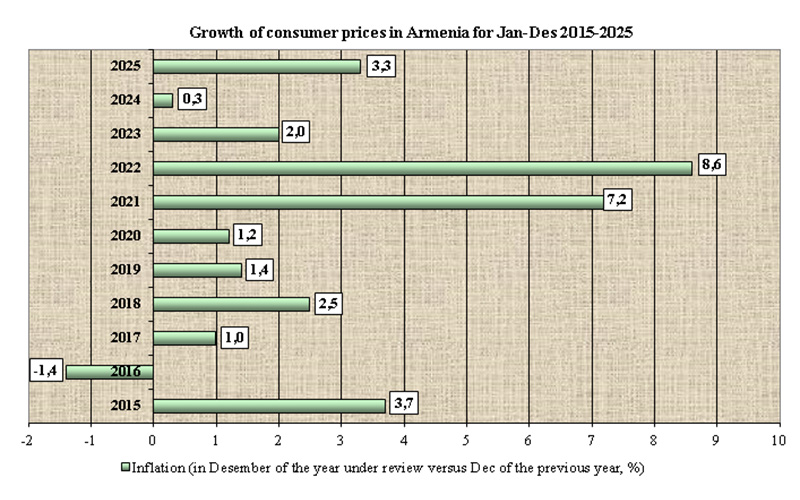
In the report, the ADB also forecasts that inflation in Armenia will accelerate to 4.2% in 2026 (from the actual 3.3% in 2025 and against the target of 3%+/-1 percentage point), after which it will decline to 3.5% in 2027.
Armenia’s economic growth slowed amid weaker demand. Strong performance in the construction sector, supported by public infrastructure and activity in the real estate market, as well as the recovery of industry, partly offset slower growth in services and a downturn in agriculture. The ADB left its forecasts for Armenia for 2026-2027 unchanged, but expects growth to be supported by domestic demand and the construction, services and tourism sectors.
On the supply side, industry and services became the main drivers of growth in Armenia. The recovery in industrial growth occurred amid a sharp acceleration in mining and quarrying, as well as a transition from contraction to growth in manufacturing. Double-digit growth in the construction sector remained устойчивым thanks to continued investment in infrastructure and residential construction. Some slowdown in services growth was caused by cooling in wholesale and retail trade, information technology and communications, financial and insurance activities, as well as professional services, outweighing growth in transportation and storage, tourism, and administrative and support services. The double-digit contraction in agriculture was driven by a decline in crop production.
On the demand side, total consumption became the main driver of growth. The slowdown in domestic demand reduced the pace of private consumption growth, but government consumption growth nevertheless accelerated to double-digit rates, reflecting increased budget allocations for pensions and higher healthcare spending following the introduction of universal health insurance in January 2026. Growth in total investment slowed sharply from double-digit rates to near stagnation, as growth in gross fixed capital formation was largely offset by a more than 50% reduction in inventories.
Import restrictions introduced by Russia and regional trade disruptions caused by the conflict in the Middle East will constrain economic growth. Nevertheless, domestic demand, the expansion of the construction and services sectors, tourism growth and continued investment in fixed capital should support performance during the forecast period, prompting the ADB to leave its forecasts for Armenia’s economic growth in 2026 and 2027 unchanged.
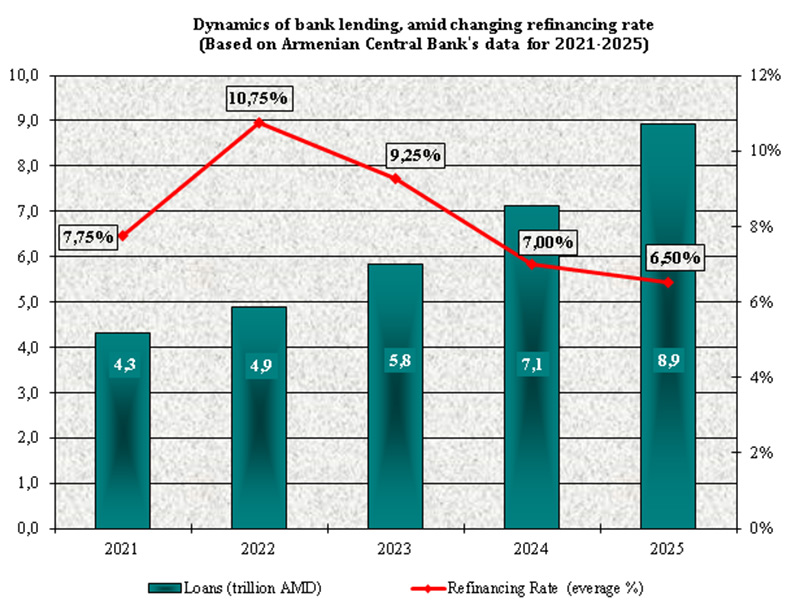
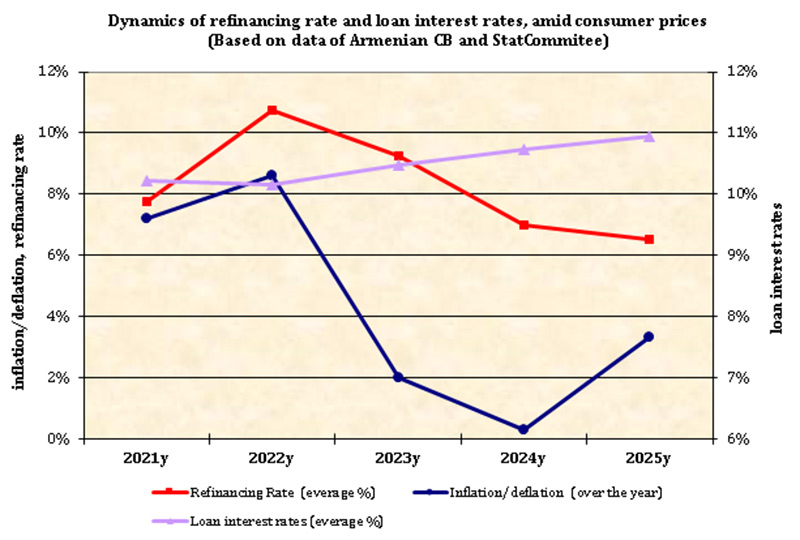
Accelerating inflation in Armenia reflects rising global food and commodity prices, as well as disruptions along regional trade routes. Annual inflation in July 2026 amounted to 4.5%, exceeding the target range of 2-4% (the target is 3%, +/- 1 percentage point). Despite rising inflation, the Central Bank kept the refinancing rate at 6.5% for 8 months of 2026 (it was already raised to 6.75% on September 15 - Ed.) to support economic growth. The ADB notes that, since inflation dynamics during these months were generally in line with expectations, inflation forecasts for 2026 and 2027 also remained unchanged.
Fiscal policy benefited from economic growth and spending restraint. Budget revenues grew at double-digit rates, as continued economic expansion contributed to increased tax receipts. Current spending grew more modestly, mainly due to higher payments for pensions, social benefits and healthcare, which partly offset a double-digit decline in capital expenditure. Significantly higher revenues and lower-than-planned capital spending resulted in a budget surplus. Accordingly, the budget deficit for all of 2026 is now projected to be below the initially expected 4.5% of GDP.
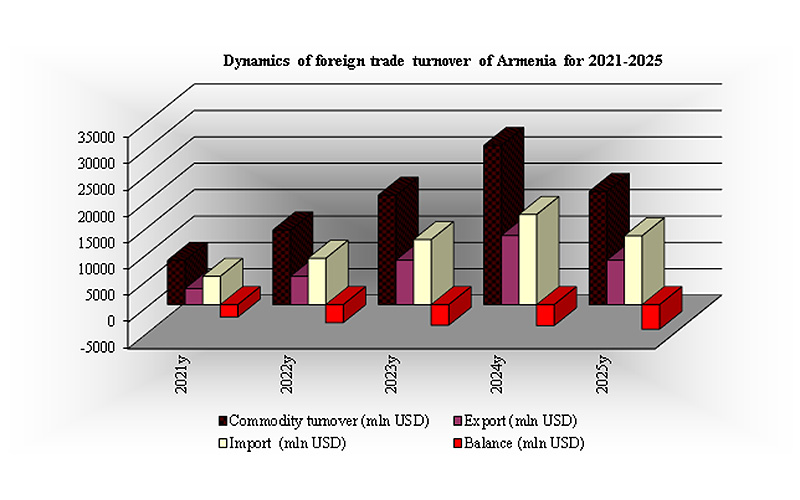
The current account deficit narrowed. Growth in the negative balance of primary and secondary income more than offset the increase in the surplus in services and transfers. The merchandise trade deficit in nominal terms remained virtually unchanged, although its share of GDP declined, as exports grew faster than imports. Russia’s restrictions on imports and regional trade disruptions caused by the conflict in the Middle East will limit export growth through the end of the year. Nevertheless, increased exports of services, particularly in transportation, information and communication technologies (ICT), and tourism, will partly offset the widening merchandise trade deficit during the remainder of the year.
Inflation in Armenia’s neighboring countries will be much higher
According to the ADB’s forecast for 2026, inflation in Armenia’s neighboring countries will be much higher: in Azerbaijan, it will accelerate to 5.9% (from 5.6% in 2025), in Georgia to 5.2% (from 3.9% in 2025), while in Turkey it will decline to 31.5% (from 35.2% in 2025). Then, in 2027, inflation in these countries will decline: to 5% in Azerbaijan, 3.3% in Georgia, and 23.5% in Turkey. At the same time, these countries’ economies will continue to grow in 2026-2027, specifically in Azerbaijan with a barely noticeable acceleration, first to 1.6% (from 1.4% in 2025) and then to 1.8%; in Georgia, with growth slowing to 6.3% (from 7.5% in 2025) and then to 5.2%; and in Turkey, to 2.8% (from 3.7% in 2025), followed by an almost full recovery to 3.6%.
Overall, in the Caucasus and Central and West Asia region (Armenia, Georgia, Azerbaijan, Kazakhstan, Kyrgyzstan, Tajikistan, Turkmenistan, Uzbekistan and Turkey), the ADB forecasts that economic growth will slow in 2026 to 3.7% (from 4.6% in 2025), followed by an acceleration to 4.1% in 2027, while inflation is expected to decline to 23.1% in 2026 (from 25.6% in 2025) and then to 17.6% in 2027.
Inflation in Kazakhstan and Kyrgyzstan will reach double digits
Among the EAEU countries, the report provides forecasts for Kazakhstan and Kyrgyzstan, where GDP growth is expected to slow in 2026-2027 to 4.8-4.5% and 8.9-8.4%, respectively (from 6.5% and 11.1% in 2025). Inflation in Kazakhstan will decline to 10.4% in 2026 (from 11.4% in 2025) and continue moving downward to 9.5% in 2027, while in Kyrgyzstan it will initially rise to 11.2% in 2026 (from 8.2% in 2025), but then retreat to 8.5% in 2027. Moreover, the economic growth expected by the Asian Development Bank in Kyrgyzstan during these years will be the highest (as before) in the Caucasus and Central and West Asia region, while Turkey will continue to have the highest inflation.
Economic growth will slow in the US and the Eurozone, while inflation will move upward
In the US, according to the ADB’s forecast, economic growth will remain at 2.1% in 2026, but then slow to 2% in 2027, while inflation will initially rise to 3.4% (from 2.6% in 2025) and then retreat to 2.4%. In the Eurozone, economic growth will slow to 0.8% in 2026 (from 1.4% in 2025), but then accelerate to 1.2% in 2027, while inflation will initially rise to 3% (from 2.1% in 2025) and then retreat slightly to 2.5%.
Empirical evidence on the scale and consequences of El Nino’s impact is mixed
Under the baseline scenario, which assumes prolonged energy supply disruptions and a very strong El Nino event, the price of Brent crude oil is forecast by the ADB to reach $90/barrel in 2026, but then decline to $78/barrel in 2027 and subsequently to $78/barrel in 2028. However, empirical evidence on the scale and consequences of El Nino’s impact is mixed. The extent and pace of energy market normalization over the forecast horizon are also highly uncertain and depend primarily, though not entirely, on developments in the conflict in the Middle East and Russia’s war in Ukraine.
According to forecasts, El Nino will intensify during the second half of 2026 and could become one of the most powerful events on record. Since its peak is expected around November, policymakers have a small but important window to take precautionary measures before the scale of its consequences in the region begins to increase.
Risks remain tilted to the downside
Further escalation of conflicts or more severe-than-expected consequences of El Nino could hamper growth and push inflation higher. According to the scenarios in the report, most of these consequences will materialize in 2027. Tighter financial conditions, a sharp repricing of artificial intelligence (AI) companies’ valuations, and renewed uncertainty in trade policy are increasing downside risks. On the positive side (potential growth factors), faster normalization of energy markets or a milder-than-forecast impact from El Nino could improve the economic outlook.
The intensification of El Nino is exacerbating pressure on energy and food prices, particularly in countries dependent on imports of fuel and agricultural products. El Nino conditions are expected to intensify toward the end of 2026 and persist in 2027. Energy and weather shocks reinforce each other through several channels. Higher prices for crude oil and petroleum products increase transportation and production costs and the cost of fertilizers, while extreme heat and insufficient rainfall threaten agricultural production volumes. At the same time, rising temperatures increase electricity consumption for cooling, while lower precipitation reduces hydropower generation, increasing demand for fuel and liquefied natural gas.
External conditions remain challenging, with heightened geopolitical tensions and a very strong El Nino event weighing on the region’s prospects. Forecasts for Brent crude oil prices have been revised upward amid the renewed conflict in the Middle East and the escalation of Russia’s war in Ukraine. Adverse weather conditions associated with El Nino are expected to exacerbate the delayed effects of higher fertilizer prices, intensifying food inflation across the region. On the positive side, sustained global demand for AI-related products is expected to support economic growth in a number of Asia-Pacific countries.
Escalating conflicts and extreme weather shocks threaten the economic outlook
Escalating conflicts and extreme weather shocks pose the greatest threat to the economic outlook. Further intensification of conflicts in the Middle East and Ukraine could worsen disruptions to global supplies of energy and other commodities. A stronger-than-expected El Nino event could further constrain food supplies. New increases in tariffs and heightened uncertainty in trade policy could also negatively affect economic activity in the region.
An additional downside risk is associated with a sharp repricing of the valuations of companies linked to artificial intelligence (AI). If expectations regarding the productivity and profitability of the AI sector weaken, a sharp market correction could lead to further tightening of financial conditions and deterioration in companies’ balance sheets, lower investment and declining investor confidence. On the positive side, faster normalization of conditions in energy markets and a less severe impact from El Nino could ease supply-chain disruptions and reduce inflationary pressure.
It should be noted that, according to the updated September forecast of the CBA, GDP growth in 2026 will amount to 5.7-5.3%, with a slight change in the pace in 2027 to 5.2%, while inflation in 2026 is expected in the range of 4.5-4.2%, declining to 3.4-2.7% in 2027. The International Monetary Fund, updating its forecast in June, did not change its expectations for Armenia’s GDP growth, forecasting a slowdown to 5.3% in 2026 and a barely noticeable acceleration to 5.5% in 2027. The World Bank (WB), in its July forecast, also maintained its expectations for Armenia’s GDP growth in 2026 and 2027, forecasting a slowdown to 5.3% and 5.1%, respectively. The European Bank for Reconstruction and Development (EBRD), updating its forecast in early June, expects Armenia’s GDP to grow by the same 5.5% in 2026 and 2027. S&P Global Ratings, in its forecast updated in August of this year, announced a slowdown in Armenia’s GDP growth to 4.9% in 2026, with a barely noticeable acceleration to 5.1% in 2027. Fitch Ratings, in its forecast updated in July of this year, expects Armenia’s economic growth to slow to 5.2% in 2026, with growth stabilizing at around 5% over the medium term. Moody's rating agency announced in July of this year a forecast according to which Armenia’s real GDP growth in 2026 and 2027 will amount to 5-5.5%. Armenia’s 2026 state budget draft provides for GDP growth of 5.4%, to 11.9 trillion drams (over $32.2 billion).
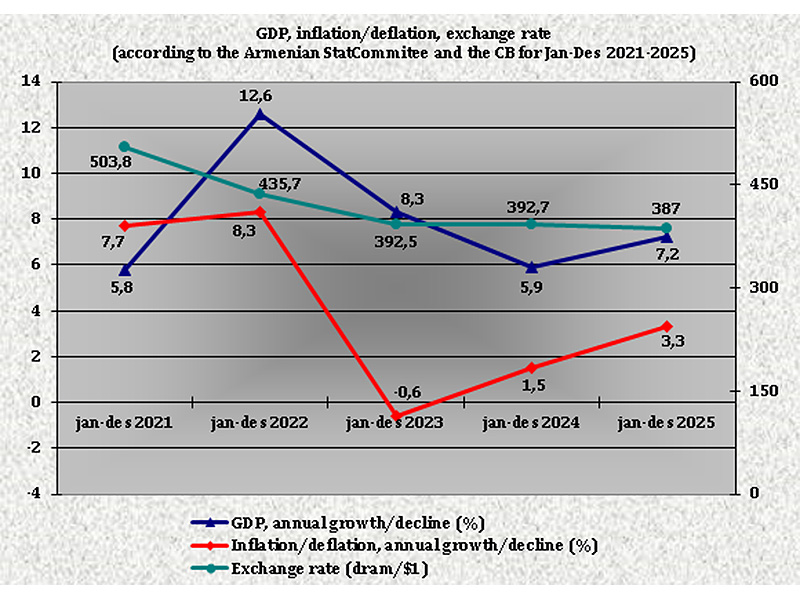
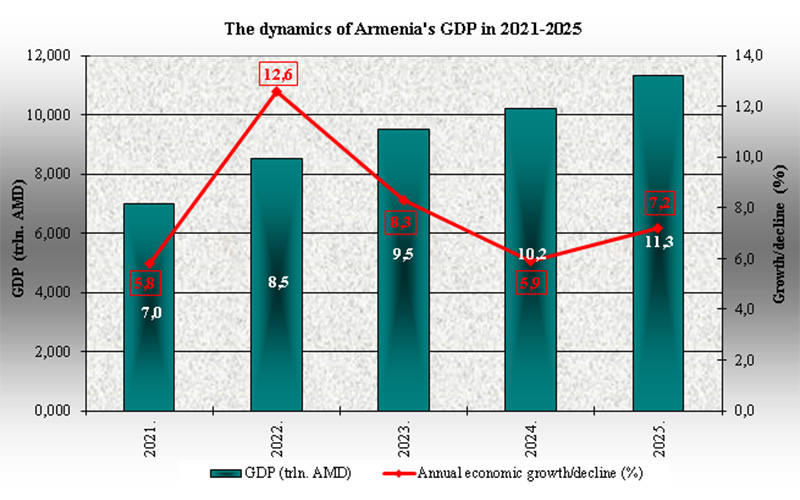
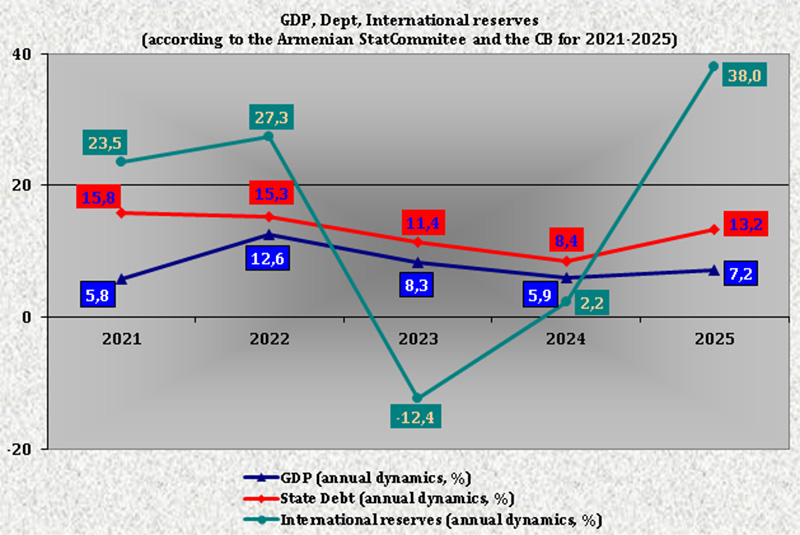
According to data from the Statistical Committee of the Republic of Armenia, after accelerating from 5.8% to 12.6% in 2022, Armenia’s GDP growth slowed to 8.3% in 2023 and then to 5.9% in 2024, after which growth accelerated to 7.1% in 2025, reaching 11.343 trillion drams in absolute terms (over $29.3 billion). The GDP deflator, after rising from 106.9% to 108% in 2022, also began to decline, reaching 103.1% in 2023 and 101.9% in 2024, before rising to 103.4% in 2025.