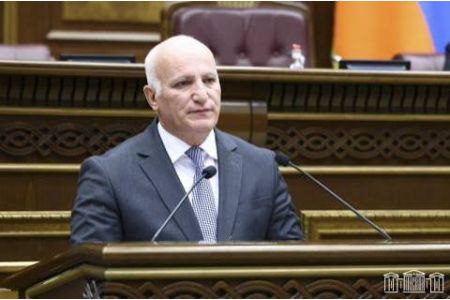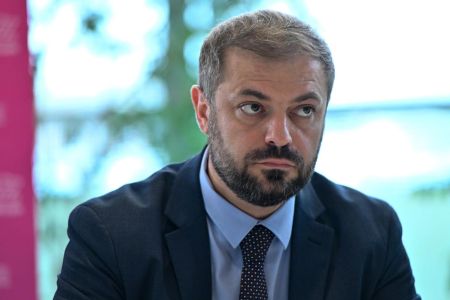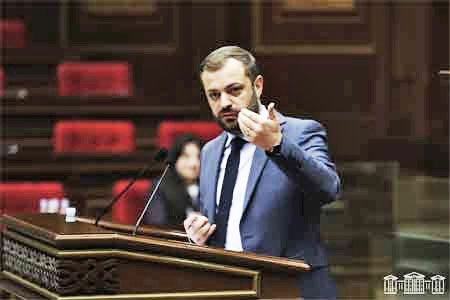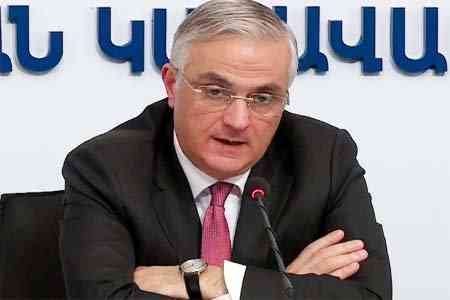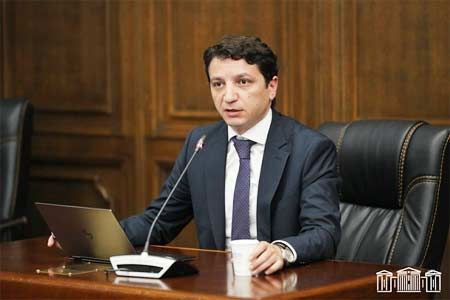


ArmInfo. It was Samvel Karapetyan's personal influence that allowed Electric Networks of Armenia (ENA) CJSC to attract loans; otherwise, no one would lend to the company. This was stated by David Kazinyan, a member of parliament from the Strong Armenia opposition faction, at a press conference in Yerevan on November 6.
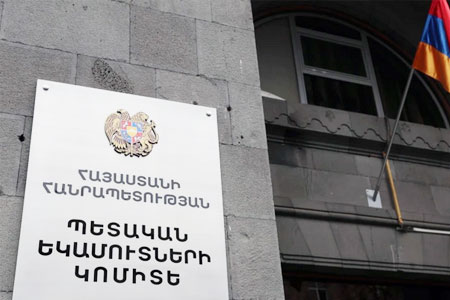
Commenting on Ashot Zhamkochyan, Head of the Main Department for the Investigation of Economic Crimes and Smuggling of the Investigative Committee of Armenia, who earlier aired on Public Television (PTA) that 6.5 billion drams were received but not used for investments, but were subsequently transferred to other organizations, Kazinyan explained that the loan agreements clearly state the intended purpose of the borrowed funds. "In particular, loans can be provided both for investments and for the repayment of accounts payable." "Dividends in the amount of 23.5 billion drams were received specifically for the purpose of paying off accounts payable," the MP noted. Kazinyan was particularly outraged by the classification of the owner's receipt of dividends as theft. "The fact is that we no longer have external investors. Now, apparently, they want to eliminate domestic investors. If we follow this logic, then ultimately any profit can be characterized as theft," Kazinyan stated.
The MP then drew attention to the issue of ESA lending and Samvel Karapetyan's personal guarantees. According to Kazinyan, beginning in 2015, Karapetyan and his companies acted as guarantors for every loan agreement—at least the international ones. "And it was precisely Samvel Karapetyan's personal factor that allowed ESA to attract credit funds, since otherwise no one would lend to the company. At that time, ESA was in dire financial straits, with a deficit of 36 billion drams. Consequently, the previous owners intended to raise electricity tariffs by 19 drams. It was then, at the request of the then-authorities, that Samvel Karapetyan took control of the company. "Imagine how many loans ESA was taking out, and yet Samvel Karapetyan acted as a guarantor even when he wasn't directly managing the company. "It turns out that Karapetyan's company was taking out loans for which he himself provided guarantees, and now he's being questioned about why he did this and why he didn't account for the corresponding obligations as unpaid amounts," Kazinyan noted.
Kazinyan also emphasized that the interest on ESA's loans was not paid from funds collected from the population through electricity tariffs, as the authorities claim. According to him, this is also supported by statements by Mesrop Mesropyan, Chairman of the Public Services Regulatory Commission (PSRC), who confirmed that, with the exception of loans provided with state guarantees, the interest on all other loans was paid by the company's owner.
"Since Karapetyan took over the PSA, not a single citizen has paid a single dram toward interest on the company's loans. Moreover, over the three-year period from 2023 to 2025 alone, the amount of interest repaid exceeded the amount of dividends received," Kazinyan noted.
He also stated that between 2016 and 2024, $650 million in investments were made in the PSA. According to the agreement, the company could attract 80% of the necessary loan funds under conditions whereby the owner would pay the interest on them, while the remaining 20% of the investment was to be made from the company's own funds. "However, no one is talking about this circumstance," Kazinyan noted.
The politician expressed his conviction that the events surrounding ENA represent an attempt by the authorities to influence public sentiment by playing on citizens' feelings and emotions. "This raises the question of why, if, in their opinion, ENA's management truly managed the company ineffectively, they still haven't achieved a reduction in electricity tariffs," Kazinyan asked.
As a reminder, the Armenian government initiated the nationalization of Karapetyan's company in July 2025, after the businessman publicly defended the Armenian Apostolic Church. Parliament later adopted amendments to laws providing for the return of ENA to state control. And on July 18, the head of the Public Services Regulatory Commission appointed Romanos Petrosyan as its interim manager. The latter, starting on July 24, began making the first personnel changes among the company's high-ranking officials, despite the decision of the Stockholm Arbitration Court not to change the composition of the company's governing bodies and refrain from actions aimed at expropriating the company. On March 3, 2026, the interim manager of ESA announced that the state was preparing for the full nationalization of the company's shares, recognizing it as a priority public interest and paying compensation to the owner, Tashir Capital. He specified that February 21 was the deadline for the government to make an offer, conduct negotiations, and as a result of the deal, 100% of the company's shares were to be transferred to the state. At the same time, the interim manager refused to name the specific value of ESA and the price offered by the government. Meanwhile, a member of the board of the Strong Armenia party, former CEO of ESA David Ghazinyan stated that the real value of ESA is is approaching $1 billion, and the company's owners will not agree to sell them at a reduced price.