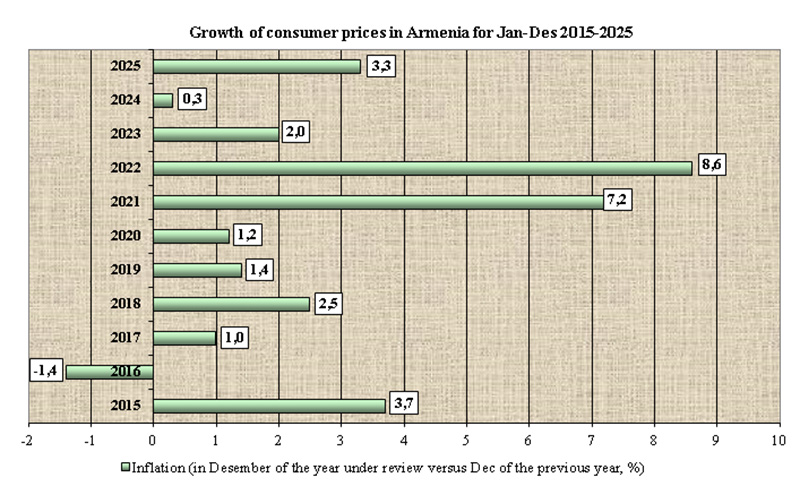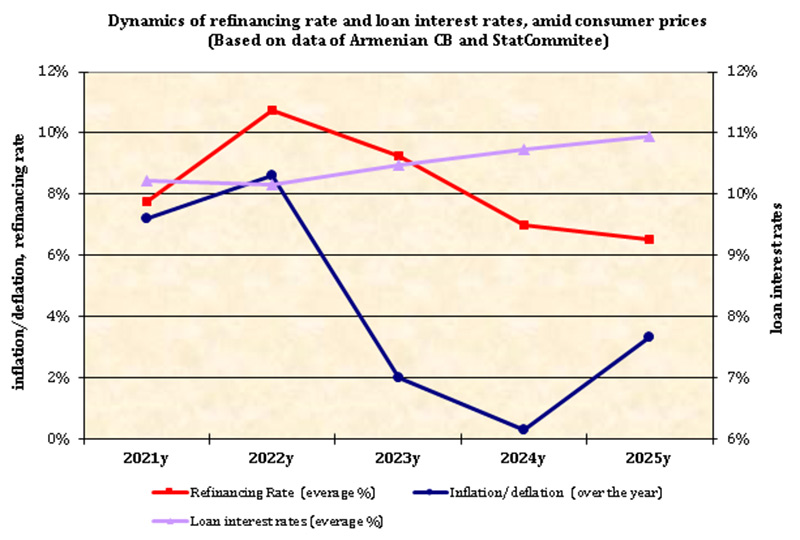


ArmInfo. In October 2026, compared to October 2025, inflation in the Armenian consumer market was 4.3% (compared to 3.7% a year ago), driven primarily by rising food prices and the continued rise in service prices.
Over the first 10 months of 2026, inflation stood at 2.4% (compared to last year's inflation of 1.4% for the same period), largely due to the continued rise in service prices and, in part, to rising non-food prices. According to the Statistical Committee of the Republic of Armenia, in October of this year alone, Inflation was recorded at 0.3% (the same as the same month a year earlier - 0.3%), driven by a more noticeable increase in non-food prices of 0.7% (versus 0.4% a year ago), while food prices rose by 0.2% (versus 0.7% a year ago) and service tariffs remained unchanged (versus a deflationary 0.3% in October 2025).
Over the 10 months of this year, Inflation was primarily driven by a continued 3.2% increase in service prices and accelerated growth in food and non-food prices – by 1.9% and 2.2%, respectively. A year earlier, low inflation was recorded over the 10 months, amid a nearly identical 3.1% increase in service prices and an imperceptible increase in food and non-food prices of 0.7% and 0.3%, respectively.
Inflation was recorded at 4.5% in January-October 2026 compared to the same period in 2025, compared to 3.3% in the previous year. Moreover, food prices increased by 7.1%, services prices increased by 2.7%, and non-food goods prices increased by 1.9%, while a year earlier, food prices increased by 5.3%, services prices increased by 3%, and non-food goods prices decreased by 0.1%.
In October 2026 compared to October 2025, inflation of 4.3% resulted from a more noticeable increase in food prices by 5.9%, which accelerated to 2.8% in non-food prices, and a 3.2% increase in service tariffs, while a year earlier, in October 2025 compared to October 2024, lower inflation of 3.7% was recorded, provoked by a 5.7% increase in food prices and a 2.9% increase in services prices with a less noticeable Non-food prices increased by 0.9%.
Of the food products, the most significant year-on-year price increases (October 2026 vs. October 2025) were: beef (22.2%), eggs (19.4%), spelt (dzavar) (13.5%), cocoa (12%), lamb (11.1%), buckwheat (8.9%), fruit (6.8%), cheese (6.2%), chocolate (5.5%), pasta (5.4%), poultry (5.3%), granulated sugar (5.1%), vegetables (5%), sunflower oil (4.3%), tea (4%), and sour cream (3.6%). The prices of milk increased much more modestly - by 2.9%, coffee - by 2.5%, bread - by 2.3%, cottage cheese - by 2.2%, peas - by 1.3% and flour - by 0.8%. Among food products, trout prices fell by 22.2%, butter by 5.3%, rice by 3.4%, beans and lentils by 2.4-2.3%, and pork by 1.5%.
Of fruit, apples increased significantly year-on-year in price: by 29.1%, bananas by 23.7%, tangerines by 12.8%, pomegranates by 9.9%, grapes by 7.9%, and pears by 6.9%. Only strawberries fell in price: by 25.2%, oranges by 13.6%, and peaches by 11.8%. Among vegetables, the most significant price increases were for cabbage (up 80.8%), greens and onions (up 13.1%), peppers (up 11.4%), potatoes (up 9.6%), onions (up 8.4%), beets (up 5.1%), eggplants (up 4.8%), and mushrooms.
- by 4.1%, while prices for cauliflower and broccoli (up 37.2%) and garlic (up 17.6%) fell, while tomatoes (up 13.8%), green beans (up 9.5%), cucumbers (up 8%), and carrots (up 5.4%) fell.
Cigarette prices increased by 6.9% year-on-year, compared to an 8.3% increase the previous year. Among alcoholic beverages, vodka has increased in price most significantly year-on-year - by 11.2%, while beer and wine have increased in price more modestly - by 4.8% and 1.1%, respectively. Last year, beer and wine increased in price almost equally - by 3.2% and 3%, while vodka increased in price less noticeably - by 5.3%. Bottled mineral water has increased in price year-on-year by 3.5% (against 3.8% growth a year ago). In the non-food market, the annual growth in prices for footwear accelerated - from 1.2% to 2.2% and for disposable household goods - from 1.1% to 4.4%. Clothing began to rise in price - by 5.3% (against a decrease of 2.1% a year ago) and furniture - by 1.8% (against a decrease of 0.1% a year ago). The annual price growth for jewelry slowed from 34.6% to 8.7%, medical equipment from 4.3% to 1.4%, and large household appliances from 2.5% to 0.3%. At the same time, the annual decline in prices for gardening tools accelerated from 6.1% to 15%, and medications also fell in price by 0.9% (compared to last year's 4%).
Gasoline and diesel fuel increased in price year-on-year (October 2026 compared to October 2025) by 17.3% and 37.3%, respectively, while a year ago, gasoline and diesel fuel prices fell by 1.5% and 0.6%, respectively. Liquid hydrocarbons (butane, propane, etc.) increased in price by 52.4% annually.
As for services, significant annual rate increases were recorded in the comprehensive leisure services sector – by 12.5% (versus 10.6% a year ago) and in the hotel industry – by 12.3% (versus 1.6% a year ago). Rates for compulsory motor third-party liability insurance slowed significantly – from 12% to 1.9%. Prices for medical services grew more slowly, by 6.1% (versus 7.1% the year before), while hairdressing and spa services grew by 3.8% (versus 11.2% the year before).
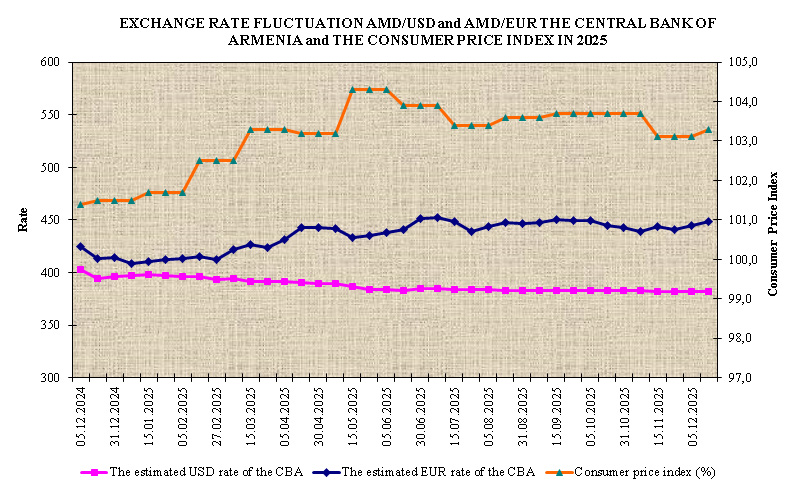
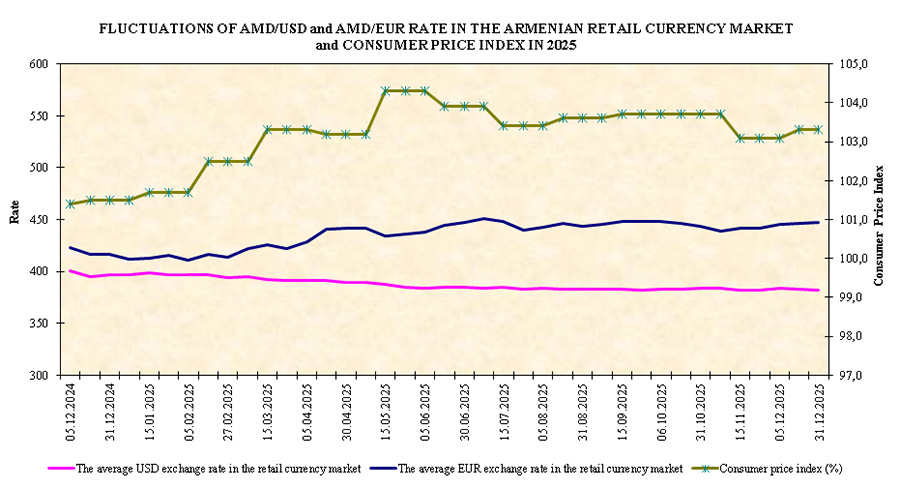
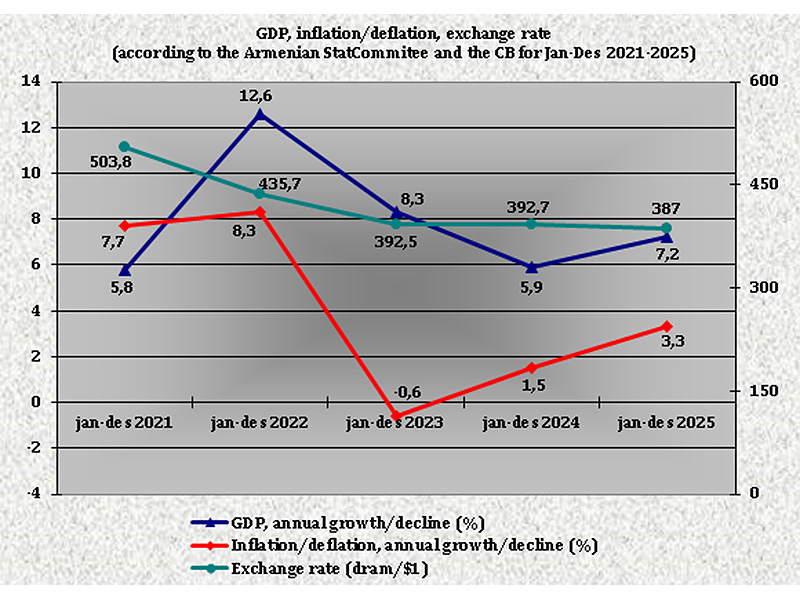
October's annual inflation of 4.3% was accompanied by a 5.5% appreciation of the dram against the dollar, which was more moderate compared to the previous year's 3.7% inflation and 1.2% appreciation. Specifically, the dram strengthened in October 2026 to 361.6 drams per dollar, from 382.7 drams per dollar in October 2025.
It should be noted that starting in 2025, the inflation target is set at 3% with an acceptable range of +/- 1 percentage point. (versus the previous 4%, +/- 1.5 percentage points).