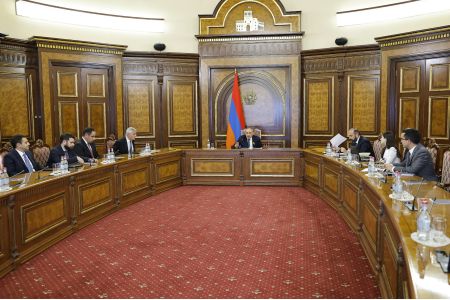



ArmInfo.The Armenian government approved the draft law "On Investments" at its 19th session.
As stated by Armenian Deputy Minister of Economy Lilia Sirakanyan, investment policy is currently implemented based on outdated and partially implemented legal acts, in particular the Law "On Foreign Investments," adopted in 1994, which does not fully regulate the investment process in line with modern requirements. The current system also fails to guarantee predictability, proportionality of incentives, transparency, and stability of investment regimes.
One of the most important aspects of the proposed draft, Sirakanyan emphasized, is that the new regulations will apply not only to foreign but also to domestic investments. "Thus, the draft establishes guarantees that preclude discrimination, with two key components-national treatment and most-favored- nation treatment," the Deputy Minister explained. As stated in the explanatory note to the document, the adoption of the draft law will create a clear and predictable legal environment for investment, which will allow Armenia to enhance its international investment rating, competitiveness, and investment attractiveness, as well as promote sustainable and inclusive economic growth.
Therefore, the draft law: 1. Defines investment guarantees and investor protection, taking into account modern internationally recognized standards. Specifically, the draft law defines: a guarantee of non- discrimination with its two well-known components: national treatment (NT) and most favored nation (MFN); and a guarantee of protection from expropriation.
The draft also defines the concept of indirect expropriation, which is expressly prohibited, and sets forth criteria that must be met for direct expropriation to occur. Taking into account the specifics of financial markets/organizations, the provisions of this guarantee also propose for the first time that the regime for the nationalization of financial organizations within the framework of rehabilitation procedures is determined by law; guarantees of legal and physical protection, transparency, and stability of the legal framework for investments. In this regard, for example, the draft stipulates that investments enjoying guarantees established by law will continue to be protected by guarantees established by law, regardless of changes in the scope of the guarantees or their cancellation, for five years after such change or cancellation; guarantees such as:
- free movement and transfer of capital and property, ownership rights and other property rights to land, guarantees of employment, dispute resolution mechanisms, etc.; - types of investment incentives (benefits), their purpose, essence, legal basis, and application mechanisms;
The draft law also defines the institutional framework for investment activity: the powers of the Government of the Republic of Armenia in this area (the necessary enabling regulations), the powers of the authorized body, and lays the foundation for the legal status of the Investment Promotion Center.
It is noted that the draft was developed taking into account the provisions of international investment agreements, the best practices of the investment law of the United Nations Conference on Trade and Development (UNCTAD), and the recommendations of international financial organizations.
According to data from the Statistical Committee of the Republic of Armenia, expressed as a net flow, meaning the difference between attracted and repaid foreign investment, the net flow of total foreign investment into the real sector of the Armenian economy decreased in 2024 to a negative $285.6 million (113.3 billion drams) from a positive $479.3 million (194.3 billion drams), or a 2.6-fold year-on-year decrease. The net flow of foreign direct investment (FDI) also fell by 2.2 times over the year, from a positive $624.1 million (253 billion drams) to a negative $112.9 million (44.8 billion drams).