

ArmInfo. The relocation of a 5.5-kilometer section of the gas pipeline on the Armenian-Georgian border is not just a technical route adjustment, but a reflection of a deeper problem. Political scientist and Doctor of Political Sciences Vahe Davtyan told ArmInfo.
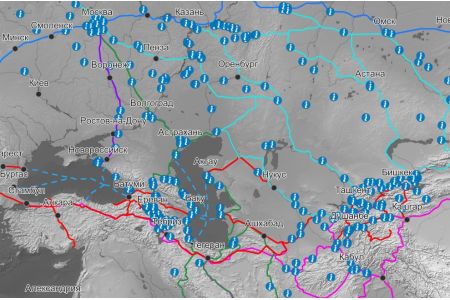
According to him, the reason is that the section of the pipeline at the junction of the borders of Armenia, Georgia, and Azerbaijan was mined back in the 1990s. As a result, part of the pipeline is effectively out of normal operation: neither repairs, nor full monitoring, nor a guaranteed response in the event of an accident are possible. The new 5,548-meter section will be removed from the danger zone. The Georgian side is constructing its part, and the Armenian side is constructing its own, with a subsequent connection. The route is critically important for Armenia, which receives its bulk of gas through Georgia-approximately 2.3 billion cubic meters per year. This refers to the basic route: Vladikavkaz-Tbilisi, which connects to the Kazakh-Saguramo gas pipeline and then to the 12-kilometer-long, 1,020-mm-diameter Red Bridge-Sevkar- Berd branch. It is at this final point in this chain that a vulnerability arises.
"Moreover, the situation is complicated by an important factor. As a result of the so-called demarcation, the main gas pipeline through which Armenia receives Russian gas through Georgia is under serious attack. We are talking about the aforementioned Red Bridge-Sevkar-Berd gas pipeline, part of which is actually under the control of the enemy. Hence, perhaps, the decision to restructure the logistics. That is, a combination of several problems arises: physical vulnerability (minefield), operational vulnerability (inability to service), geopolitical vulnerability (the factor of control over sections of the pipeline). At the same time, statements are being made about new energy projects. The possibilities of restoring regional energy ties and building new pipelines are being discussed. A simple question arises: if the existing route, providing 2.3 billion cubic meters of gas per year, contains sections with limited access and disputed control, how stable is the basis for expanding such projects? And one more thing. The initiative for the transfer comes from the Armenian side. This means that the infrastructure is adapting to risks, and not The very sources of these risks are being eliminated. You must agree that such a picture doesn't quite fit with Yerevan's rhetoric about the peace achieved," Vahe Davtyan noted.
As a reminder, a report was previously received stating that, at Armenia's request, a 5.5-kilometer section of the gas pipeline connecting Georgia and Armenia will be relocated. A corresponding application has already been submitted to the Environmental Supervision Department of the Ministry of Natural Resources of Georgia. According to the documentation, the change in the pipeline's location is related to the request of the Armenian side, since the Armenian section of the pipeline is located in the trilateral Georgian- Armenian-Azerbaijani border zone and was mined in the 1990s. "Based on the fact that it is impossible to comply with minimum safety standards and carry out repair work on this section, it was decided, on the basis of a trilateral interstate agreement, to remove the aforementioned problematic section of the gas pipeline from the mined area and build a new gas pipeline at a safe distance," the justification for the relocation states. The pipeline will be moved several kilometers and connected to the new section built by the Armenian side.