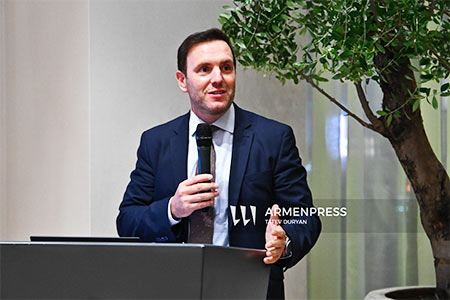



ArmInfo. Armenia's banking system is well capitalized and liquid, with a strong ability to withstand shocks and absorb the resulting losses. This assessment was given by Central Bank of Armenia Chairman Martin Galstyan on May 25 during a press conference marking the publication of the "Financial Stability 2025" report.
The macro-stress testing of the banking system has demonstrated that even in a very negative scenario, banks are capable of absorbing shock losses while maintaining the uninterrupted performance of their financial intermediation role. Over the three-year period, potential losses are estimated at 2% of total assets, or 185 billion drams, against the 175 billion drams stipulated by the CBC buffer.
He also noted that in 2025, as in previous years, Armenia's financial sector operated in challenging geopolitical and economic conditions and high uncertainty, which was reflected in the Central Bank of Armenia's macroprudential decisions: countercyclical capital buffer - 1.75%; capital conservation buffer - 2.5%; LTV for mortgage loans - the requirement-to-collateral value ratio - 90% for dram loans and 70% for foreign currency loans; systemic importance buffer - 1.5%.
The capital adequacy of the banking system amounted to 21.7% by the end of 2025, short-term liquidity (coverage ratio for all currencies) - LCR was 231.6%, and long-term liquidity (coverage ratio for currencies of the 1st group) - NSFR was 289.6%, and these indicators significantly exceed the required minimum levels. The profitability of the banking system at the end of 2025 is estimated to be quite high: ROA amounted to 3.4%, and ROE - 21.3%. Banking system assets continue to dominate the country's financial system, accounting for approximately 82%, with an absolute value increase of 15.1% in 2025 (an average of 13.8% over the past 5 years) - to almost 12 trillion drams. Pension funds hold second place by assets at 9.3%, with a more pronounced annual growth of 34.2% (31.6% on average over the five years).
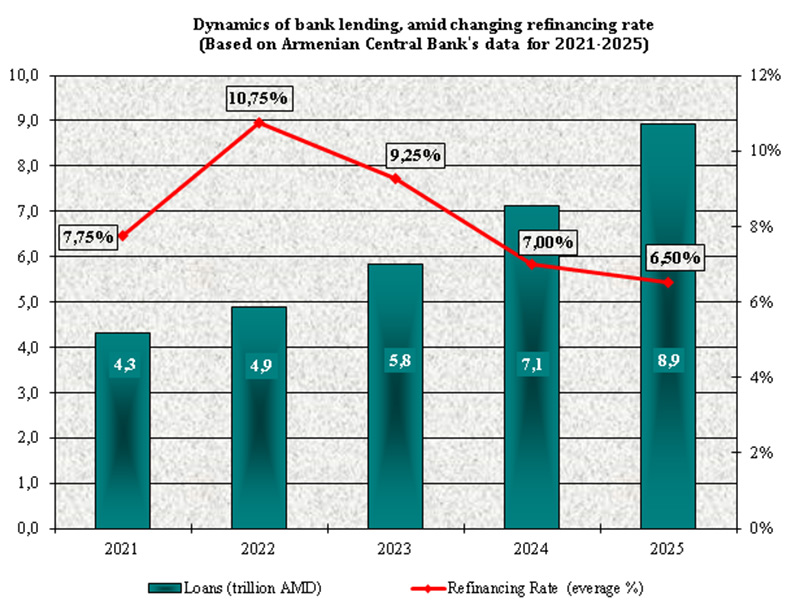
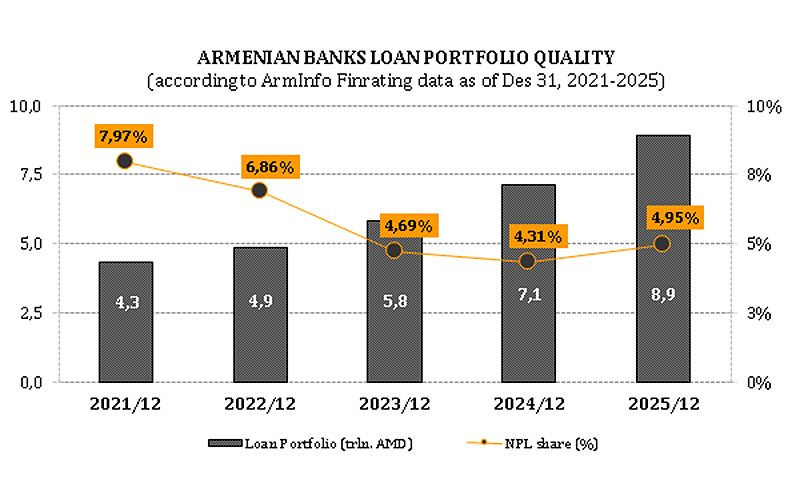
In 2025, bank lending increased by 22.5%, while deposits grew by 13.3%. This difference in growth rates indicates that the economy's demand for loans was also met by capital, which is an expensive resource, with approximately 500 billion drams being allocated for lending. High growth rates were recorded for both corporate and retail lending – 20.3% versus 25%, indicating high rates of economic income growth and coverage across all sectors, including consumer loans.
He noted that mortgage lending growth is slowing, but the number of new loans issued remains high. "We have repeatedly discussed the risks in the real estate market, but as we see, their materialization is proceeding too slowly and more manageably than expected, which can be seen as a positive development," Galstyan noted. He added that in 2025, the real estate market saw a certain stabilization of demand and a trend toward slowing price growth. Rental prices have increased, which could negatively impact attractiveness, potentially reducing the investment appeal of real estate to some extent.
Along with lending activity, there has also been an increase in financial intermediation. According to him, along with the growth of retail lending, the debt burden of individual borrowers has also increased. At the same time, loan repayment terms have been extended, which, while reducing the debt burden, increases the uncertainty of problem-free loan servicing. "In this context, given the risk factor emanating from global uncertainty, the Central Bank emphasizes the importance of banks' balanced approach to assessing credit risks. We are concerned about the fact that loans are growing faster than income. In particular, it is important to properly assess the borrower's debt burden and its ability to repay obligations on time, taking into account not only current macroeconomic risks but also the risks implied by a negative scenario," he emphasized.
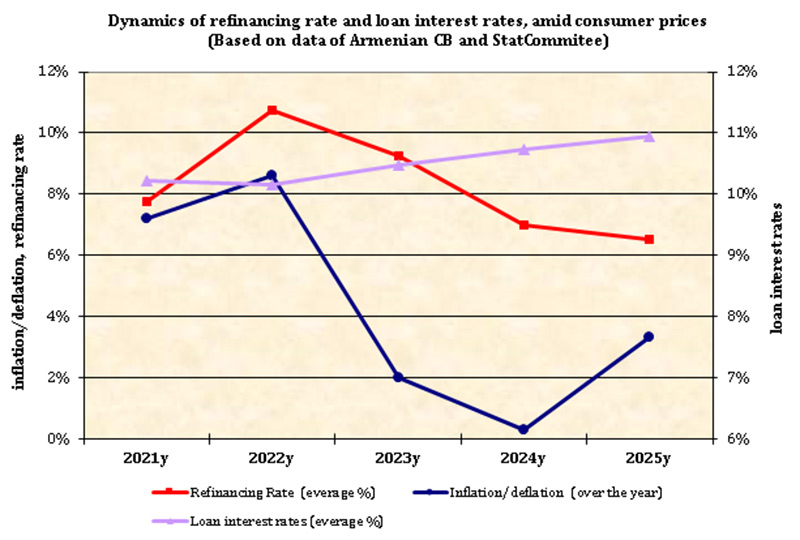
Galstyan identified two key risks to financial stability, one -driven by external factors and the other -by internal developments. The main risks stem from the high uncertainty of global politics and the economy. As early as 2026, the conflict in the Middle East caused a negative demand shock in the global economy, leading to a sharp rise in energy prices, high volatility in financial markets, and higher yields on government bonds. Under these conditions, the risks of a deterioration in the global economy and inflation have further increased, as they are highly dependent on the timing and further scale of the escalation of this conflict. "There are estimates that even if this conflict ends today, we will live for at least several months in a world where its effects will still be felt," Galstyan noted.
Regarding internal risks, he believes that the accumulation of credit risks resulting from increased lending to the economy requires the greatest attention. In particular, high growth in construction and consumer lending could lead to an increase in the debt burden in these segments and signal the accumulation of credit risk.
In conclusion, he stated that the expected negative scenario for macro-stress testing envisions the following shock consequences: a decline in GDP, pressure on the exchange rate, rising interest rates, and inflationary pressure. The initial shock will be the materialization of risks emanating from geopolitical uncertainty and trade and economic tensions, leading to a decline in external and domestic demand, increased inflation expectations, and higher energy prices. The main impact of these shocks is expected to be felt in 2026- 2027, but will then gradually subside.