

ArmInfo. International instability, specifically US military actions against Iran and their negative impact on international trade, has not affected Armenia's financial stability, but risks always exist. This opinion was expressed in an interview with an ArmInfo correspondent by the Deputy Minister of Finance of the Republic of Armenia, Avag Avanesyan, on the sidelines of the international conference "25 Years of Excellence, Growth, and Global Integration," dedicated to the 25th anniversary of the Armenia Securities Exchange (AMX).
In the context of the fact that foreign institutional investors currently hold over 10% of the country's domestic debt (Government Bonds), as recently stated by the Governor of the Central Bank of Armenia, and to what extent the country can allow this share to increase, Avanesyan noted that in any case, it would be reasonable to limit their volumes. "Our main risk is that when institutional players arrive and face international instability, some panic may begin, creating instability in the market. Yes, despite the war in Iran—and this is very important—they did not leave, and the market growth trend driven by institutional investors continued. Our 'peace policy' helped us here: we did not get involved in the conflicts in any way, and this allowed investors to view us as a 'safe haven'."
Avanesyan noted that the Middle East crisis only indirectly affected Armenia through rising prices, but the players did not leave. Moreover, during this time, they increased their share of investments in Armenia's government bonds from 10% to 10.3%. "I think there is still room for growth. But here, we must understand that when we talk about the free movement of capital, it is not just our wishful thinking—it happens on its own. For us, as a small country, the arrival of players ready to invest in our securities should be viewed positively. The only negative aspect is that in the event of specific shocks, in our turbulent times, we might face problems."
Speaking about the attitude of institutional players toward the stability of the Armenian dram as the currency of domestic debt securities, Avanesyan emphasized that the hedging market is not yet developed. This applies to both bondholders and exporters. However, the lack of development is rather due to the fact that the Armenian dram is showing stability and is even strengthening. "For now, the impression is that the dram is highly trusted, given its stable history in recent years, and investors are already considering it as a hedging tool—an instrument with relatively high yields and stable behavior," Avanesyan emphasized.
Moreover, according to him, anchor investors of Armenian Eurobonds are begging the government to issue these securities in Armenian drams, which the government refuses to do. "But there is absolutely no need for this, because it would create an additional debt burden. However, the fact itself is interesting—there is an increased demand for our national currency on foreign markets," Avanesyan said.
According to the Deputy Minister, Armenia's debt securities market has become noticeably more active since the beginning of the conflict in Ukraine. The closure of the Russian market has shifted the diversification of investment portfolios toward the post-Soviet space, including Armenia, and players are trying to operate here. This is also evident from the Eurobond market, where demand has increased. "There is room for financing additional projects. But again, we are somewhat conservative. We are moving within the general diversification strategy for anchor Eurobond investors, but we are not yet actively working with 'investment boutiques.' We see their increased interest; they invest in our securities, then exit, then return again, conducting 'reconnaissance by fire.' This means they are testing how well the system works and how smoothly the free movement of capital is established in the country. This is very important because, again, it will take a long time before they stop perceiving us as a 'controlled post-communist space.' Therefore, the durability test is ongoing," the Deputy Minister emphasized.
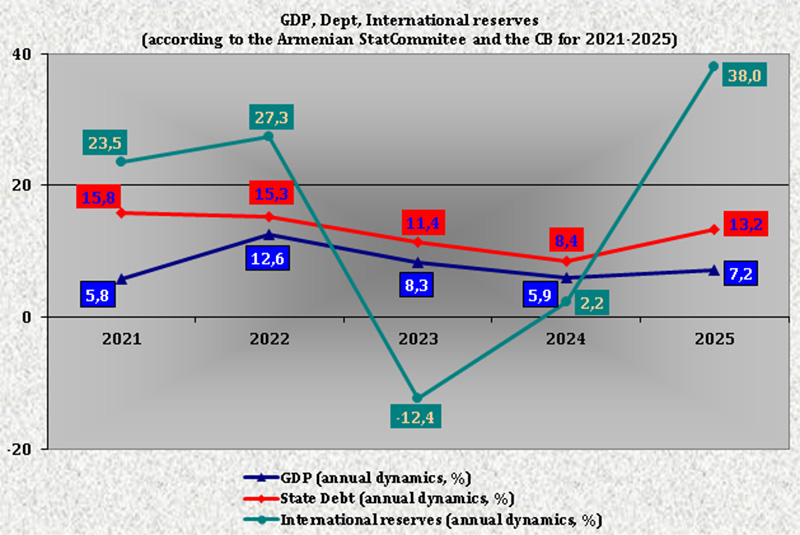
It is worth noting that according to official statistics, as of April 1, 2026, Armenia's public debt exceeded $14.7 billion. The external debt amounted to $7.2 billion (2.7 trillion drams), while the domestic debt stood at $7.5 billion (over 2.8 trillion drams). At the same time, throughout its history, Armenia has executed 5 tranches of sovereign Eurobonds totaling $3.1 billion. As of 2026, taking into account redemptions and partial buybacks, the total volume of Eurobonds in active circulation stands at $2 billion.