


ArmInfo. Armenia's dominant export category—mineral products—has significantly increased in volume, while its primary import category—machinery and equipment—has broken out of stagnation to post moderate growth, according to data provided by the Statistical Committee of the Republic of Armenia for January–April 2026.
Precious metals/stones, prepared foodstuffs, and machinery and equipment occupy the second, third, and fourth positions in exports, respectively. In imports, the corresponding positions are held by mineral products, land/air/water vehicles, and prepared foodstuffs. In total, the combined share of these four categories accounts for 77.4% ($1.8 billion) of exports and 55.5% ($2.2 billion) of imports. Notably, precious metals/stones continue to contract substantially in both exports and imports; they lost the top spot in imports last year to machinery and equipment, and have now also ceded their leadership position in exports to mineral products.
During the reporting period, mineral raw materials were exported for $585.7 million (25.2% of the total), precious metals and stones for $456.9 million (19.6%), finished food products for $389.99 million (16.8%), and machinery and mechanisms for $369.3 million (16%). Machinery and mechanisms imported totaled $960.7 million (24.1%), mineral raw materials $466.7 million (11.7%), land/air/water transport $446.3 million (11.2%), and finished food products $343.6 million (8.6%). Precious metals and stones fell to fifth place in imports at $318.9 million (less than 8%).
Let's look at the year-over-year dynamics of these goods in both export and import. Specifically, mineral raw material exports recovered from the decline to a significant 90.3% growth rate, while import growth accelerated to 18.8%. Finished food products saw an even faster growth rate in imports, reaching 45.5%, while export growth slowed to 7.3%. Machinery and equipment recovered from stagnation in imports by 18.8%, while accelerating the decline in exports to 8.8%. Precious metals and stones declined significantly in both exports and imports, ranging from 44.8% to 57.5%. Imports of land/air/water transport increased by 19.8% year-on-year, but a significant slowdown was noted. A significantly smaller volume of these exports recovered from the decline to double-digit growth of 21.4%.
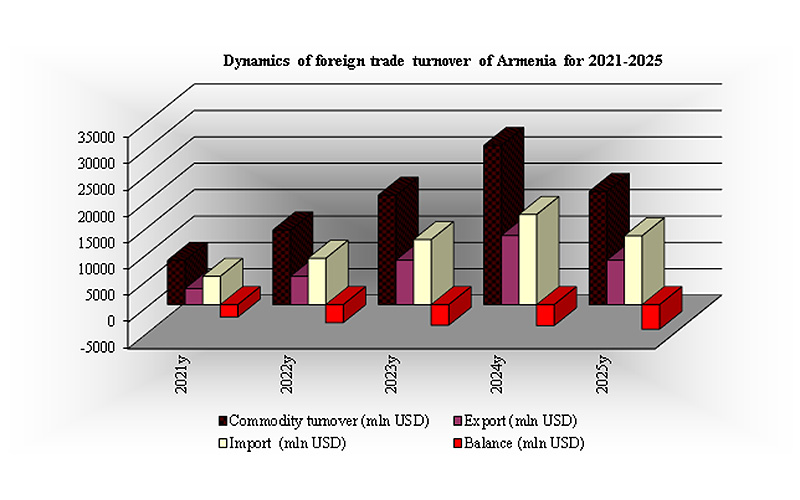
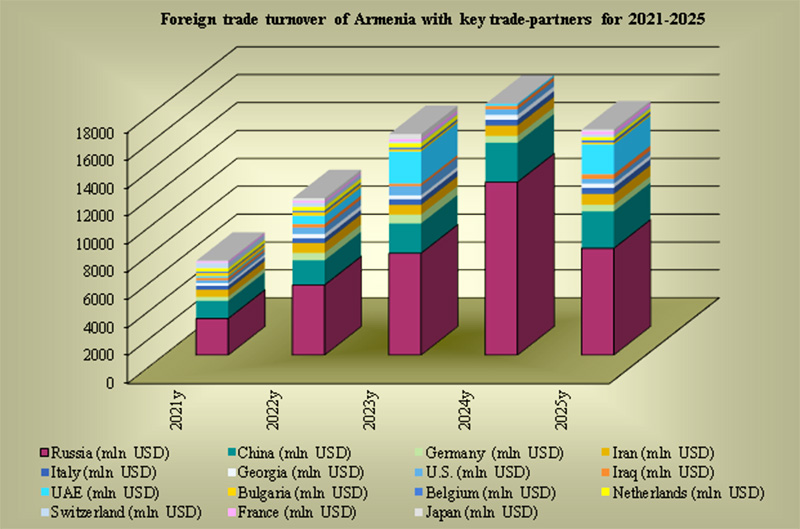
According to statistics, total exports in January-April 2026 exceeded $2.3 billion, while imports amounted to $3.99 billion. Exports remained in decline, but with an annual growth rate slowing from 60.4% to 3.3%, while imports recovered from a 46.5% decline to 2.5% growth. By country, exports and imports to the EAEU decreased by 4.7-29.3%, while increasing significantly to the EU by 97.3-28%. Moreover, exports to most EU countries increased significantly, while imports also increased for some. Export and import growth during the reporting period was also recorded in Switzerland, Brazil, and the United Kingdom. To China, a significant increase in exports was accompanied by a decrease in imports, while to the United States, the opposite was observed—a significant increase in imports and a decrease in exports. Russia and China occupied the top two positions in both exports and imports. The UAE, Bulgaria, and Iraq were next in the top five for exports, while Iran, Germany, and the United States were the top five for imports.