


ArmInfo. The International Monetary Fund (IMF) has improved its forecast for Armenia's GDP growth in 2026 from the previous 5.3% to an updated 5.5% (against actual growth of 7.1% in 2025), now expecting growth rates to remain at 5.5% in 2027 (against the previously predicted acceleration to the same level). This is noted in the IMF's October report "World Economic Outlook. Resilience in a Tense Situation, Urgent Decisions."
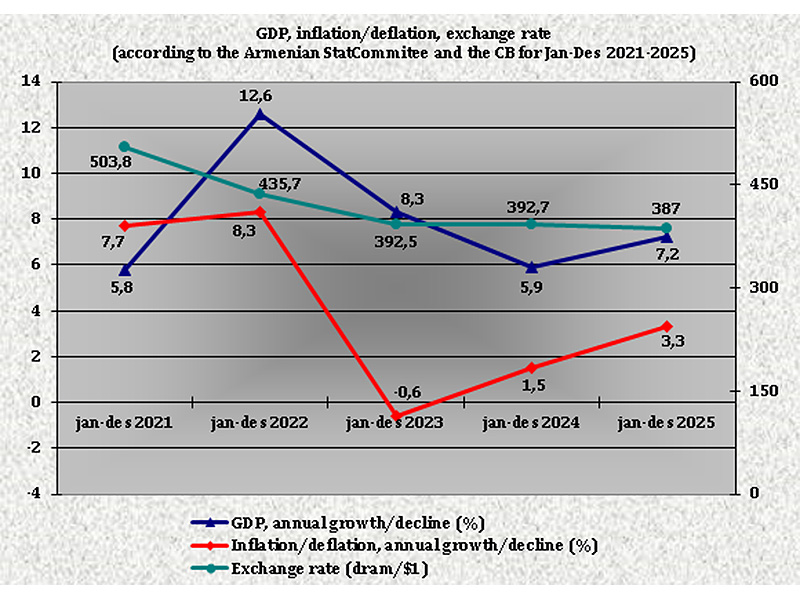
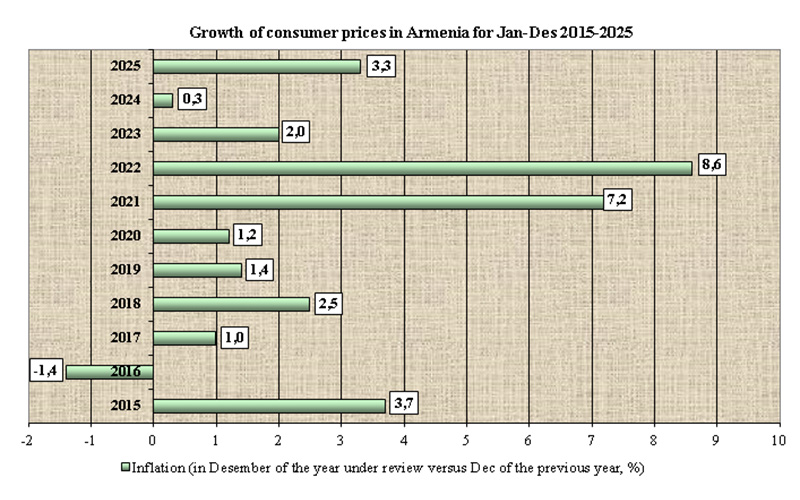
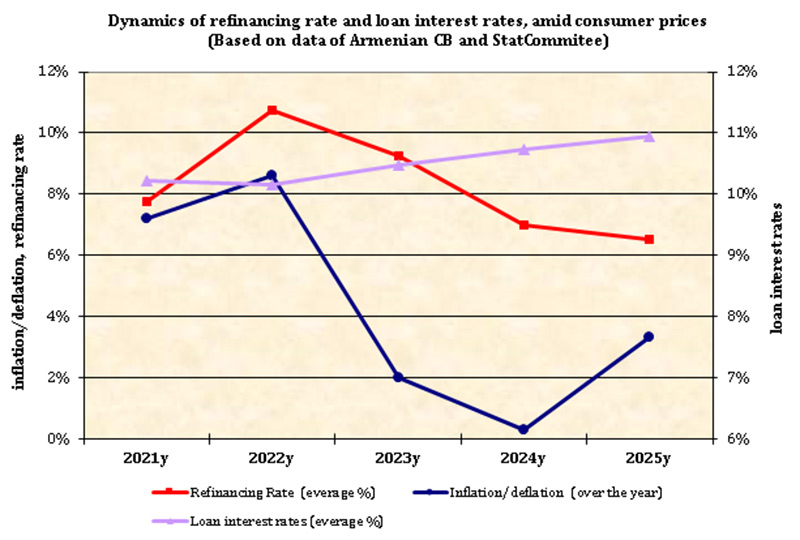
According to the new IMF forecast, inflation in Armenia will significantly exceed the target in 2026 and reach 4.6% (versus the previously expected 4.2% and the actual 3.3% in 2025), but will then retreat to 3.6% in 2027 (versus the target of 3%, +/- 1 percentage point).
At the same time, the IMF maintained its unemployment forecast in Armenia, expecting a decline in 2026 to 12.8% (from 13% in 2025) and further in 2027 to 12.7%.
According to the updated IMF forecast, the current account deficit to GDP ratio, after Growth in 2025 will increase from 4.6% to 8.7%, retreat slightly in 2026 to 8.2%, and then decline to 7.7% in 2027, compared to the previously expected more noticeable declines in 2026 and 2027 to 6.3% and 5.6%, respectively.
Among Armenia's neighboring countries, according to the new IMF forecast, higher GDP growth in 2026 is expected in Georgia - 7.2% (versus 7.5% in 2025), with a further slowdown in 2027 to 5.7%. Low GDP growth is expected in Azerbaijan - 1.7% in 2026 (versus 1.4% in 2025), with an acceleration in 2027 to 2.3%. In Turkey, GDP growth will slow to 2.7% in 2026 (from 3.7% in 2025), but will accelerate to 3.6% in 2027. In Iran, the economy will continue to contract, accelerating to 7.6% in 2026 (from 0.9% in 2025) and then slowing to 3.6% in 2027.
Inflation in Georgia will increase to 5.4% in 2026 (from 3.9% in 2025), but will decline to 3.6% in 2027. Georgia's current account deficit to GDP will increase to 3.5-3.7% in 2026-2027 (from 2.6% in 2025), while unemployment will remain at 13.9% over these years.
Inflation in Azerbaijan will increase to 5.8% in 2026 (from 5.6% in 2025), but will fall to its previous level of 5.6% in 2027. Azerbaijan's current account surplus to GDP will increase to 11.3% in 2026 (from 4.6% in 2025), but will decline to 9.8% in 2027. The unemployment rate in Azerbaijan will remain at 5.3% in 2026 and decrease slightly to 5.2% in 2027.
Inflation in Turkey will decline to 31.2% in 2026 (from 34.9% in 2025) and then continue to decline in 2027 to 26.5%. Turkey's current account deficit to GDP will increase to 2.9% in 2026 (from 1.9% in 2025) and only slightly decline to 2.4% in 2027, while unemployment will remain at 8.2-8.3% in 2026-2027 (versus 8.3% in 2025).
Inflation in Iran will jump to 78.6% in 2026 (from 50.6% in 2025), after which it will moderately decline to 42% in 2027. Iran's current account deficit to GDP will be 1.2% in 2026 (versus a 3.3% surplus in 2025), rising to a 1.2% surplus in 2027. Unemployment will rise to 9.2% in 2026 (from 7.5% in 2025), only to retreat slightly to 9% in 2027.
Policy Actions: Flexibility in the Face of Constraints. Policymakers face the same underlying drivers, but the implications for them differ. For most countries, the war in the Middle East acts primarily as a negative supply shock, raising costs while simultaneously undermining confidence. For some countries, however, it has turned into a positive terms-of-trade shock, raising real national income and generating additional fiscal revenue. While the AI-driven technological upswing is supporting investment, exports, and asset prices in economies linked to the global technology value chain, it is also increasing demand pressures, increasing concentrations, and increasing repricing risks in financial markets. Economies outside this chain may not see a short-term upswing in activity, while the potential for negative consequences from a potential market correction and the risk of lagging behind in the AI-driven global economy remain.
Fiscal Policy. Renewed focus on restoring fiscal space is urgent, given high debt levels, rising borrowing costs, mounting demands on government budgets, and heightened uncertainty. Any new spending increases or tax cuts must be well-financed to ensure the necessary fiscal adjustment trajectories. A credible medium-term consolidation should be based on clearly defined plans, including measures to secure sustainable revenues, strengthen tax administration, broaden the tax base, improve tax collection, and enhance spending efficiency, accompanied by significant upfront investments and underpinned by institutional improvements. The adjustment should be designed to protect growth- and equity-enhancing spending, such as investment in infrastructure and skills development, and targeted social protection. In highly indebted economies, the required adjustment may be larger than has generally been feasible in the past and may need to be complemented by deeper rationalization of spending through, among other things, a rethinking of the scope of public activity and the implementation of growth-enhancing structural reforms.
For countries with above-target inflation or elevated underlying inflation pressures, fiscal consolidation can curb demand and complement monetary policy efforts to maintain price stability. Prudent debt management and financial regulation would help reduce intertemporal borrowing costs, limit refinancing vulnerabilities, and reduce currency mismatches, thereby mitigating the risk of destabilizing feedback loops that could lead to fiscal dominance. Windfall revenues should be saved, used to rebuild buffers, or redirected to high-yield investments. Trust will be strongest where governments combine short-term discipline with reforms that enhance potential growth, and where medium-term fiscal frameworks are supported by independent institutions, transparent reporting, realistic macroeconomic assumptions, and contingency planning.
Restoring fiscal space will need to be balanced with mitigating the impact of current shocks on the most vulnerable segments of the population. Many countries have turned to fiscal instruments in response to the latest war that has rocked commodity markets, but they have not always followed the basic principles of ensuring the targeted and temporary nature of such fiscal measures. The room for maneuver is now more limited than during previous crises, as debt levels have risen, borrowing costs have increased, and demands on government budgets have increased exponentially.
Fiscal support measures should be used sparingly, designed so as not to complicate the task of monetary policy, and quickly phased out as the shock subsides. Large-scale fuel subsidies, universal tax breaks, and price controls should be avoided. These measures are typically poorly targeted, costly to the budget, create distortions in the economy, and are politically difficult to reverse once implemented. They also weaken the price signals that encourage energy conservation, fuel substitution, and energy efficiency investments. If support is needed to prevent severe hardship or social instability, it should be temporary, tightly targeted to vulnerable households, and delivered primarily through cash transfers or existing social safety nets.
Eligibility criteria, sunset clauses, and budgetary compensation should be defined in advance, especially in contexts of limited fiscal space. Aid should be limited to viable businesses facing temporary liquidity shortages due to high energy prices or supply disruptions. Where appropriate, government support should be transparent, subject to ex post evaluation, and consistent with medium-term fiscal objectives.
A key lesson from repeated shocks is that the capacity to provide targeted support cannot be built overnight. Countries should invest in national registries, digital payment systems, interoperable administrative data, and aid mechanisms that can be quickly scaled up in the event of shocks. Adopting early principles of emergency support—temporary nature, narrow targeting, maintaining price signals, transparent eligibility criteria, and identified funding sources—can help governments resist calls for broad-based measures.
Monetary and Financial Policy. Monetary policy (MP) should remain clearly aligned with central bank mandates, including maintaining or, if necessary, restoring price stability. The two forces shaping the global economy are having disparate inflationary impacts across countries. While energy disruptions have put upward pressure on inflation globally, the specific dynamics vary significantly between energy importers and exporters. Concurrently, AI-related activities are putting pressure on prices in a group of countries that are part of the technology value chain. Countries also differ in their starting conditions: in some, inflation was still above target at the onset of the conflict. Taken together, these factors lead to differences in monetary policy recommendations.
For energy importers, higher fuel prices pose a stagflationary challenge, simultaneously raising headline inflation and reducing output. Monetary policy may ignore direct and possibly short-term indirect effects, but only if the shock is temporary. Such an assessment can be made by distinguishing between price increases driven by geopolitical risk premiums and those driven by actual supply disruptions. Secondary effects, including any signs of de-anchoring of inflation expectations, should remain subdued. The likelihood of these conditions being met is low when inflation is already above target and broader price pressures are expected to remain elevated, justifying a tightening stance. Even when ignoring the shock is deemed appropriate, maintaining a constant real monetary policy rate over a given horizon may require raising nominal policy rates if expected inflation rises. In economies integrated into the technology value chain, the case for tightening monetary conditions becomes stronger regardless of their status as energy importers or exporters, with particular urgency required when inflation exceeds the target. In a changing economic environment, flexibility is especially valuable. Central banks should avoid overreacting to high-frequency fluctuations in headline inflation, especially when these movements are driven by volatile energy prices. However, they should respond if higher inflation begins to be factored into expectations or wage setting, or if technology-related activity begins to amplify the pass-through of headline price increases to core inflation.
Maintaining orderly adjustment and financial stability is vital as large shocks unfold. For countries with credible inflation targets or other domestic nominal anchors, exchange rate flexibility should generally remain the first line of defense, helping economies absorb external shocks, maintain relative price adjustments, and avoid costly reserve depletion. Such measures should not replace sound macroeconomic adjustment, should be transparent and temporary, and applied with due regard for reserve adequacy, institutional capacity, and multilateral spillovers. Supervisors should also strengthen their monitoring of sovereign-bank linkages, foreign exchange risks, non-bank financial institutions, and liquidity imbalances. The concentration of market capitalization and investor expectations around AI-related companies requires close attention to leverage, high exposure, collateral valuation, and cross-border risks. Capital, liquidity, and reserve buffers must remain adequate during normal times and be released in a timely and coordinated manner in the event of deteriorating financial conditions and the emergence of macro-financial feedback loops.
Structural and International Policies. Structural reforms can smooth out macroeconomic tradeoffs by enhancing the flexibility, resilience, and productive capacity of the economy while simultaneously increasing long-term growth potential. Priorities should include measures to enhance business dynamism: lowering barriers to entry and exit, promoting competition, reducing regulatory uncertainty and complexity, strengthening bankruptcy institutions, and facilitating labor mobility across firms and sectors. These reforms can help economies absorb changes in relative prices with less disruption to output and accelerate the reallocation of resources toward sectors benefiting from the introduction of new technologies. Energy security is another urgent priority. Accelerated deployment of renewable energy, modernization of the electricity grid, increased energy efficiency, and improved storage and interconnection infrastructure can reduce vulnerability to future commodity shocks while supporting climate goals.
Such reforms are particularly important for energy importers, but they are also important for economies benefiting from AI investments, as data centers and digital infrastructure require reliable and affordable electricity supplies. The benefits of AI and digitalization will be more widespread if they are supported by investments in human capital and infrastructure, as well as robust governance systems for data protection, cybersecurity, competition, and the responsible use of technology.
At the macroeconomic level, addressing domestic imbalances would contribute to a better global adjustment: China's continued rebalancing toward domestic consumption, credible fiscal consolidation in the US, and deeper integration of the single market, reforms, and investments in the EU would help reduce external imbalances, strengthen the structure of demand, and boost medium-term growth.
Commonly accepted international economic rules are essential for reducing uncertainty and limiting fragmentation. Trade policy frameworks characterized by clarity, transparency, predictability, and mutual benefit are essential for ensuring more sustainable growth and international economic integration. Trade measures implemented to address cross-border spillovers should be strictly targeted. A pragmatic approach to cooperation is needed to protect key global public goods, as well as to update international rules to reflect structural shifts (such as the growing role of services) and align them with policies that promote employment growth and supply chain resilience. In a world shaped simultaneously by geopolitical shocks and rapid technological change, cooperative mechanisms that make adaptation less costly and more resilient remain critical—particularly for managing the spillover effects of commodity market pressures, refugee flows, and debt vulnerabilities.
It should be noted that, according to the Central Bank of Armenia's updated forecast in September, GDP growth in 2026 will be in the range of 5.7-5.3%, with a slight change to 5.2% in 2027. The Central Bank forecasts inflation in the range of 4.5-4.2% for 2026 and 3.4-2.7% for 2027. Moreover, according to the Central Bank's new forecast, inflation in the non-tradable goods segment, characterized by rigid prices, will increase to 3.8-3.7% in 2026 (from 2.2% in 2025), with a slight decline in 2027 to 4.7-3.5%.
In its July forecast, the World Bank (WB) also maintained its expectations for Armenia's GDP growth in 2026 and 2027, predicting a slowdown to 5.3% and 5.1%, respectively. The European Bank for Reconstruction and Development (EBRD), updating its forecast in early June, expects the same 5.5% GDP growth for Armenia in 2026 and 2027. S&P Global Ratings, in its August update, In its forecast, Fitch Ratings announced a slowdown in Armenia's GDP growth in 2026 to 4.9%, with an imperceptible acceleration in 2027 to 5.1%. In its forecast updated in July of this year, Fitch Ratings expects Armenia's economic growth to slow to 5.2% in 2026, with stabilization in the medium term at around 5%. In July of this year, Moody's Ratings Agency announced a forecast according to which Armenia's real GDP growth in 2026 and 2027 will amount to 5-5.5%. In its September forecast, the Asian Development Bank (ADB) predicted 5% GDP growth for Armenia in 2026, with an acceleration in 2027 to 5.5%, while expecting inflation to initially accelerate to 4.2% and then decline to 3.5%. Armenia's draft state budget for 2026 projects GDP growth of 5.4%, reaching 11.9 trillion drams (over $32.2 billion).
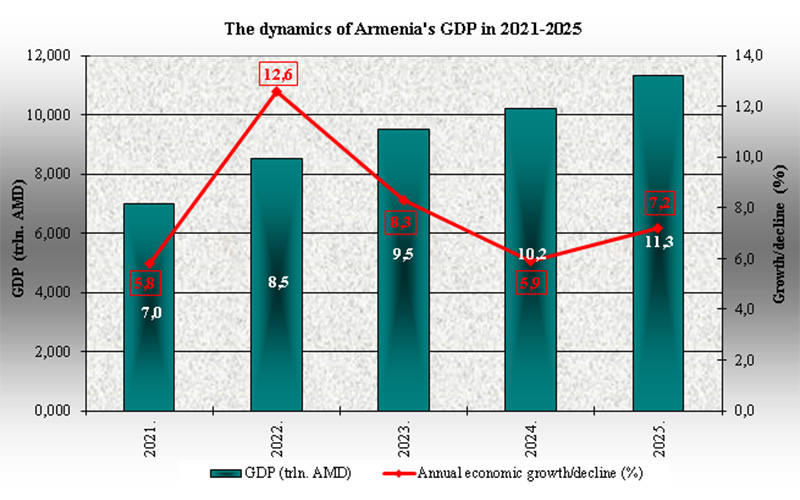
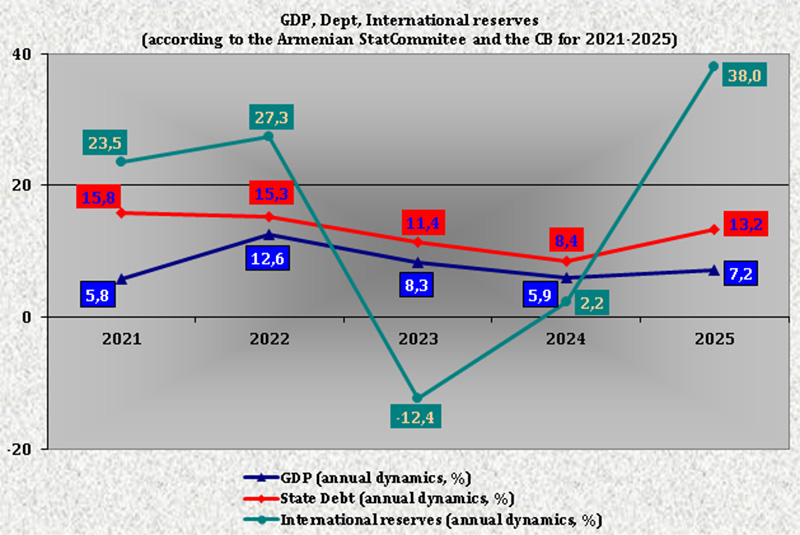
According to the RA Statistics Committee, Armenia's GDP growth, after accelerating in 2022 from 5.8% to 12.6%, began to slow in 2023 to 8.3% and then to 5.9% in 2024. Growth then accelerated to 7.1% in 2025, reaching 11.343 trillion drams (over $29.3 billion) in absolute terms. The GDP deflator index also, after growing in 2022 from 106.9% to 108%, began to decline to 103.1% in 2023 and to 101.9% in 2024, then rising to 103.4% in 2025.