

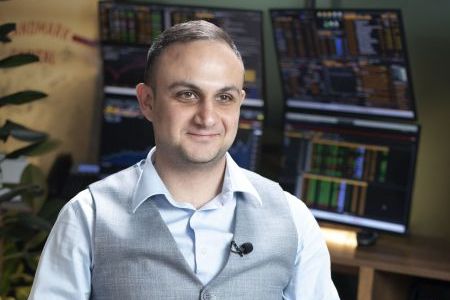
... says Hayk Khekoyan, Head of Investments and Products at the investment company “Landmark Capital”
The Armenian dram has shown high resilience in recent years. What is today the main fundamental factor behind this resilience, and can the dram be considered one of the factors that make Armenian assets attractive?
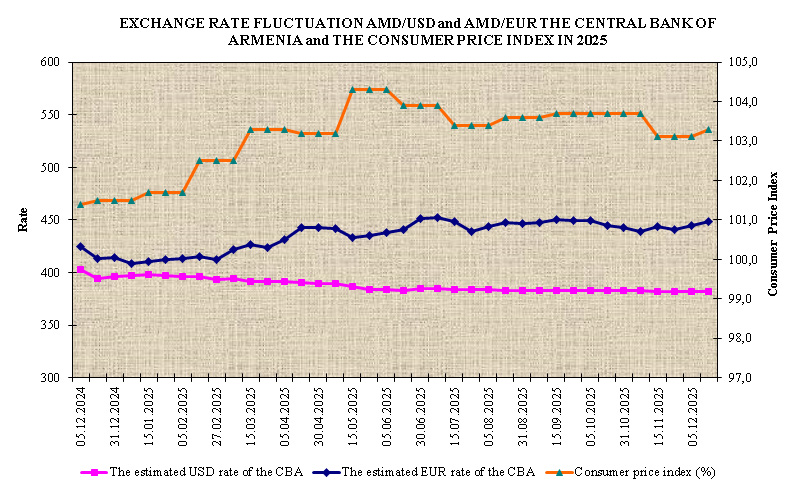
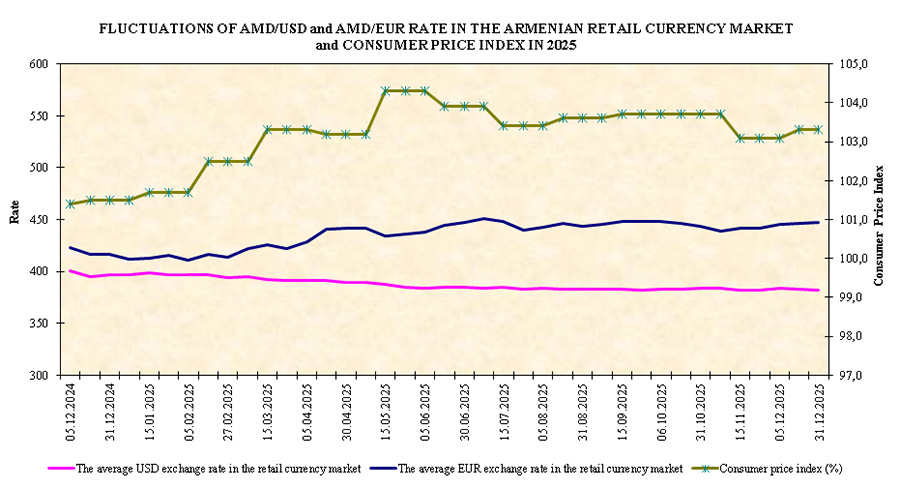
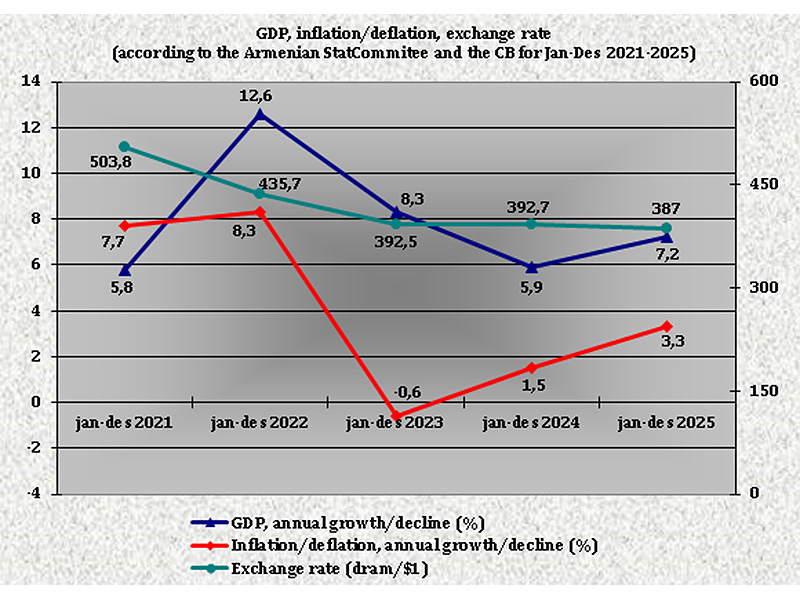
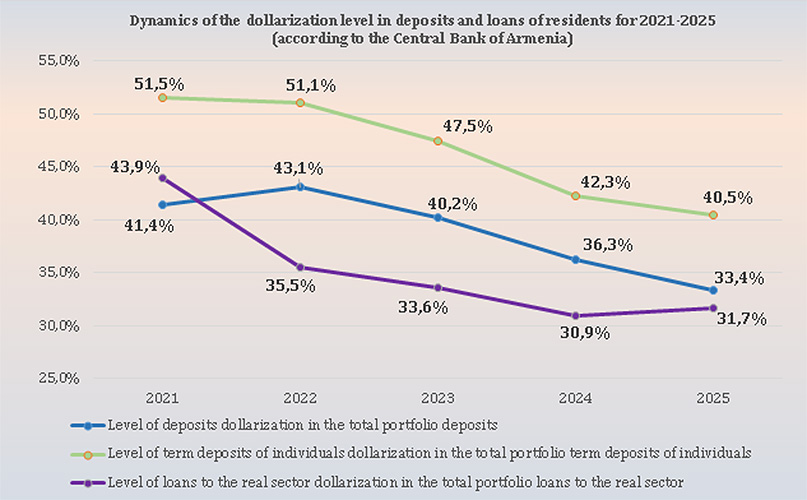
For emerging markets, the stability of the national currency is one of the main arguments in favor of investing, and the dram looks impressive here. Over the past five years it is one of the best currencies in its dynamics against the dollar, if not the best, and since the early 2000s it has remained one of the most stable. We recently compared it both with its closest analogues, such as the Kazakh tenge and the Georgian lari, and with the major world currencies only the Swiss franc has outperformed the dram.
Of course, like the currency of any developing country, the dram is also exposed to risks. Since 2000 there have been two significant depreciations of the dram: during the global financial crisis in 2009 and in 2014 against the backdrop of geopolitical events. And even in those cases there the currency experienced a relatively moderate depreciation without lasting negative consequences. And the latest external shocks worked in the opposite direction. In 2022 the dram strengthened sharply amid the Russia-Ukraine conflict, and at the beginning of this year, when the conflict in the Middle East broke out, the strengthening of the dram repeated and continues to this day.
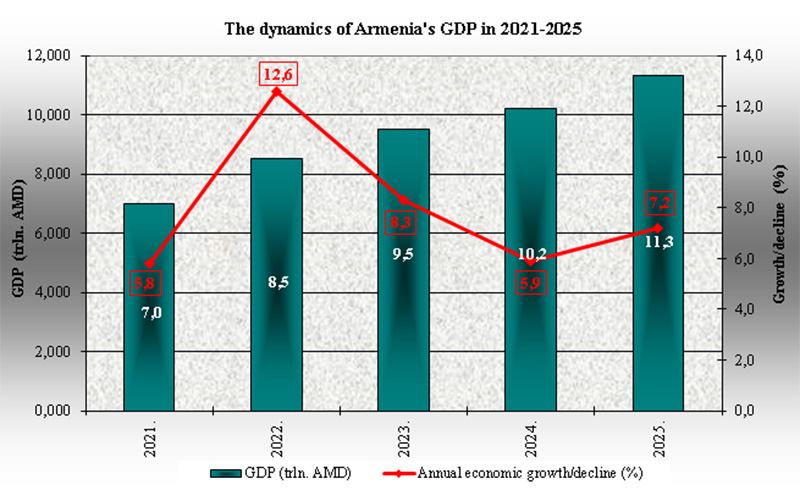
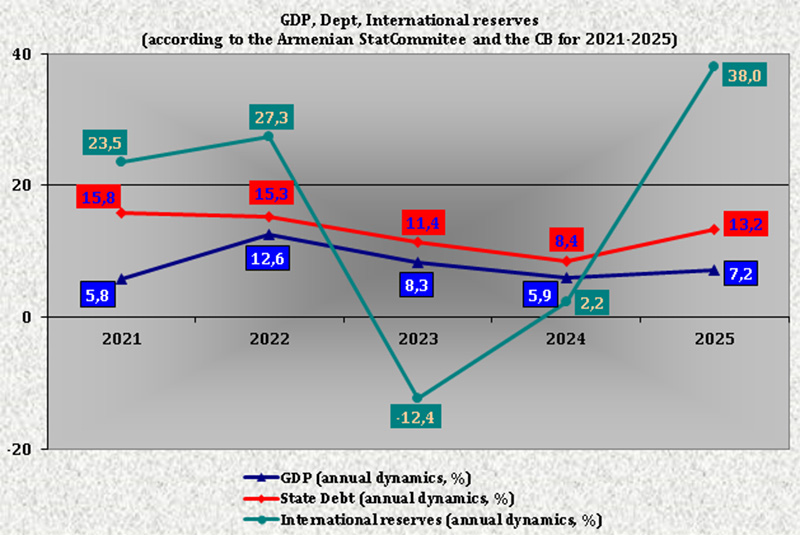
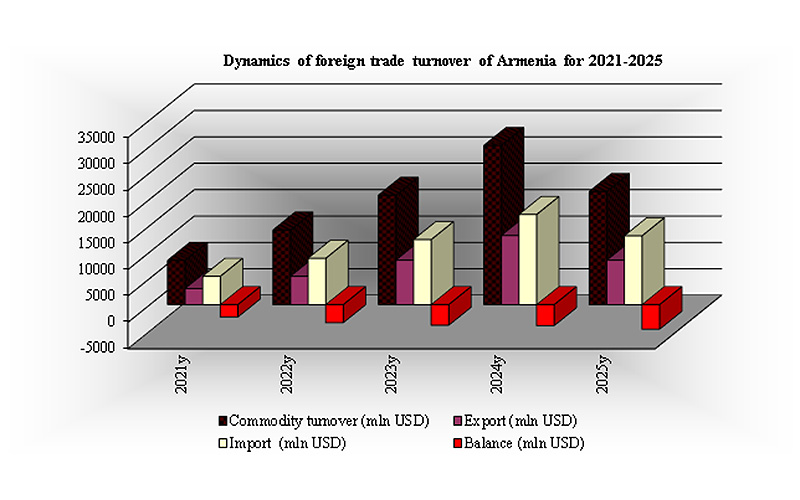
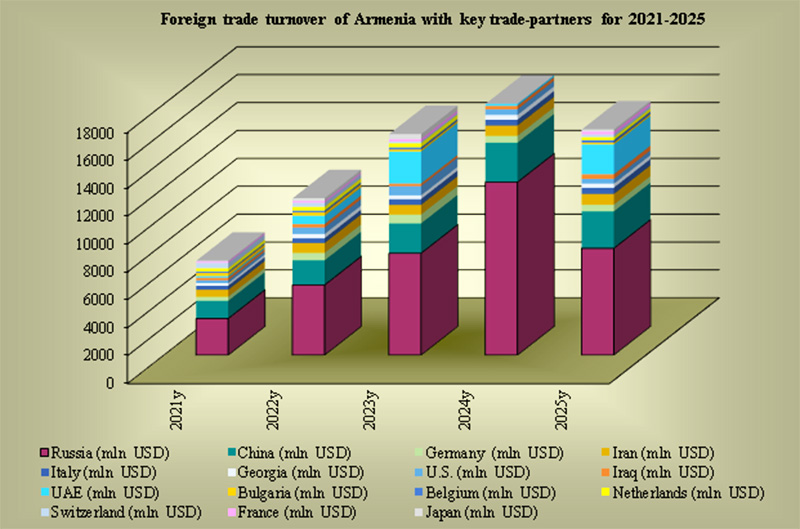
But besides the influence of external events, there are also fundamental changes in the economy. Over the past 5 years Armenia's GDP has doubled, the Central Bank's international reserves have almost doubled, and in dollar terms even more thanks to the strengthening of the dram. Public debt has been growing rapidly, but the economy has been expanding even faster , so the ratio of public debt to GDP has declined. The structure of the economy has changed — it has become much more open and diversified, with more external players and large investment projects. This is the main reason for the strengthening of the Armenian dram. I want to draw your attention to the fact that the dram's rate against the dollar is now higher than a year or five years ago, even though the Central Bank at certain periods bought significant volumes of currency. Without these interventions the dram would have strengthened even more: the exchange rate could easily have reached 330 drams per U.S. dollar.
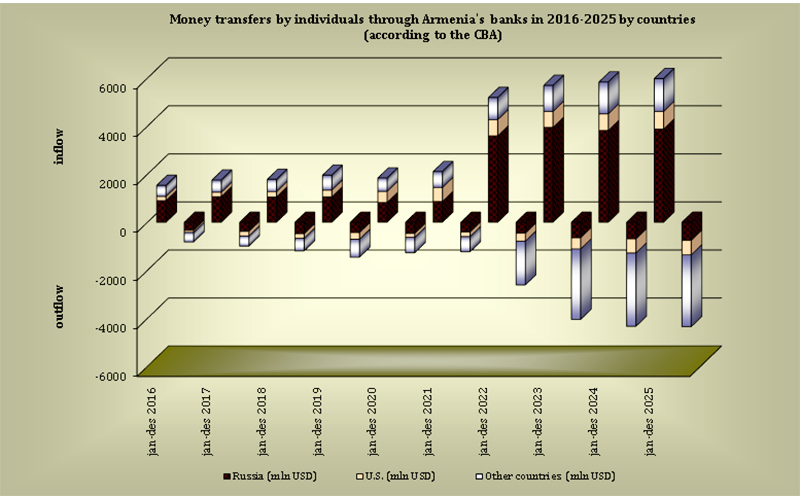
The strengthening of the dram in 2022 is explained by the inflow of capital from Russia. And in 2026?
The scenario is similar, although the scale is smaller: it is about an inflow of capital due to the involvement of regional players in the conflict, in particular the UAE. Dubai, which was considered a safe haven for global capital, has partly lost that status, which led to an outflow of funds from the UAE and other Gulf countries. Part of this money has found a new place.
Can it be said that Armenia is becoming a “safe haven” for capital?
To some extent, yes, particularly at the regional level. If the normalization of relations in the region takes place, it will only strengthen this status of Armenia in the eyes of global investors.
The yields on government and corporate bonds in Armenia look quite attractive. What forms these yields, and which instruments are particularly interesting today for an investor who is looking for a balance between return and risk?
High yields are a global phenomenon today. US Treasury yields are at multi-year highs, and global rates are largely determined by the dollar, on which the Armenian market also depends. The reasons are common: the inflation shock after the pandemic, the supply shocks of 2022, and in 2026 also the conflict with Iran, which through oil prices once again increases inflationary pressure.
Therefore it is important to look not only at absolute yield, but also at the spread to the US benchmark, and in the local market also to take currency risk into account. The yield curve of Armenian government bonds looks quite logical, and the term premium is clearly pronounced: from 6.6% at the short end of the curve to 9.15% on thirty-year bonds.
I find the five-to-ten-year segment particularly attractive. Retail investors typically favor shorter-dated securities, while pension funds and large institutional investors buy ones that are too long, and so the middle of the curve remains undervalued. It is there, in my view, that the most attractive risk-adjusted spread to US bonds is observed.
Armenia's Eurobonds provide a good illustration of this trend. When US bond yields rose by, for example, 0.3 percentage points, the yields on Armenian ones rose by only 0.15 points. That is, the spread narrowed. The ten-year issue of 750 million dollars, placed last year at a yield of 7.10%, is now trading at a yield of around 7%, despite the geopolitical situation and inflationary pressure.
What does the structure of investors in Armenia's government bond market look like today? What is the share of foreign investors, and what factors determine their interest in the Armenian debt market?
Data on the structure of holders is not transparent, so I can only speak about estimates. International institutional investors — asset managers and large funds, including market giants such as BlackRock and JPMorgan — hold about 10% of government debt, which corresponds to roughly one billion dollars in equivalent. This includes not only Eurobonds but also local securities denominated in drams.
The core of the holders is still made up of local banks and pension funds, but the circle of participants has noticeably expanded and interest has grown. The main factor of attractiveness is the dram. A strong currency combined with high yield attracts a significant volume of institutional capital here. There are still few retail investors in the market. Much depends here on the financial literacy of the population, but that is a topic for a separate conversation.
There are more and more corporate bonds on the market, new issuers are appearing and investor activity is growing. Which industries and types of companies are most actively entering the debt market today, and what opportunities does this create for investors?
The corporate market has become truly diverse. Previously the issues were mainly bank issues, but today construction companies, retailers, and representatives of the agricultural sector, industry and telecommunications are entering the market. Since 2021 the number of listings has roughly doubled. The risk and yield profiles are very different: there are issues with yields of 13–14% — they are riskier, but also offer a high premium. For an investor this is an opportunity to build a diversified portfolio, distributing investments among different industries and levels of risk.
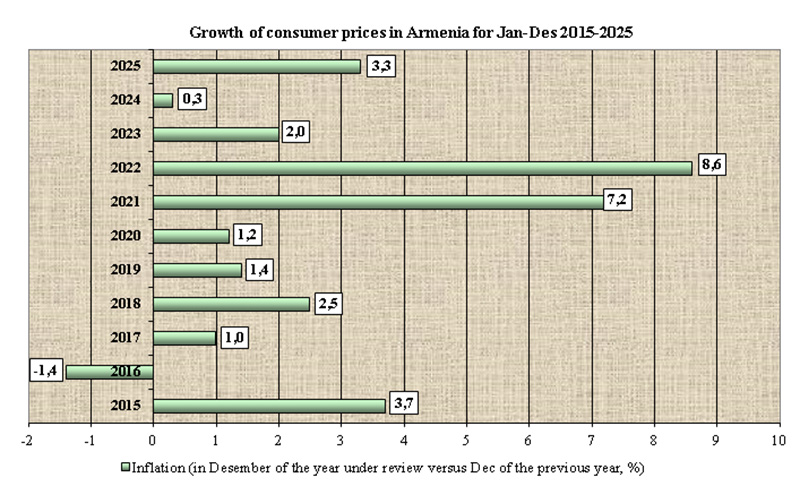
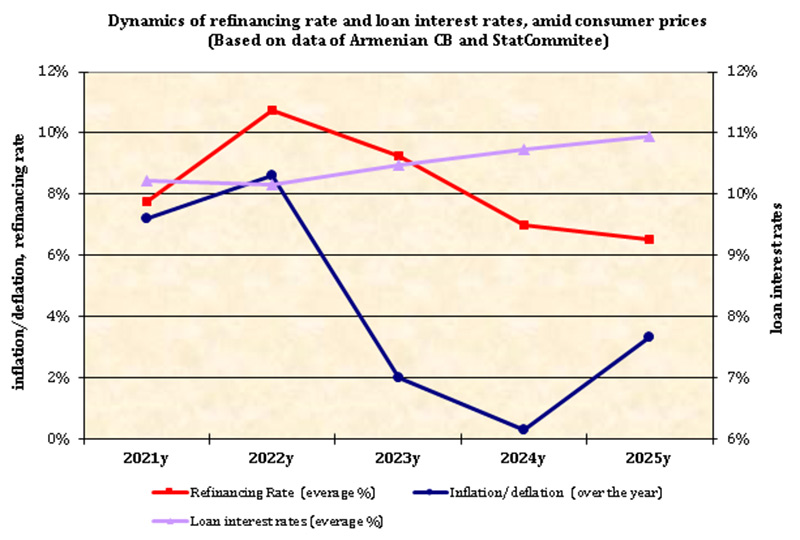
The macroeconomic background is also important. Inflation is now 4.4%, which is above the Central Bank's target, although there was a period when it fell almost to zero. Therefore real yield comes to the fore, and investors increasingly look at riskier securities.
In addition, a new instrument appeared on the market this year: Ameriabank issued the market's first perpetual bond which has no scheduled maturity date. For developed markets such instruments are familiar; for ours it is another stage of development.
How do the Central Bank's key rate decisions affect the situation in the bond market? Do you expect rates to rise, and what would this mean for bond yields?
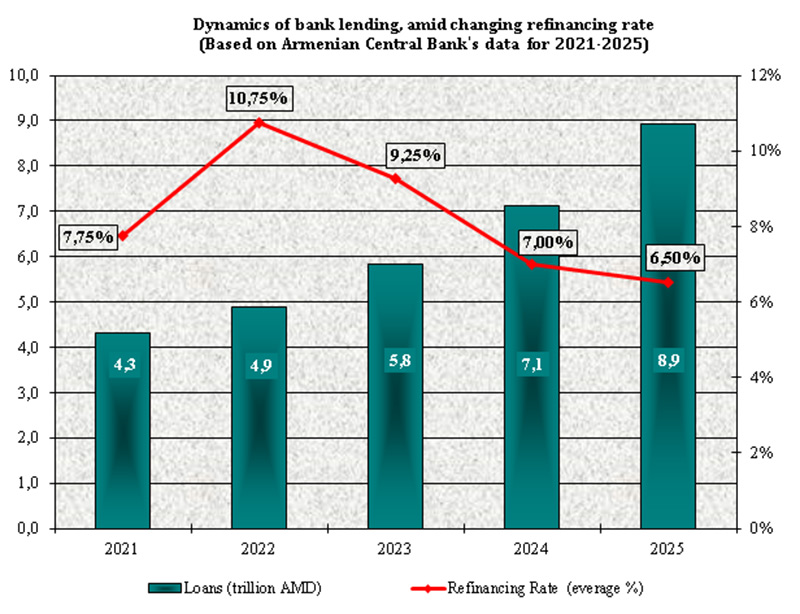
Over the past years we at “Landmark Capital” have made forecasts on the eve of the Central Bank's meetings about thirty times, and in the overwhelming majority of cases they turned out to be correct. At the September meeting the Central Bank of Armenia raised the rate by 0.25 percentage points, to 6.75%. Interestingly, the Central Bank of Armenia raised the rate before the Fed, although markets usually follow the decisions of the US regulator. Inflation in Armenia exceeded the target level, so the Central Bank acted ahead of the curve.
We forecast one more increase of 0.25 points before the end of the year — and that is what happened: a few days ago the Central Bank raised the rate again. In our opinion, the rate will normalize at the level of 7%. There is always one caveat here: a lot depends on the global situation, which we constantly monitor.
The market reacts to Central Bank decisions very quickly: overnight repo transactions and many other instruments are tied to the rate, so a change is reflected in transactions as early as the next day. Recently the EBRD placed floating-rate bonds linked to the Central Bank's six-month rate, and Cube Invest issued bonds linked to the refinancing rate. Such issues in themselves convey to the market information about the regulator's decisions and make it possible to see how its policy affects financial instruments.
If we look at Armenian bonds as an opportunity to earn income, what risks is it important for an investor to take into account besides the issuer's credit risk: currency risk, interest rate changes, liquidity? And how much are these risks currently compensated by the yield?
Yield is only one parameter of a bond. The second most important factor, and perhaps equal to it, is liquidity. The final result largely depends on whether it is possible to exit a position at the right moment. No large institutional investor is ready to put up with low liquidity; everyone needs a simple and clear exit. Global practice confirms this. The US borrows money all over the world at very low interest rates, and American stocks are valued so highly largely thanks to exceptionally deep liquidity. The size of the stock market is about 75 trillion dollars, government debt is about 40 trillion, and to this are added huge volumes of corporate issues in dollars. The same logic applies to the dram.
Recently, progress in Armenia has been noticeable. The secondary market has revived, there are more participants, and international institutional investors, who regularly rebalance portfolios and rarely hold securities to maturity, provide an additional source of liquidity. So far their interest is concentrated mainly on government rather than corporate bonds.
Suppose I bought corporate bonds. If I want to sell them, will I be able to do so?
Formally, yes. Most issues have market makers who ensure a minimum trading volume. For a retail investor these volumes are, as a rule, sufficient; for a large institutional one, not yet. This is one of the bottlenecks of the market, and much remains to be improved here. If we are talking about a large position, it is easier to find a buyer on the over-the-counter market, where transaction volumes are larger. On the other hand, corporate bonds are mostly issued for a term of one to three years, so they can quite well be held to maturity.
And what about currency risk?
It is both a risk and a source of income. The currencies of developing countries are subject to sharp fluctuations, and the dram has twice experienced a significant fall. But the overall return on investments in the Armenian market consists of several components, and over the past few years the currency factor has made only a positive contribution.
So how much are the risks compensated by the yield?
If we take into account how Armenian bonds and the dram have behaved in recent years, the risk premium is now quite attractive.
Which opportunities of the Armenian market do you consider the most undervalued? And what, in your view, should happen to the market in the coming years for investor interest in Armenian assets to continue to grow?
I consider the equity segment the most undervalued: IPOs in Armenia do not happen often. Stocks and other riskier instruments open up more opportunities than bonds, although they imply a more speculative nature of investment. As the market develops, their potential is revealed to a greater extent. In the US, for example, over more than a hundred years investors received on average about 10% a year in the stock market, despite sharp crashes and prolonged periods of negative returns. Of course, this does not mean that such a result is guaranteed in any market, but it shows the opportunities that a developed equity segment opens up over a long horizon.
Targeted government incentives can help the development of the market. In the bond market this approach has already worked: there were subsidies for issuance costs on the supply side and tax benefits for holders on the demand side. Largely thanks to these measures the corporate market has become significantly more diversified. For stocks the logic is similar. In addition, infrastructure needs to be developed, including custody services and depositories. Today the financial sector is much better prepared for this than it was a few years ago.
In general, the direction of the market's development is, in my opinion, the right one. If nothing unforeseen happens, further growth of interest in Armenian assets and the arrival of new international players in the local market is a matter of time. Telling examples are the purchase of Ameriabank by Lion Finance Group last year and the launch of an artificial intelligence factory in Armenia by the company Firebird.
Human capital deserves separate mention. By the number of CFA holders per capita, Armenia is among the top ten in the world. I myself plan to add to this statistic in the near future. A significant part of the international operations of Armenian banks and investment companies is conducted precisely from Armenia. Not only volumes are growing, but also the complexity of financial products.
The experience of developing the bond market shows that, under the right conditions and with targeted support, the financial market is capable of expanding substantially. Now it is important to achieve comparable progress in the equity segment. The market has significant potential, and the challenge now is to unlock it.