


ArmInfo.The transactions involving precious metals and stones in Armenia's foreign trade have started to decline since 2025, accounting for 26% of the total volume for the year ($5.5 billion), compared to 51% ($15.4 billion) in 2024.
This category of goods played a decisive role in the decline of the country's annual foreign trade turnover, which shifted from a pronounced 41.5% growth to a double-digit 29% decline. According to the RA Statistics Committee, the share of precious metals and stones imported and exported in total trade fell to 20% and 34%, respectively, in January-December 2025, compared to 43% and 61% in the same period last year. In terms of volume, $2.6 billion worth of these products were imported and $2.9 billion worth of them were exported during the reporting year: imports fell by 64.5% over the year, while exports decreased by the same amount - by 64.5%.
For comparison, it should be noted that a sharp increase in this item, which became dominant in Armenia's foreign trade, was already observed in 2022, accelerating even more significantly in the following two years. Specifically, in 2022, $989.3 million worth of precious metals/stones and their products were exported (a threefold increase year-on-year), while $690.8 million were imported (a 2.8-fold increase year- on-year). In 2023, the significant growth in the export and import of precious metals/stones and products made from them not only continued but also accelerated to 3.2-3.3 times, reaching export volumes of $3.2 billion and imports of $2.7 billion. This trend continued in 2024, and despite some slowdown in growth, the pace remained impressive (2.5-2.7 times), further increasing export and import volumes to $8 billion and $7.4 billion, respectively.
However, starting in 2025, transactions involving precious metals/stones began to decline at an impressive rate, worsening the annual dynamics of export and import volumes from impressive growth of several times in 2024 to a significant decline of 64.5% for the entire year. At the same time, production volumes in the jewelry industry continue to look very modest: for 2022 - 42 billion drams (an increase of 51.8%), for 2023 - 230.9 billion drams (a jump of 4.9 times), for 2024 - 53.2 billion drams or $135.4 million (a decline of 32.2%). The downward trend continued in 2025, as evidenced by a decline in volumes in January- December by 51.4% per annum (to 28.4 billion drams or $74.3 million), and a year ago a deterioration in dynamics was already visible from 46.8% growth in 2023 to a 32.2% decline in 2024, with a volume of 53.2 billion drams ($134.1 million). According to experts, the very fact that precious metals and stones began to significantly dominate in exports and imports three years ago, while domestic jewelry production volumes remained low, already indicated a sharp increase in re-exports and re-imports, which, judging by data for 2024, were still occurring. However, starting in 2025, such transactions at the previous level became impossible due to the settlement of customs duties on jewelry within the EAEU. Specifically, Russia eliminated duties on jewelry imports from the UAE. Diamond and gold trade concentrated precisely in these areas, with imports from Russia in 2023-2024 and exports to the UAE. Starting in 2025, diamonds began to be imported from the UAE and exported primarily to the UAE and Russia, while gold, as before, was imported from Russia and shipped to the UAE.
The actual volumes of re-export and re-import of precious metals and stones are illustrated by Armenia's customs data for 2024, according to which diamonds and gold, imported primarily from Russia (73% and 99.4%, respectively), were exported primarily to the UAE (74.8% diamonds and 70.2% gold) and Hong Kong (16.4% diamonds and 20.2% gold). A nearly identical picture emerged at the end of 2023, but then 46.7% of diamonds and 99.2% of gold came from Russia, which were also exported to the UAE (84.6% diamonds and 71.4% gold) and Hong Kong (2.7% diamonds and 25.4% gold). However, some changes were revealed in customs data for the first half of 2025, according to which the dominant share of diamonds was already coming from the UAE (52.1%), followed by exports there (59.4%) and a slightly smaller share to Russia (36.4%). The picture for gold remained unchanged: 91.6% was imported from Russia and 91.3% was exported to the UAE.
According to statistics, despite a significant decline in transactions with precious metals and stones, this item still maintains its leadership in both exports and imports. It is worth noting that previously traditionally dominant export and import items-mineral products and finished food products-having lost ground to precious metals, machinery, equipment, and mechanisms, are still struggling to regain their leading position in foreign trade, judging by the accelerated rate of volume growth. However, the duration of the decline in precious metals and stones suggests that mineral products and finished food products will recover their positions by 2027.
Specifically, in terms of mineral product exports and imports, after growth slowed in 2022 and declined by 13.6-6.9% in 2023, both exports (by 15.1%) and imports (by 0.3%) were regained growth in 2024. The growth then accelerated in 2025, with imports (by 7.7%) and exports (by 18.9%) reaching a combined $1.2 billion. This allowed mineral products to consolidate their position in exports as the fourth-largest commodity (now behind not only precious metals and stones, but also machinery/equipment and finished food products). Mineral products held onto third place in imports, slightly ahead of "land, air, and water transport" but significantly behind the leading imports of "precious metals and stones" and "machinery, equipment, and mechanisms."
Exports of machinery, equipment, and mechanisms reached $1.3 billion in 2025, while imports reached $2.6 billion. The annual trend of these indicators is downward: exports slowed from 3% to 0.3%, while imports reversed their 7.1% growth to a 1.5% decline. Machinery, equipment, and mechanisms occupy second place in both imports and exports, behind the leading precious metals and stones, although the gap in imports is insignificant. Exports and imports of prepared food products improved year-on-year, showing strong double-digit growth of 28.7% and 29.4%, respectively, accelerating from 6.9% and 16.7% in 2024. The volume of prepared food exports in 2025 reached $1.2 billion (3rd place), while imports reached $950.8 million (5th place).
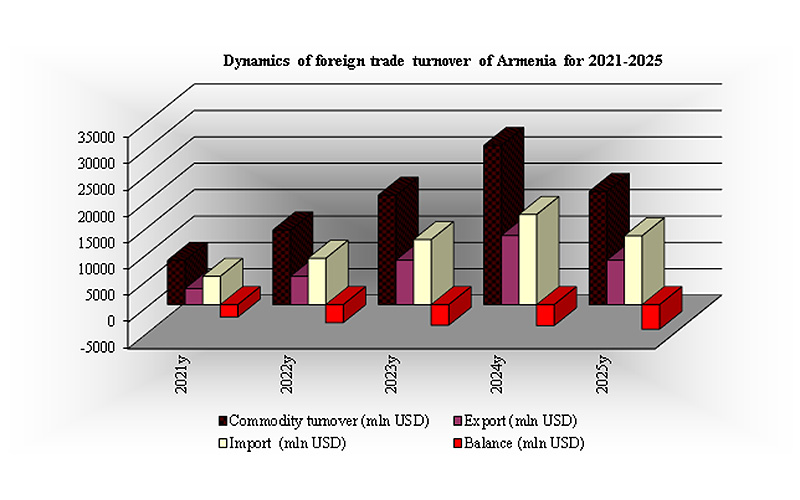
Overall, exports in 2025 reached $8.4 billion, with a shift in annual growth from 53.1% to a 36.1% decline. Imports exceeded $13 billion, also declining from 33.8% growth to a 23.6% decline. As a result, foreign trade turnover fell by 29% during the reporting year (compared to 41.5% growth in 2024), amounting to $21.4 billion in January-December 2025.
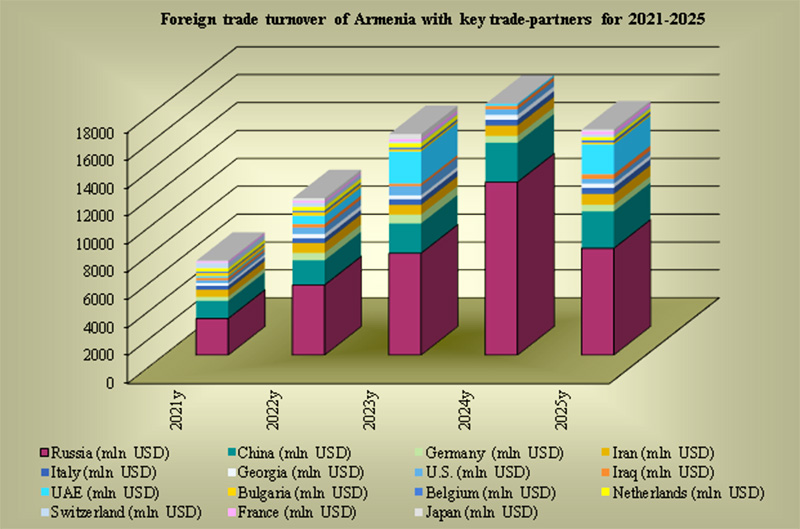
Moreover, when broken down by country, a significant deterioration in the annual dynamics of foreign trade turnover was recorded for the leading countries: Russia (from 56.5% growth to 64.2% decline), the UAE (from 2.3-fold growth to 60% decline), and China (from 34.4% growth to 6.5% decline). Specifically, both imports (by 49.2%) and exports (by 6.9%) fell from Russia. The same was observed for the UAE, with exports declining by 60.9% and imports by 4.1%. For China, a 30.4% decline in exports was accompanied by an acceleration in import growth to 8.8%. For comparison, in 2024, a 10.7% decline in exports to the Russian Federation was accompanied by an impressive 2.1-fold increase in imports; in the direction of the UAE, growth was recorded in both exports by 2.4 times and imports by 12%, and the same dynamics were observed in the direction of China - an increase in exports by 2.6 times and imports by 3%.
It is worth noting that foreign trade turnover between Armenia and the EU grew by 7.2% (from an 11.7% decline in 2024), reaching $2.5 billion in January-December 2025. This was due to an improvement in the annual dynamics of both imports, from an 11% decline to 6.5% growth, and exports, from a 13.8% decline to 9% growth, amounting to $1.8 billion and $666.8 million, respectively. The EU's share of total foreign trade increased in 2025 from 7.7% to 11.7%, in particular in exports - from 4.6% to 7.9% and in imports - from 10.1% to 14.1%.
Additionally, foreign trade turnover between Armenia and the EAEU worsened in annual dynamics from 54% growth to a 36.9% decline, amounting to $8 billion in 2025, as a result of a significant drop in imports by 48.5% (against a 2.1-fold growth in 2024) and exports that lingered in decline with a slowdown from 10.7% to 5%, the volumes of which amounted to $4.8 billion and $3.2 billion, respectively. The share of the EAEU in the total volume of foreign trade decreased in 2025 from 42.3% to 37.5%, and the decline in the share of imports from 54.9% to 37% was accompanied by an increase in the share of exports from 25.8% to 38.4%.
It should be noted that the Central Bank of Armenia, in its updated December forecast, predicted that, after nearly equal growth in exports and imports in 2023 of 30.7-30.2% and a decline of 11-3.2% in 2024, they would be in the red in 2025 by 37.3-36.1% (for exports) and 32.7-32.5% (for imports). However, as early as 2026, the Central Bank expects both exports to improve, with growth of 4.5-3.4%, and imports to improve by 3.1%, with this trend continuing in 2027 to 3.9-4.1% (for exports) and 4.2-3.8% (for imports). In its December forecast for 2025, the IMF predicted a 31.1% decline in Armenia's foreign trade exports and a 28.1% decline in imports, with growth returning to almost flat levels of 2.2-2.1% in 2026 and further accelerating to 3.4-3.7% in 2027.